Algeria
 Egypt
 Libya
 Morocco
 Sudan
 Tunisia
 Benin
 Burkina Faso
 Cabo Verde
 Côte d'Ivoire
 Ghana
 Guinea
 Guinea-Bissau
 Liberia
 Mali
 Mauritania
 Niger
 Nigeria
 Sierra Leone
 The Gambia
 Togo
 Cameroon
 Central African Republic
 Chad
 DR Congo
 Equatorial Guinea
 Gabon
 Republic of the Congo
 São Tomé and Príncipe
 Burundi
 Comoros
 Djibouti
 Eritrea
 Ethiopia
 Kenya
 Madagascar
 Malawi
 Mauritius
 Mozambique
 Rwanda
 Seychelles
 Somalia
 South Sudan
 Tanzania
 Uganda
 Angola
 Botswana
 Eswatini
 Lesotho
 Namibia
 South Africa
 Zambia
 Zimbabwe
A handshake that goes beyond protocol
In Dakar, a brief visit can carry considerable weight. When a former Senegalese president returns home to discuss a major international role, the occasion goes beyond a simple diplomatic meeting. It touches on political memory, continuity of the state and Senegal’s image in West Africa.
The issue is sensitive because it brings together three levels. First, there is the personal trajectory of Macky Sall, president of Senegal from 2012 to 2024. Then there is Bassirou Diomaye Faye, elected in March 2024, in a country emerging from a closely contested transfer of power and seeking to stabilise its institutions. Finally, there are regional balances, as ECOWAS continues to try to preserve its political influence in West Africa.
What happened in Dakar
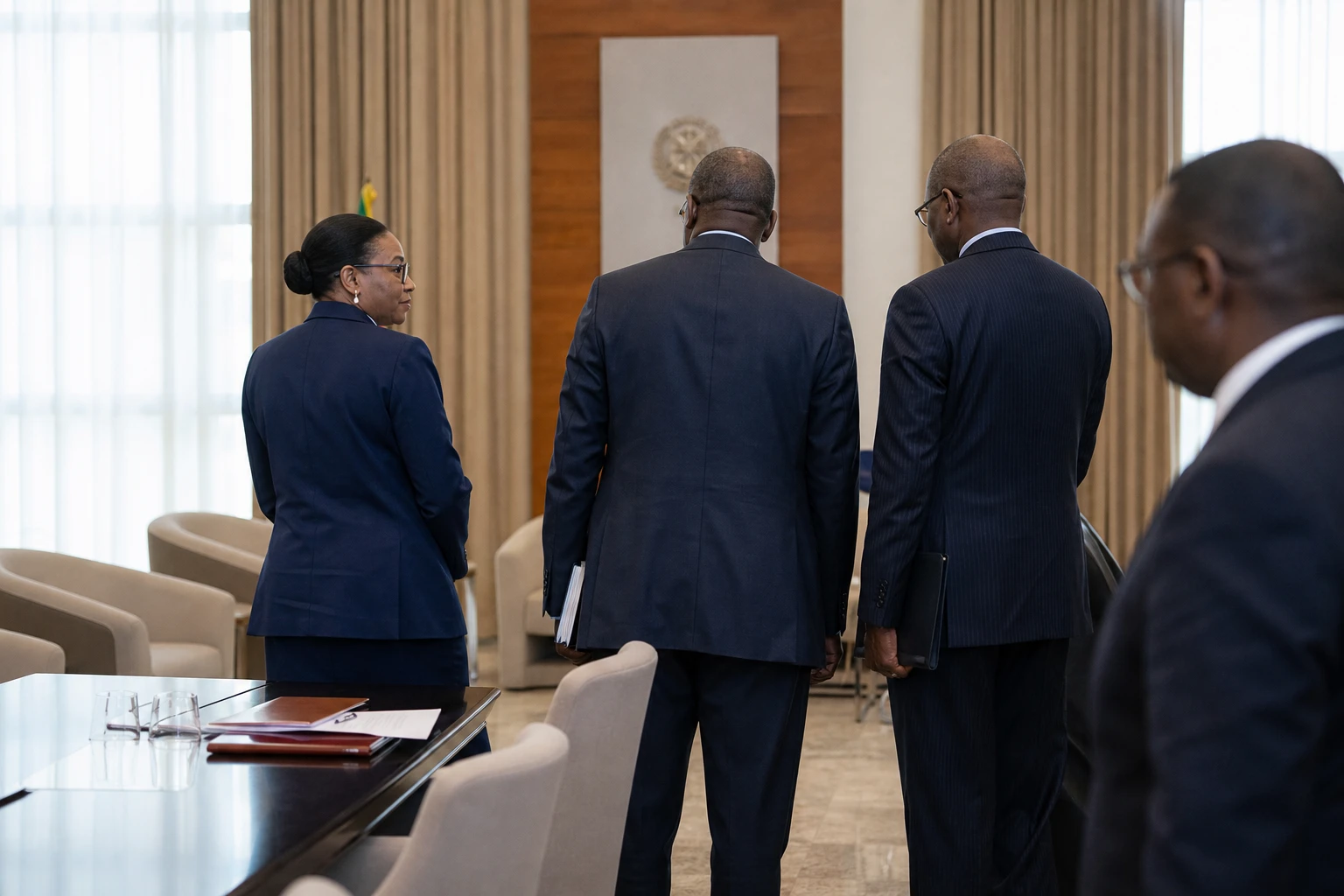
On Friday 17 July 2026, Macky Sall arrived in Dakar for a brief visit. The Senegalese Press Agency said he was subsequently received at the presidential palace by President Bassirou Diomaye Faye. According to the official statement cited by APS, the former head of state came to inform his successor in person of his candidacy for the post of United Nations secretary-general.
The Senegalese presidency confirmed the same account, describing the meeting as an institutional exchange about the candidacy. APS also reported that Macky Sall had announced the visit a few days earlier, explicitly linking it to his international consultations. His arrival in Dakar was greeted by supporters at the airport, a sign that, beyond protocol, the former president retains a visible political base.
The timing is no coincidence. The United Nations website lists Macky Sall among the declared candidates for secretary-general, following a nomination submitted in March 2026. The UN also plans interactive dialogues with the candidates, including a public meeting scheduled for 23 July 2026. In other words, the visit to Dakar is part of an international selection process already well under way.
Why the gesture matters for Senegal
In a country such as Senegal, diplomacy remains an important marker of prestige. Any potential backing by a sitting president for a former head of state seeking a UN post is never a minor matter. It could strengthen a campaign, but it also shapes how partners view Senegal’s political stability. The message here is clear: despite the 2024 transfer of power, institutional channels remain open between the former and current governments.
This comes as Bassirou Diomaye Faye emphasises an approach based on consultation. Since 2026, the Senegalese presidency has stressed consistency in public interventions, territorial reform and a consensual electoral code. In this context, receiving Macky Sall also shows that major matters of state can be addressed without a sharp break. It is a useful signal for the administration, diplomats and investors watching Dakar closely.
But the visit does not erase political tensions. In recent months, several voices have recalled episodes of repression and the wounds left by the end of the previous political cycle. Victims’ associations also responded to the announcement of the visit, urging caution over any possible official backing. Their reminder shows that Macky Sall’s candidacy is not being played out solely in diplomatic salons; it also touches on justice, memory and Senegalese people’s relationship with power.
An African perspective and continental significance
At the regional level, the issue goes beyond Senegal. ECOWAS is undergoing a period of realignment, with high expectations around security, mobility and institutional credibility. At the same time, Bassirou Diomaye Faye attended an ECOWAS summit in Freetown after the Dakar meeting, a reminder that Senegalese diplomacy remains caught up in a busy West African agenda. The Macky Sall question is therefore part of a regional geopolitics in which capitals carry as much weight as organisations.
At continental level, the candidacy of a former Senegalese president for the post of UN secretary-general offers another perspective: that of an Africa seeking greater influence in multilateralism. The African Union itself is holding more coordination meetings with the United Nations on peace, development and the financing of peace support operations. In this context, the prospect of an African leader at the UN is a matter of visibility, but also of approach: what place should Africa have in global governance, and what kind of coalition will stand behind its candidate?
The next stages of the UN process will determine what happens next. The dialogues with candidates, the support already submitted and the balance among member states will matter more than the communications impact. For Dakar, the challenge is straightforward: show that Senegal remains a stable diplomatic voice, able to combine domestic political competition with international ambition. For the continent, the question is broader: how to turn an individual candidacy into a genuine lever for greater African presence in multilateral institutions.