Algeria
 Egypt
 Libya
 Morocco
 Sudan
 Tunisia
 Benin
 Burkina Faso
 Cabo Verde
 Côte d'Ivoire
 Ghana
 Guinea
 Guinea-Bissau
 Liberia
 Mali
 Mauritania
 Niger
 Nigeria
 Sierra Leone
 The Gambia
 Togo
 Cameroon
 Central African Republic
 Chad
 DR Congo
 Equatorial Guinea
 Gabon
 Republic of the Congo
 São Tomé and Príncipe
 Burundi
 Comoros
 Djibouti
 Eritrea
 Ethiopia
 Kenya
 Madagascar
 Malawi
 Mauritius
 Mozambique
 Rwanda
 Seychelles
 Somalia
 South Sudan
 Tanzania
 Uganda
 Angola
 Botswana
 Eswatini
 Lesotho
 Namibia
 South Africa
 Zambia
 Zimbabwe
A credibility test for Dakar
In Senegal, the question is no longer just how much the debt costs. It has become political, institutional and almost symbolic. For a country seeking to preserve macroeconomic stability while financing its development, every signal sent to markets matters as much as every meeting with the International Monetary Fund (IMF). The prospect of giving Lazard, a bank often associated with sovereign debt restructurings, an advisory role is therefore prompting close scrutiny in Dakar and abroad.
This sequence is unfolding in a specific regional context. Within the West African Economic and Monetary Union (WAEMU), the public debt ceiling is set at 70% of GDP. Senegal has moved well beyond it following a revision of its public accounts. In the union, this standard is no technical detail: it shapes multilateral surveillance and weighs on member states’ budgetary room for manoeuvre.
What the verified facts show
The broad picture is well known. After an audit of Senegal’s accounts, the IMF confirmed significant under-reporting of deficits and debt between 2019 and 2023. Central government debt was initially revised to 99.7% of GDP at the end of 2023, then the IMF later said it was estimated at 111.0% of GDP at the end of 2023 following the reconciliation exercise conducted by Forvis Mazars. In December 2025, the institution still estimated total debt at 132% of GDP at the end of 2024.
The IMF has also maintained its engagement with Dakar. In June 2026, a mission visited Senegal to examine macroeconomic developments, financing needs and reforms. The institution noted that the budget deficit had narrowed to 6.4% of GDP in 2025, but stressed that debt and financing vulnerabilities remained high. It also said that the Senegalese authorities remained interested in a new IMF-supported programme.
It is against this backdrop that Lazard comes into the picture. Reuters reported on 16 July 2026 that Senegal was expected to appoint the investment bank as financial adviser on debt matters, following a selection process launched in early July. Senegalese media reported the same information, specifying that discussions remained preliminary at this stage and that the precise mandate had not yet been made public.
Precision is therefore important. Appointing an adviser is not the same as a restructuring having been agreed. It could help explore several options: rescheduling, reprofiling or a broader operation. But above all, it signals one thing: Dakar wants to regain control of an issue on which confidence has been damaged.
A financial strategy under political constraint
The constraint is not just about the numbers. It is also about power. In May 2026, President Bassirou Diomaye Faye appointed Ahmadou Al Aminou Lo as prime minister after dismissing Ousmane Sonko, then head of government and an outspoken opponent of debt restructuring. Reuters and Senegalese official media confirmed that Lo is an economist who worked at the BCEAO, the central bank of West Africa. His appointment reinforced the impression of a more technocratic team at a time when budgetary trade-offs are becoming difficult.
The new balance remains fragile. Sonko, now a central figure in the governing majority, retains considerable political influence, while tensions within the government complicate the choices ahead. International media have noted that the governing camp is openly debating its approach to the IMF and creditors. In such a context, any comment on debt can be read either as a negotiating signal or, conversely, as an attempt to buy time.
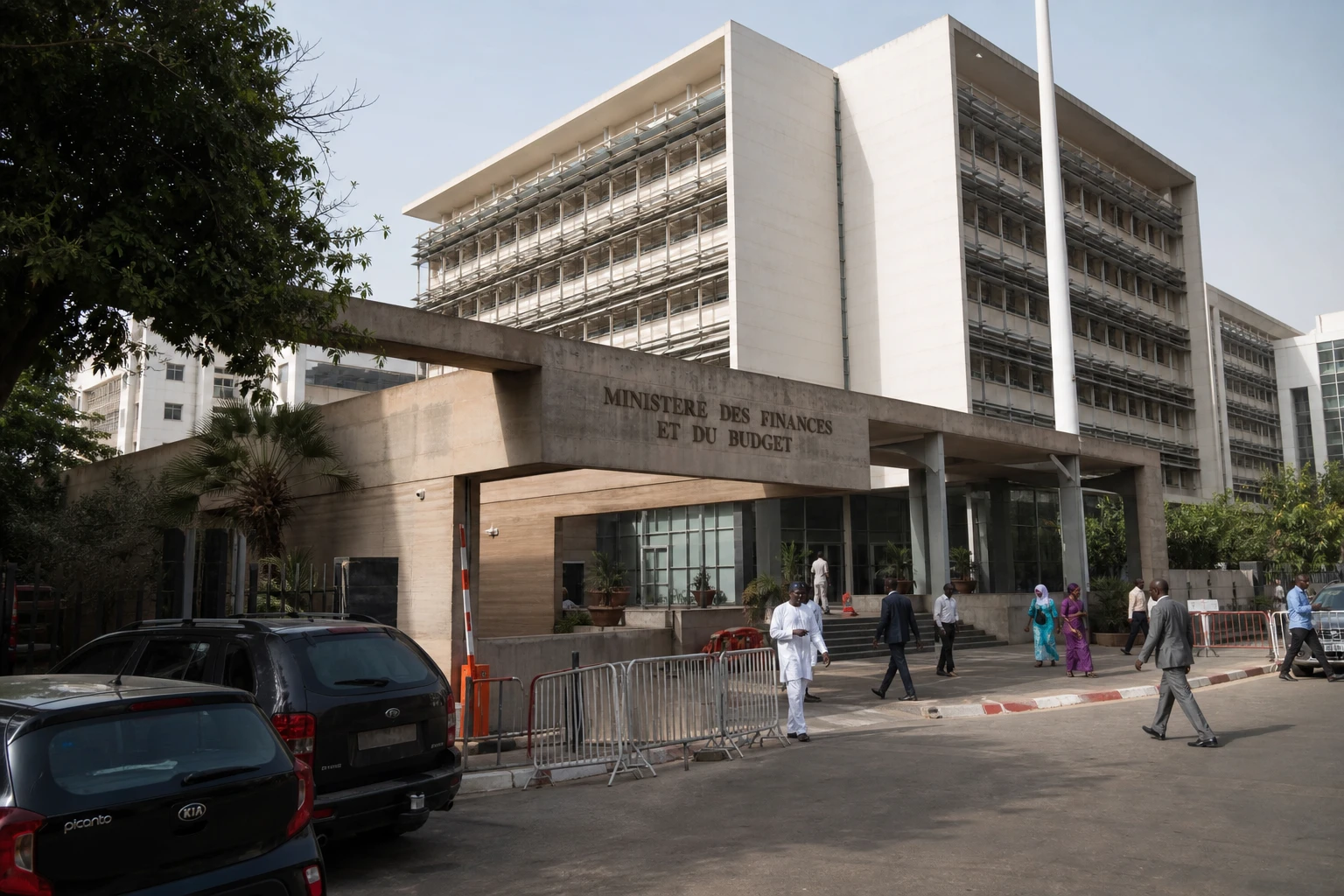
On the budget front, the state is seeking resources without shutting the door on markets. Senegal’s finance ministry says its remit covers mobilising financing, managing public debt and setting borrowing policy. The official investor portal also points to substantial financing needs for 2026, a sign that pressure on cash flow remains intense. Greater reliance on the WAEMU regional government securities market illustrates this tension, but also shows that Dakar still has options.
What this means for Senegal and the region
For the state, the challenge is to restore a credible trajectory. For households, the question is immediate: the cost of debt limits the scope for social spending, subsidies and public investment. For businesses, particularly in the informal economy and urban services, uncertainty over public financing translates into delayed payments, more hesitant demand and possible tax pressure. Here, the budget is not an abstract document: it shapes everyday life.
Across West Africa, the Senegalese case is a reminder that regional rules are not enough if public data are unreliable. The 70% of GDP ceiling set by WAEMU remains a benchmark, but Senegal exceeded it by a wide margin after its accounts were revised. This raises a question of budgetary governance that extends beyond Dakar. Other states in the region, also constrained by markets and high social needs, are watching the case closely.
At continental level, the Senegalese case illustrates a broader trend: several African states are seeking to renegotiate their relationship with debt amid high interest rates, uneven growth and pressure on public revenues. The African Development Bank also notes that Senegal is now combining a fiscal adjustment effort with high debt, making it a case watched far beyond West Africa. What happens next will depend less on a dramatic announcement than on consistency between political choices, accounting transparency and the ability to secure new support from the IMF.
The decisive point now is simple: Dakar must say what kind of exit strategy it favours. A financial adviser can help organise the discussion. It cannot replace either budgetary discipline or the political agreement needed to put debt back on a sustainable path.