Algeria
 Egypt
 Libya
 Morocco
 Sudan
 Tunisia
 Benin
 Burkina Faso
 Cabo Verde
 Côte d'Ivoire
 Ghana
 Guinea
 Guinea-Bissau
 Liberia
 Mali
 Mauritania
 Niger
 Nigeria
 Senegal
 Sierra Leone
 The Gambia
 Togo
 Cameroon
 Central African Republic
 Chad
 DR Congo
 Equatorial Guinea
 Gabon
 Republic of the Congo
 São Tomé and Príncipe
 Burundi
 Comoros
 Djibouti
 Eritrea
 Ethiopia
 Kenya
 Madagascar
 Malawi
 Mauritius
 Mozambique
 Rwanda
 Seychelles
 Somalia
 South Sudan
 Tanzania
 Uganda
 Angola
 Botswana
 Eswatini
 Lesotho
 Namibia
 South Africa
 Zambia
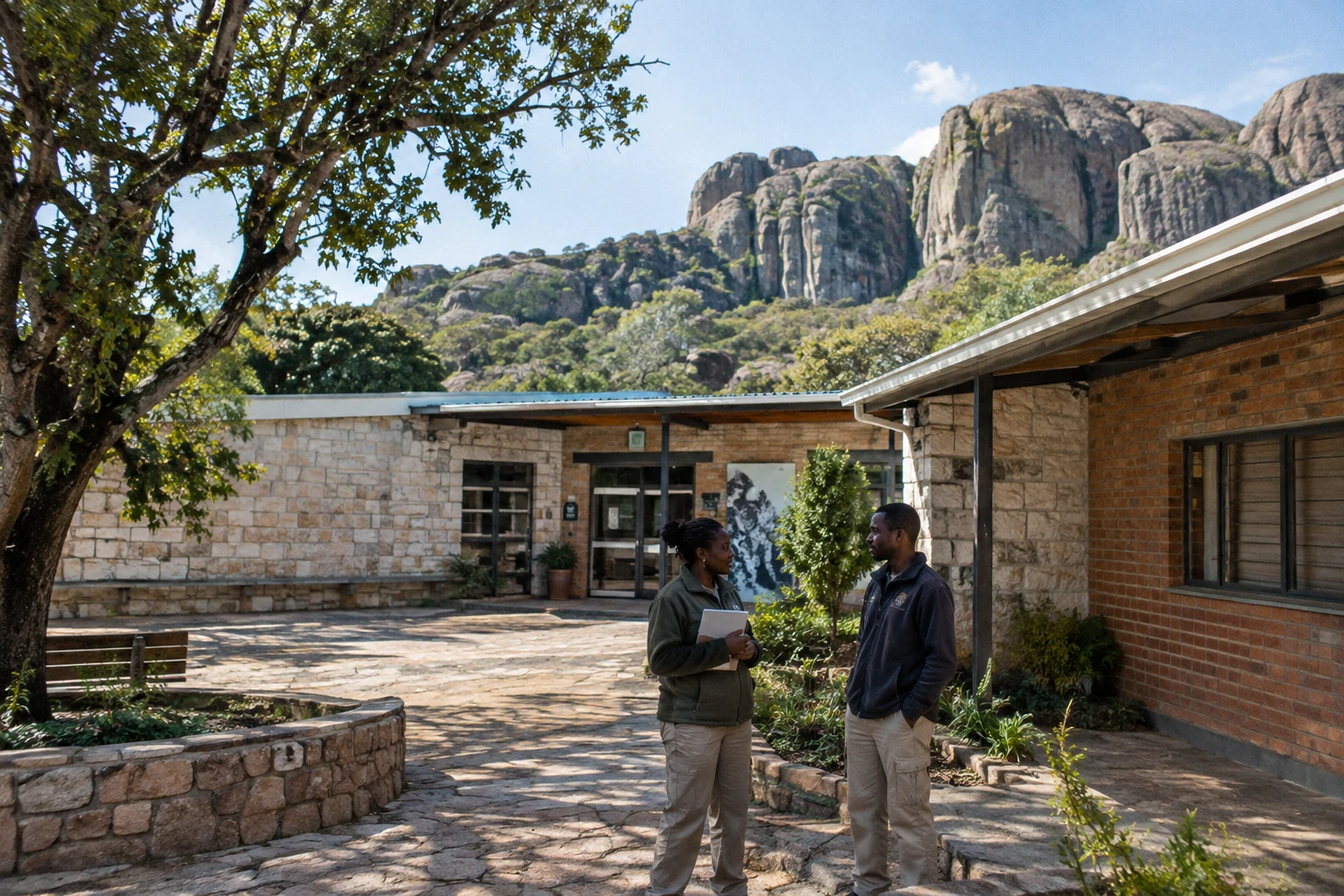
About 30 kilometres south of Bulawayo, the rocks of Matobo are more than a spectacular backdrop. They form an inhabited, protected landscape passed down through generations, where ancient paintings, shrines and community life coexist. In Zimbabwe, preserving this heritage therefore means protecting both nature and the cultural ties that root it in the land.
A cultural landscape, not just a park
The Matobo Hills lie in south-western Zimbabwe, in southern Africa. Granite, eroded over time, forms domes, rounded boulders and natural shelters. Matobo National Park covers about 424 sq km, but the World Heritage site extends well beyond its boundaries.
UNESCO inscribed the Matobo Hills in 2003 for their cultural value. The site contains one of the highest concentrations of rock art in southern Africa. Some paintings date back at least 13,000 years. Archaeological traces attest to a much earlier human presence, across several periods.
The images painted in the rock shelters are not simply decorative motifs. They document ancient practices and world views. They still sit alongside places of worship and shrines visited by local communities. UNESCO highlights in particular the role of the Mwari religious tradition, which remains associated with the region.
International recognition has not turned Matobo into a uniform space. The landscape includes state-protected land, communal land and private property. Heritage management therefore involves several stakeholders: public services, local authorities, traditional leaders, residents and landowners.
Living shrines and a history told in many voices
In the Matobo Hills, some sites have spiritual significance that goes beyond their tourist appeal. Shrines associated with Mwari and ancestral spirits remain places of practice and remembrance. Visiting them requires respect for the rules set by their custodians and the communities concerned. This living heritage is not merely an attraction to be explored without regard for its uses.
The landscape also bears the traces of colonial history. At the summit of Malindidzimu, often called World’s View, is the grave of Cecil Rhodes, a central figure in the British colonisation of the territory then known as Rhodesia. The site thus brings together legacies that tell different stories. This layering invites visitors to see Matobo as a contested place of memory as well as a natural landscape.
Site protection also depends on how decisions are made. UNESCO says that wildlife management and the management of cultural properties fall under different systems. Communal lands, meanwhile, are administered with local authorities and traditional leaders. Coordinating these responsibilities is essential to ensure that protection decided at national or international level does not marginalise the people who live in the region.
Wildlife, conservation and local benefits
The national park is home to black and white rhinos, antelopes and a wide variety of birds. Zimbabwe’s parks and wildlife authority, ZimParks, describes Matobo as one of the country’s intensive rhino protection zones. The presence of these animals attracts visitors, but it also requires resources for surveillance and careful management of interactions with neighbouring communities.
Conservation does not stop at the park boundaries. Around protected areas, residents also depend on land, water and natural resources. Tourism activities can generate income and jobs, but the benefits depend on the role given to local businesses and how the proceeds are shared. Protecting animals without taking account of communities’ practices and needs risks undermining support for conservation efforts.
Zimbabwean organisations such as the Matobo Conservation Society advocate an approach that brings together heritage, biodiversity and local participation. Research on the landscape also shows that changes in land use are not the same in the park and in the surrounding areas. These findings are a reminder that international designation alone is not enough to guarantee the site’s preservation.
A challenge for Zimbabwe and southern Africa
Matobo contributes to the diversity of Zimbabwe’s heritage offering, alongside sites such as Great Zimbabwe and Khami. For visitors, the region offers opportunities to explore near Bulawayo, the country’s second-largest city. For communities, the challenge is also to retain control of spiritual and cultural places while benefiting from economic activities linked to their promotion.
At regional level, the site is a reminder that southern African heritage is defined neither solely by built monuments nor by national borders. Rock art and cultural landscapes connect ancient human histories with practices that continue today. Within SADC, the Southern African Development Community, co-operation on conservation and tourism can support this networking, provided local priorities and knowledge are respected.
The central question for the years ahead is practical: how can the protection of paintings, shrines and wildlife be funded while ensuring communities have a genuine role in decision-making? At Matobo, the answer is measured not only by the number of visitors or animals seen. It also depends on the ability to pass on a living landscape without separating it from those who care for it.
For information on the criteria for inscription and the values recognised at the site, see the Matobo Hills entry on the UNESCO World Heritage Centre website. Information on the park and its wildlife is also provided by ZimParks, Zimbabwe’s national parks authority.