Algeria
 Egypt
 Libya
 Morocco
 Sudan
 Tunisia
 Benin
 Burkina Faso
 Cabo Verde
 Côte d'Ivoire
 Ghana
 Guinea
 Guinea-Bissau
 Liberia
 Mali
 Mauritania
 Niger
 Nigeria
 Senegal
 Sierra Leone
 The Gambia
 Togo
 Cameroon
 Central African Republic
 Chad
 DR Congo
 Equatorial Guinea
 Gabon
 Republic of the Congo
 São Tomé and Príncipe
 Burundi
 Comoros
 Djibouti
 Eritrea
 Ethiopia
 Kenya
 Madagascar
 Malawi
 Mauritius
 Mozambique
 Rwanda
 Seychelles
 Somalia
 South Sudan
 Tanzania
 Uganda
 Angola
 Botswana
 Eswatini
 Lesotho
 Namibia
 South Africa
 Zambia

A market changing its nature
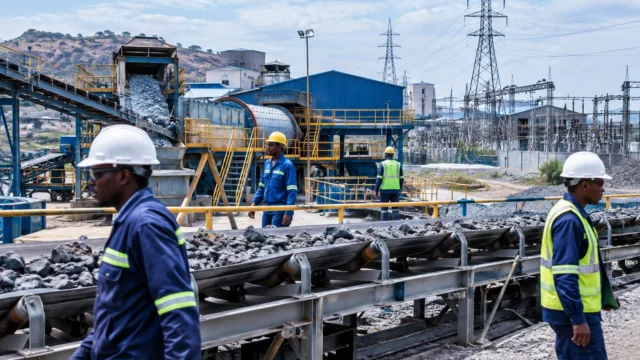
In Harare, the question is no longer simply how many tonnes leave Zimbabwean mines. It is now more specific: how much of the value stays in the country, and how much still leaves in raw form for foreign plants? In lithium, Zimbabwe is trying to move beyond the traditional role of a mere raw-material supplier and towards local processing. This shift is decisive for public revenue, industrial employment and the country’s position in the global battery supply chain.
Zimbabwe belongs to the Southern African Development Community, SADC, which brings together 16 member states and seeks to strengthen regional economic integration. In this context, Harare’s mining policy matters well beyond its borders. Decisions on Zimbabwean lithium influence investors, neighbouring producers and, more broadly, African debates about local processing of critical minerals.
The Zimbabwean government has set the direction itself. In its 2026-2030 development framework, it plans to end lithium concentrate exports by January 2027 and promote more value addition at home. This timetable offers a clear reading of current choices: higher revenues are not enough; the sector’s centre of gravity must also shift towards local industry.
Revenue boosted by prices, processing and restrictions
According to the budget presentation on 30 July 2026, Zimbabwe’s lithium exports generated $782.2 million in the first half of 2026. Finance Minister Mthuli Ncube said this figure already exceeds the $571 million recorded for the whole of the 2025 financial year. He also reported a 298% increase compared with the $237.2 million in the first half of 2025.
This performance is not down to a single factor. In February 2026, Harare suspended exports of raw minerals and lithium concentrates, officially to tackle practices deemed opaque and the loss of value. Reuters reported the decision on 25 February, while several Zimbabwean media outlets confirmed the shift towards a local processing policy. Then, in April, the first shipments of lithium sulphate left the Arcadia complex near Harare, operated by Zhejiang Huayou Cobalt. Reuters described the cargo as the first of its kind in Africa.
Lithium sulphate is an intermediate product. It sits higher up the value chain than raw concentrate, although it is not yet the finished product used in batteries. In other words, Zimbabwe is selling more than a mineral simply extracted from the ground. It is capturing a larger share of industrial value. This is where the difference lies between a conventional mining windfall and an upgrading strategy.
Global prices have also helped. Fastmarkets reported a marked recovery in battery-grade lithium carbonate in the first half of 2026, following the 2025 slump. The price rebound supported exporters that still have concentrates, but above all it strengthened the case for local processing projects, which are more profitable when the market recovers.
What this means for Zimbabwe’s economy
For the public purse, lithium is becoming a more visible fiscal asset. For the mines, the message is more demanding: exports remain possible, but the state now wants to steer the sector towards plants, chemicals and processing equipment. This approach could support tax revenues over the medium term. It could also create more skilled jobs around Goromonzi, Bikita and Kamativi, rather than concentrating the gains in extraction alone.
But the transition comes with constraints. Local processing requires reliable electricity, water, chemical reagents, engineers, transport and clear regulation. These conditions cannot be put in place in a few months. Several industry players have stressed that value addition does not depend solely on an export ban. It also depends on production costs, logistics, licensing times and the ability to keep plants running.
Foreign companies operating in Zimbabwe, particularly Chinese firms, are at the heart of this new balance of power. Huayou has invested heavily in the sector and has already crossed a symbolic threshold with lithium sulphate. Other groups, including Sinomine, Yahua and Chengxin, must also adapt to the new rules. Harare’s strategy is clear: attract capital, but only if it leads to measurable local industrialisation.
For the population, the stakes are even more tangible. If the sector moves up the value chain, the country can earn more foreign currency and reduce its dependence on highly volatile exports. But if local processing remains incomplete, the benefits could be concentrated among a few mining groups and in public finances, without spreading sufficiently to workers, subcontractors and rural areas near extraction sites. This is where the promise of value addition will be judged.
A signal for Southern Africa and the continent
Zimbabwe is sending a message that reaches beyond its borders. In an Africa where several countries still export minimally processed minerals, the lithium case shows that industrial policy can alter the very structure of trade. The Zimbabwean precedent is already of interest to other African lithium producers, including Mali, and more broadly to states seeking to retain more value on their soil.
The case also resonates with the logic of the African Continental Free Trade Area, which encourages the continent to industrialise before opening markets further. The debate is not theoretical. It concerns Africa’s ability to sell more processed products, negotiate more effectively with global buyers and gain greater weight in clean-technology value chains. Zimbabwean lithium is serving as a full-scale test.
What happens next will depend on two key milestones: January 2027, when the government roadmap calls for the end of raw lithium concentrate exports, and the next budget reviews, which will show whether upgrading translates into sustainable revenue. The credibility of Zimbabwe’s model will be decided in the gap between industrial ambition and productive reality.