Algeria
 Egypt
 Libya
 Morocco
 Sudan
 Tunisia
 Benin
 Burkina Faso
 Cabo Verde
 Côte d'Ivoire
 Ghana
 Guinea
 Guinea-Bissau
 Liberia
 Mali
 Mauritania
 Niger
 Nigeria
 Senegal
 Sierra Leone
 The Gambia
 Togo
 Cameroon
 Central African Republic
 Chad
 DR Congo
 Equatorial Guinea
 Gabon
 Republic of the Congo
 São Tomé and Príncipe
 Burundi
 Comoros
 Djibouti
 Eritrea
 Ethiopia
 Kenya
 Madagascar
 Malawi
 Mauritius
 Mozambique
 Rwanda
 Seychelles
 Somalia
 South Sudan
 Tanzania
 Uganda
 Angola
 Botswana
 Eswatini
 Lesotho
 Namibia
 South Africa
 Zimbabwe
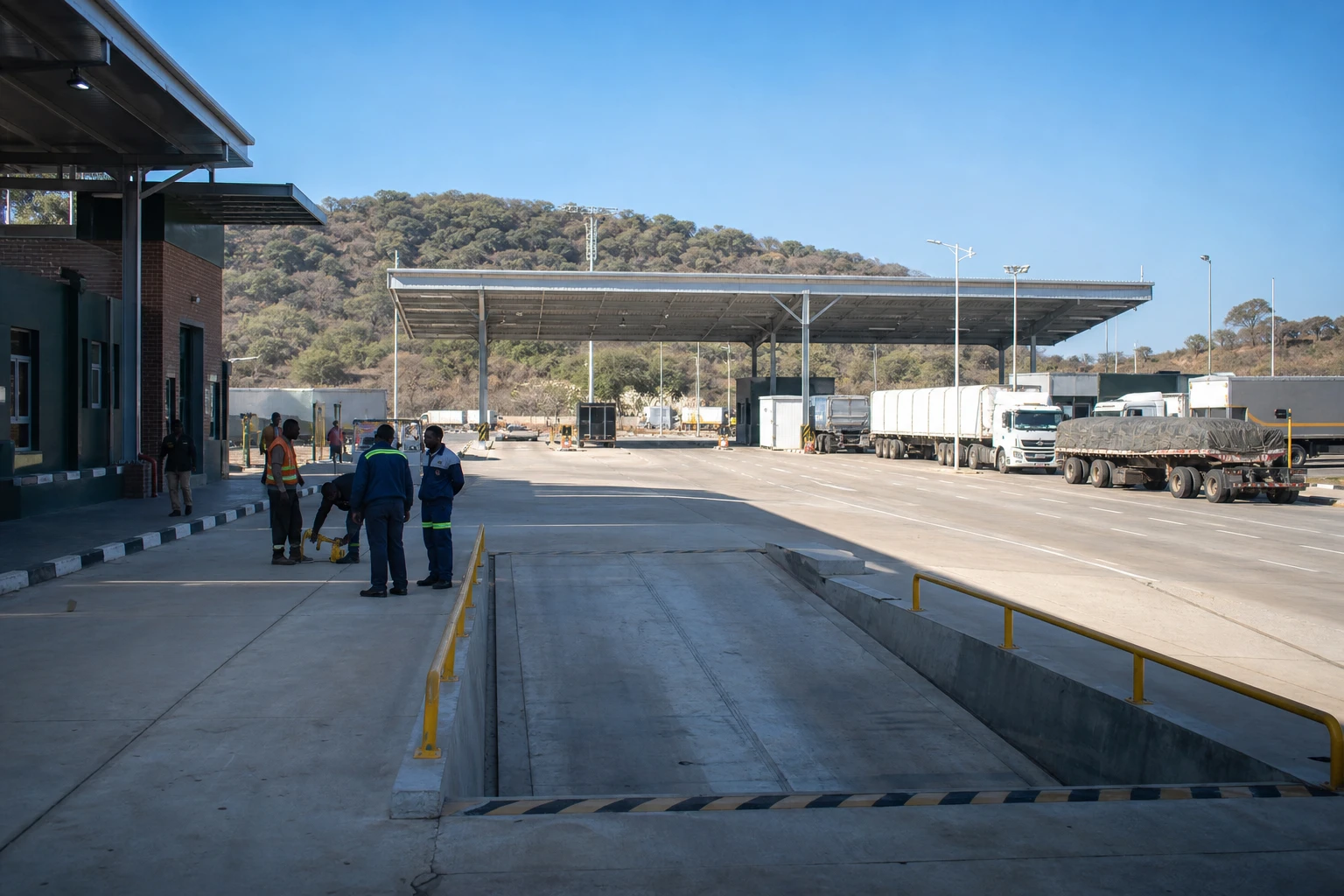
At Chirundu, the movement of lorries between Zimbabwe and Zambia is set to change scale. The financial close of the border post modernisation project paves the way for work long awaited at one of the sensitive points on the North-South Corridor, the major trade route linking Central Africa’s mining areas to southern African ports.
A logistics bottleneck between Zimbabwe and Zambia
Chirundu border post lies on the border between Zimbabwe and Zambia, near the road linking Harare with Zambia’s and the Democratic Republic of the Congo’s Copperbelt. This location gives it a major role in the transport of copper, cobalt, fuels, fertilisers and mining equipment.
For hauliers, every hour spent at the border adds to costs. It increases fuel expenditure, delays deliveries and complicates supply-chain management. The effects therefore extend beyond customs services alone. They also affect transport companies, cross-border traders and industries located along the corridor.
Chirundu is part of the SADC region, the Southern African Development Community. The organisation brings together Zimbabwe, Zambia, the Democratic Republic of the Congo and South Africa, among others, around regional integration projects. The efficiency of the border post is therefore of interest to several economies, not just Harare and Lusaka.
Financing now secured
The Zimbabwean government and the Chirundu Border Consortium, or CBC, announced the financial close of the modernisation project in September 2026. This means the agreements required for financing have been finalised. It allows the project to move from preparation to implementation.
The structure is based on a public-private partnership. Under this type of contract, the private operator provides a substantial share of the capital, builds the infrastructure and takes part in its operation for a defined period. For Chirundu, the CBC is to finance, build and operate the modernised border post without a capital contribution from the Zimbabwean government, according to information published by the authorities and the consortium.
The arrangement was approved by Zimbabwe’s cabinet in July 2024. The contract provides for a “Build, Operate, Own and Transfer” model — building, operating and temporarily owning the infrastructure before transferring it — over a period of 20 years. The consortium is to renovate existing buildings, add new facilities, develop roads, car parks and weighbridges, and upgrade IT systems and traffic processing.
The financing brings together Standard Bank of South Africa, described as lead debt arranger and senior lender, Stanbic Bank Zimbabwe, SAFAGA International and Strategic Partners Group. A credit facility of $80.25 million was also reported by South Africa’s export credit agency. This figure refers to guaranteed financing. It should not automatically be treated as the project’s final total cost.
Public documents cite several figures. The estimate presented by the government in 2024 was $66.8 million. Another estimate linked to national planning put the figure at $68.8 million. At this stage, no public communication gives a precise breakdown of the difference between these amounts and the $80.25 million facility. This distinction matters for monitoring the project’s financial transparency.
Works focused on traffic flows and checks
The modernisation is not limited to renovating buildings. It is intended to reorganise the movement of heavy goods vehicles, light vehicles and travellers. The project includes new traffic lanes, parking areas, weighbridges and digital equipment to speed up the processing of documents.
The developers also promise improved security and coordination between the administrations operating at the border. At a one-stop border post, the two countries’ services can carry out more checks jointly and reduce duplication. The outcome will nevertheless depend on the actual alignment of procedures, the availability of staff and the maintenance of equipment.
A faster system will initially benefit regular corridor operators. Mining companies and hauliers will be better able to plan their journeys. Small cross-border businesses could also benefit from more predictable delays. However, the modernisation must avoid shifting queues to access roads or creating new charges that would weigh on smaller operators.
Initial business mobilisation has already begun, according to communications relayed by the authorities and the consortium. Construction equipment is reportedly being installed on site, while the full start of works is scheduled for October 2026. The timetable will still need to be monitored on the ground, particularly to ensure traffic continues during construction.
Harare turns to partnerships for infrastructure
The Chirundu project extends the strategy pursued by Harare to modernise its main entry points. Beitbridge border post, on the border with South Africa, was redeveloped through another partnership with the private sector and inaugurated in 2023. Other posts, including Forbes and Nyamapanda, also feature in Zimbabwe’s stated modernisation plans.
This approach responds to a budget constraint. The state wants to improve its infrastructure but has limited scope to fund major projects on its own. Private partnerships can accelerate investment. They also create an obligation to oversee tariffs, performance targets, service quality and the sharing of risks.
In March 2026, the government approved new guidelines to regulate public-private partnerships. They aim to harmonise project assessments, clarify responsibilities and make procedures more predictable for investors. The Chirundu project will therefore provide a practical test of this new regulatory framework.
An issue that extends beyond the border
The project’s success will depend as much on regional coordination as on infrastructure. A modernised border cannot sustainably reduce delays if access roads remain in poor condition, required documents differ substantially or digital systems cannot communicate with one another.
For Zimbabwe, Chirundu could strengthen Harare’s logistics role and support trade with Zambia and the Democratic Republic of the Congo. For SADC, the project concerns the smooth operation of a corridor linking the continent’s central mining basins to the ports of Durban, Beira and other southern African coastlines.
The next milestone will therefore be the actual start of construction, followed by an assessment of results. The number of vehicles processed, average customs clearance times, charges and continuity of service will help determine the investment’s real impact. At Chirundu, the challenge will not simply be to build a more modern border post. It will be to make it function as a reliable link in a regional trade network.