Algeria
 Egypt
 Libya
 Morocco
 Sudan
 Tunisia
 Benin
 Burkina Faso
 Cabo Verde
 Côte d'Ivoire
 Ghana
 Guinea
 Guinea-Bissau
 Liberia
 Mali
 Mauritania
 Niger
 Nigeria
 Senegal
 Sierra Leone
 The Gambia
 Togo
 Cameroon
 Central African Republic
 Chad
 DR Congo
 Equatorial Guinea
 Gabon
 Republic of the Congo
 São Tomé and Príncipe
 Burundi
 Comoros
 Djibouti
 Eritrea
 Ethiopia
 Kenya
 Madagascar
 Malawi
 Mauritius
 Mozambique
 Rwanda
 Seychelles
 Somalia
 South Sudan
 Tanzania
 Uganda
 Angola
 Botswana
 Eswatini
 Lesotho
 Namibia
 South Africa
 Zimbabwe
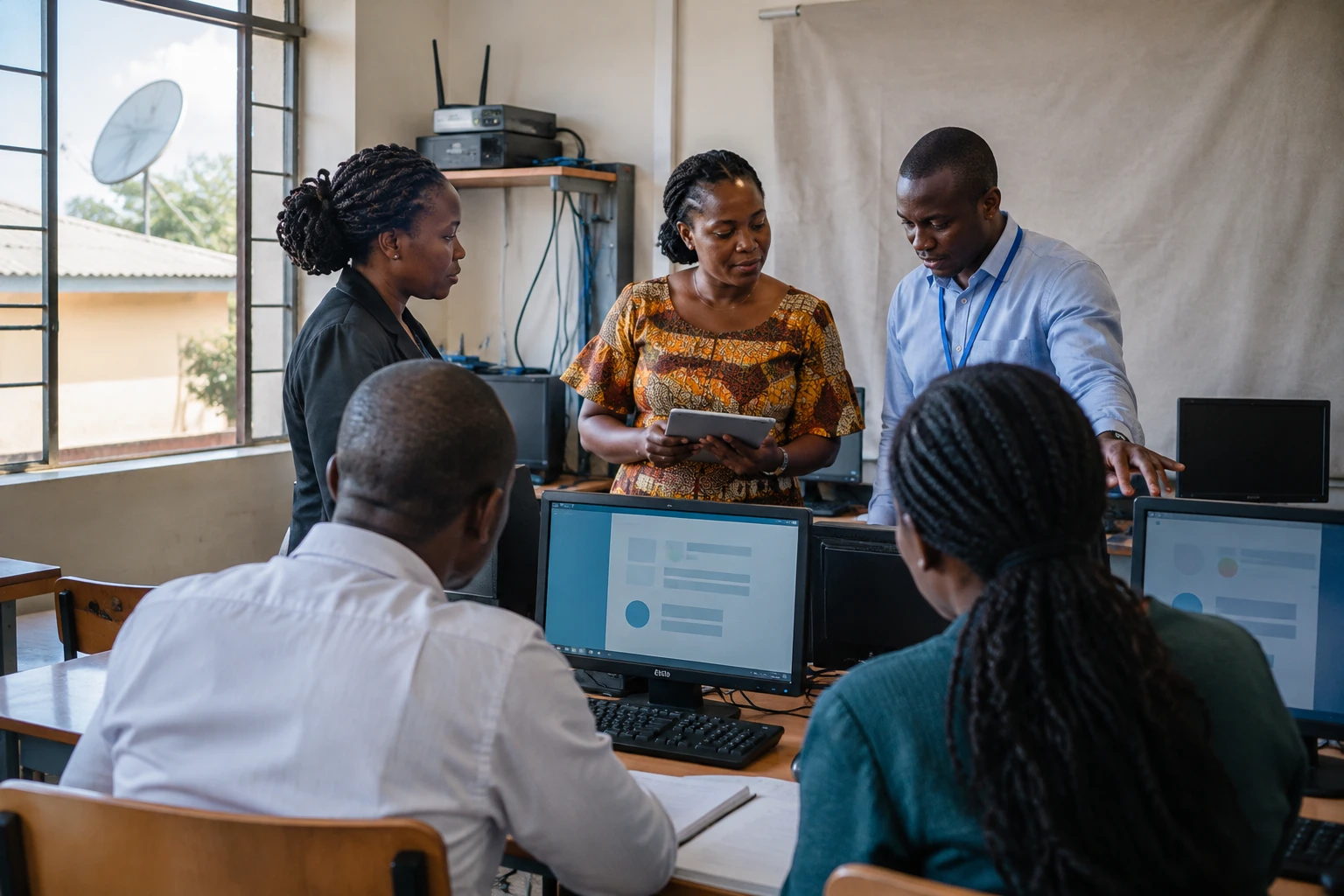
For a pupil, a connection that cuts out in the middle of an online search is not a reliable learning tool. In Lusaka, the installation of satellite internet in 18 schools has brought a wider question in Zambia back into focus: how can access to the network be turned into regular learning across the country?
In Lusaka, a targeted solution in 18 schools
On 15 October 2026, Paratus Zambia announced that it had completed the installation of Starlink terminals in 18 schools managed by Family Legacy in two weeks. The organisation supports more than 10,000 children in Zambia. It says previous connections suffered frequent outages. The new access is intended to facilitate online activities for pupils and education teams, including research for information and communication technology courses.
The deployment was reported by Paratus, the operator responsible for the installation. Its announcement, published in a company-sponsored content section, is not an independent assessment of network performance. The number of schools and the duration of the work should therefore be understood as information provided by the operator. The practical outcome will also depend on daily use of the equipment and its maintenance.
This private project is part of a broader education drive. Since 2024, Zambia’s Ministry of Education, UNICEF and Airtel have been working to connect schools and develop digital learning. In July 2026, UNICEF reported that 300 schools had been connected across the ten provinces, 4,930 teachers had been trained and more than 292,000 pupils had access to digital resources. The account published by UNICEF in Zambia also highlights the role of the Learning Passport platform, which offers educational content accessible online.
Coverage does not guarantee classroom use
The distinction between internet for administration and internet for teaching remains important. According to Ministry of Education figures cited in a key sector publication, 8,239 of 13,987 schools had access in 2025 for administrative tasks. By contrast, 5,487 used the internet for teaching and learning. Only 3,276 reported having a stable connection. These figures show that having a subscription is not enough to ensure uninterrupted digital lessons.
The number of national subscriptions is nevertheless rising. Data attributed to the Zambia Information and Communications Technology Authority (ZICTA), presented on the public results-tracking portal, record 14.7 million mobile internet subscriptions at the end of 2025, up from 13.3 million at the end of 2024. This increase indicates market expansion, but does not in itself provide information about signal quality at a school, the cost of data or the availability of devices.
Electricity is just as practical a concern. The publication available on school statistics says that 5,812 schools had no electricity supply in 2025. In these schools, a satellite connection cannot operate sustainably without a suitable energy solution. More broadly, maintenance costs, teacher training and pupils’ access to computers or tablets determine whether the network becomes a classroom tool or remains equipment that is little used.
Different models, the same need for continuity
The Lusaka project relies on a private operator and an organisation working in its own schools. The UNICEF–ministry–Airtel partnership, meanwhile, aims for coverage in all ten provinces and links connectivity with teacher training. The initiatives are not directly comparable in scale or objectives. They nevertheless show that technical equipment is only one step: educational content, skills and the funding of costs also matter.
For pupils and teachers, a more regular connection can facilitate access to digital textbooks, research platforms and revision resources. For school management, it can support some administrative tasks. But the benefits will not be the same at every school. Schools that already have equipment and electricity can adopt digital tools more quickly; those lacking power or equipment risk being left behind, even as national coverage improves.
Zambia is a member of the Southern African Development Community (SADC), a regional organisation for economic and political co-operation. The challenge of school connectivity therefore extends beyond Lusaka: in the region and elsewhere on the continent, authorities are seeking to expand digital education without widening the gaps between cities and less well-served areas. The number of connected schools remains a useful indicator, but it does not show whether pupils can actually follow an online lesson, or how often.
The next step will be to measure service continuity and its integration into learning, beyond the installation itself. The results of the UNICEF–Airtel programme and changes in school statistics will help assess the reach of these initiatives. For Lusaka’s 18 schools, the immediate challenge is now to turn a connection described as more stable into lasting access to educational resources.