Algeria
 Egypt
 Libya
 Morocco
 Sudan
 Tunisia
 Benin
 Burkina Faso
 Cabo Verde
 Côte d'Ivoire
 Ghana
 Guinea
 Guinea-Bissau
 Liberia
 Mali
 Mauritania
 Niger
 Nigeria
 Senegal
 Sierra Leone
 The Gambia
 Togo
 Cameroon
 Central African Republic
 Chad
 DR Congo
 Equatorial Guinea
 Gabon
 Republic of the Congo
 São Tomé and Príncipe
 Burundi
 Comoros
 Djibouti
 Eritrea
 Ethiopia
 Kenya
 Madagascar
 Malawi
 Mauritius
 Mozambique
 Rwanda
 Seychelles
 Somalia
 South Sudan
 Tanzania
 Uganda
 Angola
 Botswana
 Eswatini
 Lesotho
 Namibia
 South Africa
 Zimbabwe
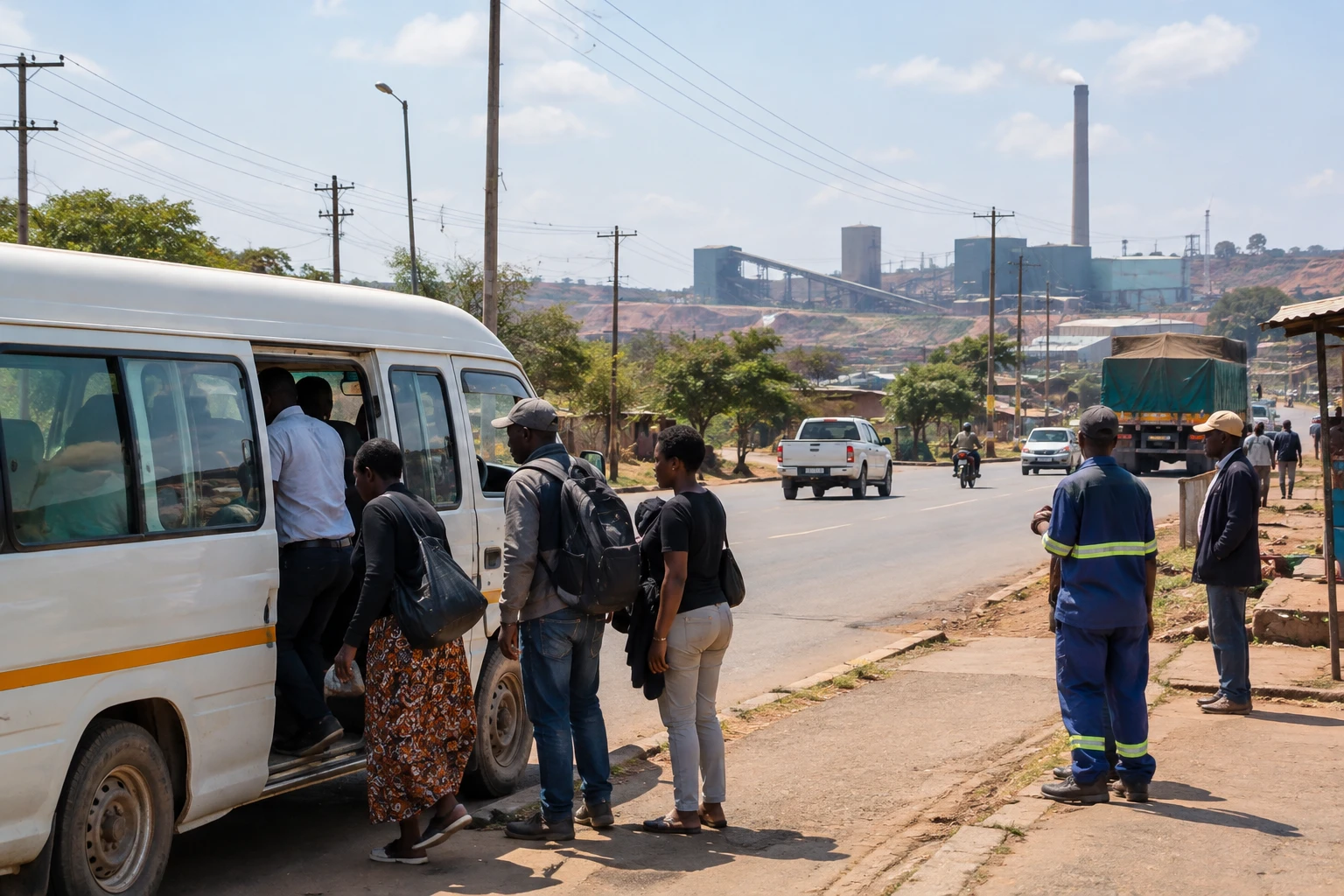
For copper mines in north-western Zambia, electricity is no longer just a production cost: it is essential to keeping operations running. The Kusoka solar plant, announced at 112 MWp, illustrates the growing role of private producers in addressing this challenge. But it also highlights a national issue: ensuring that new capacity strengthens the electricity system beyond serving only large consumers.
Hydropower dependence put to the test
Zambia suffered prolonged electricity shortages after the 2024 drought. The country relies heavily on hydropower, whose output was reduced by the lack of water. The World Bank estimates that the drought cut available power by about a third. Outages affected households and businesses, while smaller enterprises, less well equipped to absorb interruptions, had to contend with an unreliable supply.
The crisis has made diversifying energy sources more urgent. Solar can supplement dams during daylight hours, but cannot on its own replace dispatchable generation or resolve transmission and storage challenges. The issue is therefore as much about connecting new plants, managing fluctuations in output and sharing electricity between sectors as it is about building them.
Mines play a decisive role in this balance. According to figures attributed to the Energy Regulation Board (ERB), Zambia’s energy regulator, they consumed nearly 9.8 TWh in 2025, or about 63% of national consumption. This concentration of demand gives mining companies considerable influence over supply decisions and the development of new capacity.
Kusoka, a private plant for the Trident complex
On 29 October 2026, Solarcentury Africa announced a partnership with First Quantum Minerals (FQM) to develop the Kusoka photovoltaic plant, with a stated capacity of 112 MWp. The project is in North-Western Province. It is intended to supply mainly the Trident mining complex, which includes the Sentinel copper mine and the Enterprise nickel mine.
Solarcentury is to own and operate the plant. YEO has been appointed to carry out engineering, equipment procurement and construction. The project is described as a merchant plant: electricity could be sold to FQM, other buyers or, subject to availability, on the regional market. This flexibility could broaden its potential customer base, but the detailed sales and connection arrangements will be crucial.
The distinction between MWp and MW is useful here. MWp measures the panels’ maximum rated output under standardised conditions; actual generation depends, among other things, on sunlight, equipment and system losses. The announced 112 MWp therefore does not mean the plant will supply that level of power at every hour.
FQM is already seeking to diversify its supply. In its third-quarter 2026 results, published on 28 October, the group said imports and local independent power producers cover about 80% of its electricity needs in Zambia, compared with 20% supplied by ZESCO, the state-owned utility. Kusoka is part of this strategy. It also complements the 430 MW solar and wind project associated with FQM, TotalEnergies and Chariot, previously announced by Zambia’s Ministry of Energy.
Opening the market without leaving consumers behind
The rise of independent power producers is accompanying changes in the electricity market. In 2024, the regulator approved guidelines for open access to the grid. Under certain conditions, this mechanism allows producers and buyers to transmit electricity through existing infrastructure. It is intended to facilitate trading, but its effectiveness depends on stable rules, transparent tariffs and sufficient network capacity.
The World Bank has highlighted the importance of consistently applying grid-access rules and increasing private-sector participation in infrastructure. For Zambia, the challenge is to accommodate new investment while preserving ZESCO’s central role. Private plants can bring in capital and diversify supply; they do not remove the need to strengthen the grid or ensure that the framework is accessible to different producers.
FQM is not the only company investing in its own energy security. On 21 October, Solarcentury announced that a further 34.5 MWp had begun operating at its Mailo site. The company said this brings its operational capacity to 59.5 MWp, out of a planned total of 118 MWp. This growth shows that private solar is already expanding in Zambia, although each project must be assessed in terms of its actual output and contribution to the shared system.
The effects will not be the same for everyone. A more reliable supply can support mining activity, employment and revenues from copper and nickel. However, a contract primarily intended to supply a mine does not guarantee that residential neighbourhoods, small businesses or rural communities will receive more electricity. That will depend on sales agreements, the grid and decisions about how power is allocated.
Mining demand, a test for energy strategy
The Zambian government is targeting annual copper production of three million tonnes. This ambition will require more energy, as mine expansions and ore processing increase electricity needs. The national energy plan estimates that the mining sector’s power demand could rise from 886 MW in 2020 to 1,552 MW in 2030. These projections highlight the tensions ahead between industrial growth, grid reliability and access for other consumers.
Regionally, Zambia is a member of the Southern African Development Community (SADC) and participates in the Southern African Power Pool, which organises electricity trading between several countries. Depending on agreements and available capacity, Kusoka’s merchant model could therefore be part of cross-border trade. But the immediate priority remains reducing the vulnerability exposed by the drought and securing domestic supply.
The next thing to watch will be whether Kusoka moves ahead: its construction timetable, grid connection, sales contracts and the volume of electricity actually delivered. Lusaka’s challenge is not simply to attract solar plants. It is to turn this investment into a more diverse and reliable supply, while ensuring that market liberalisation also benefits consumers without the purchasing power of a large mining company.