Algeria
 Egypt
 Libya
 Morocco
 Sudan
 Tunisia
 Benin
 Burkina Faso
 Cabo Verde
 Côte d'Ivoire
 Ghana
 Guinea
 Guinea-Bissau
 Liberia
 Mali
 Mauritania
 Niger
 Nigeria
 Senegal
 Sierra Leone
 The Gambia
 Togo
 Cameroon
 Central African Republic
 Chad
 DR Congo
 Equatorial Guinea
 Gabon
 Republic of the Congo
 São Tomé and Príncipe
 Burundi
 Comoros
 Djibouti
 Eritrea
 Ethiopia
 Kenya
 Madagascar
 Malawi
 Mauritius
 Mozambique
 Rwanda
 Seychelles
 Somalia
 South Sudan
 Tanzania
 Uganda
 Angola
 Botswana
 Eswatini
 Lesotho
 Namibia
 South Africa
 Zimbabwe
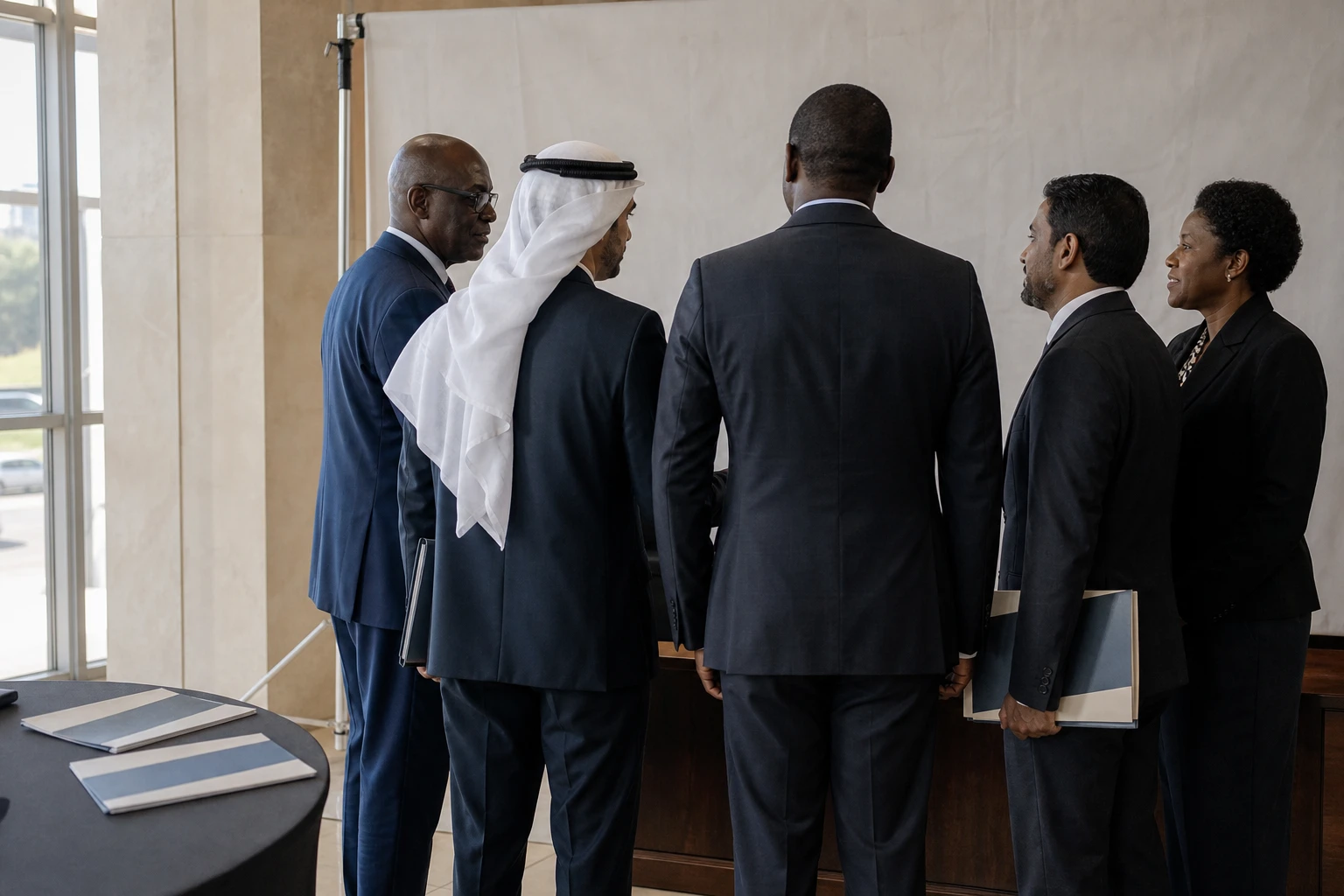
In Lusaka, economic diplomacy is entering a more operational phase. After securing an Emirati partner for Mopani Copper Mines, Zambia now wants to broaden the relationship to energy, infrastructure, agriculture and the local processing of minerals.
President Hakainde Hichilema will travel to the United Arab Emirates on Tuesday 29 and Wednesday 30 September 2026. The working visit comes a few weeks after the start of his second term and is intended to give practical effect to the «Grow Zambia» economic agenda.
A visit focused on economic diplomacy
The trip was announced by the Zambian authorities. Hakainde Hichilema is responding to an invitation from Emirati President Mohamed bin Zayed Al Nahyan. The two leaders are due to review the status of existing agreements and identify projects that have yet to materialise.
Memoranda of understanding could be signed during the official talks. They are expected to cover mining, mineral beneficiation, agriculture, energy, transport, logistics, tourism and health. Zambia also wants to move towards a comprehensive economic partnership agreement, designed to facilitate trade and investment between the two countries.
The programme also includes a business and investment forum. The head of state is due to meet Emirati companies and engage with the Zambian community living in the UAE. The aim is to bring political commitments closer to investment decisions by private-sector groups.
This approach reflects the new diplomatic line advocated by Lusaka. In September 2026, Hichilema called on newly accredited foreign representatives in Zambia to turn diplomatic relations into commercial opportunities, investment and jobs. The Zambian presidency presents this approach as a pillar of the «Grow Zambia» programme.
Copper remains the partnership’s anchor
The rapprochement with Abu Dhabi is not starting from scratch. Emirati interests are already present in Zambia’s mining sector, notably through International Resources Holding, or IRH. The company owns 51% of Mopani Copper Mines, while ZCCM-IH, Zambia’s state-owned mining company, retains 49% of the equity.
The deal represents an initial commitment of $1.1 billion. It was completed in 2024 through Delta Mining, an IRH subsidiary. The Zambian government also secured the restoration of a «golden share», which gives the state specific rights over certain strategic decisions. Zambia’s Mines Ministry set out the terms of the transaction to parliament.
Mopani operates two major mining complexes in the Copperbelt, at Nkana and Mufulira. Reviving these sites matters for regional employment, local suppliers and public revenue. It also matters for the national strategy, which aims to significantly increase copper production and develop more industrial activity around the mineral.
IRH says it wants to raise Mopani’s production to 200,000 tonnes of copper cathode a year in the coming years. The company has since cited a more ambitious target of 300,000 tonnes a year by 2029. These projections remain dependent on upgrading equipment, the availability of electricity and access to new reserves.
According to information published by the company in July 2025, Mopani’s ore production rose by 35% in the first half of 2025 compared with the same period in 2024. Contained copper production increased by 54%. These figures come from the operator itself and should therefore be read with the usual caution about data reported by a company on its own activities. IRH published the main indicators of this operational recovery.
From mining to local processing
For Lusaka, the challenge is not limited to attracting foreign capital into extraction. The priority is also to retain more value in Zambia. This means developing processing, metallurgy, mining services, industrial maintenance and the infrastructure needed for exports.
This ambition nevertheless faces several constraints. The mining sector consumes large amounts of electricity, while Zambia remains exposed to fluctuations in hydroelectric output. Companies must also contend with the distances between mining areas, export corridors and international markets.
Investment in roads, rail, border posts and logistics could therefore have a broader impact than on the copper sector alone. It would benefit large companies, as well as agricultural producers and small businesses in mining towns. By contrast, an agreement limited to ore exports would generate fewer benefits for the local economy.
Governance will also remain central. ZCCM-IH’s stake gives the state a direct presence in Mopani. It does not relieve the authorities of the need to publish clear information on financing, production targets, tax revenue and the company’s social commitments.
A partnership extending beyond bilateral ties
The relationship between Zambia and the UAE is part of a wider competition for access to Africa’s strategic minerals. Copper is sought after for electricity grids, electric vehicles and equipment linked to the energy transition. Producer countries are therefore seeking to attract capital while negotiating better industrial terms.
Zambia is also acting within the Southern African Development Community, SADC, which includes several neighbouring countries and coordinates regional policies on transport, energy and trade. Infrastructure linking the Copperbelt to southern African ports gives any investment in Zambia a regional dimension.
Diplomatic ties have strengthened in parallel. Zambia opened its embassy in Abu Dhabi in 2023. In September 2026, Emir Mohammed Saeed Mohammed Alkaabi presented his credentials as the UAE’s first resident ambassador to Zambia, according to the Zambian authorities. This development confirms the deepening of institutional ties between Lusaka and Abu Dhabi.
The 29 and 30 September visit will therefore be judged by what follows. Announcements will matter, but implementation will matter more. For Zambians, the outcome will be measured in mines, factories, jobs, access to energy and the quality of infrastructure, far beyond the meeting rooms of Abu Dhabi.