Algeria
 Egypt
 Libya
 Morocco
 Sudan
 Tunisia
 Benin
 Burkina Faso
 Cabo Verde
 Côte d'Ivoire
 Ghana
 Guinea
 Guinea-Bissau
 Liberia
 Mali
 Mauritania
 Niger
 Nigeria
 Senegal
 Sierra Leone
 The Gambia
 Togo
 Cameroon
 Central African Republic
 Chad
 DR Congo
 Equatorial Guinea
 Gabon
 Republic of the Congo
 São Tomé and Príncipe
 Burundi
 Comoros
 Djibouti
 Eritrea
 Ethiopia
 Kenya
 Madagascar
 Malawi
 Mauritius
 Mozambique
 Rwanda
 Seychelles
 Somalia
 South Sudan
 Tanzania
 Uganda
 Angola
 Botswana
 Eswatini
 Lesotho
 Namibia
 South Africa
 Zimbabwe
In Lusaka, a closure that raises legal questions
When an election has just been decided and a legal challenge can still be filed, access to a judge becomes a test of democratic maturity. In Zambia, that test took a dramatic turn: on the final day for challenging the presidential election, the doors of the main courts were shut under police escort, just as the opposition said it intended to seek justice.
The country had only just emerged from a presidential election held on 13 August 2026. A few days later, the electoral commission declared incumbent President Hakainde Hichilema the winner with just over 60% of the vote, against Brian Mundubile, who was reported to have received around 38%. In a constitutional system where a presidential election challenge must go through the Constitutional Court, timing matters as much as the substance of the case.
Zambia’s framework: a short deadline, a sensitive dispute
The Zambian Constitution provides that a person may petition the Constitutional Court to annul an election within seven days of the declaration of the elected president. The same institutional framework then requires the Court to rule swiftly. The short deadline is intended to secure the transition, but leaves challengers little room to manoeuvre, especially amid post-election tensions.
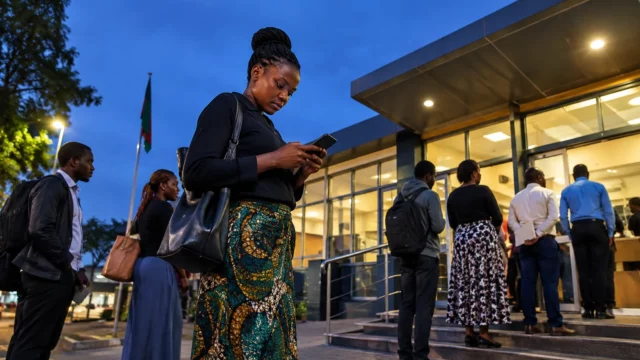
In this context, the closure of courts in Lusaka, including the buildings housing the High Court and Constitutional Court, had an immediate effect. An internal memorandum circulated by the judiciary cited “security reasons” and told staff not to report for work. Reuters observed that the gates were closed and police were stationed at the sites.
The measure did not come in a political vacuum. The campaign and the period after the vote were marked by security incidents, arrests of opposition figures and a heavy police presence. Regional and continental observers, brought together under the auspices of SADC, the African Union and COMESA, had already called for calm while urging that grievances be pursued through the prescribed legal channels.
What happened on 24 August
On 24 August, the authorities closed the country’s main courts as the opposition announced that it intended to file a petition against Hakainde Hichilema’s re-election. The internal memorandum cited by Reuters said the closure was for security reasons, without specifying a reopening date. According to the same outlet, risk assessments were still under way, and the police authorities had not given details of the precise nature of the threat.
The closure affected the Supreme Court, the Lusaka High Court and the Constitutional Court, which share premises in the centre of Zambia’s capital. Civic organisations saw it as a direct infringement of access to justice. A coalition of civil society groups, including lawyers and women human rights defenders, denounced the situation as “unprecedented” and said the timing could not be ignored.
Opposition leader Brian Mundubile had said the previous week that he intended to challenge the results before the Constitutional Court. According to the information available, he had seven days from the declaration of the results to act. The issue, therefore, was not simply whether the election was close or disputed; it was also whether it was practically possible to exercise a constitutional right within the deadline.
An issue extending beyond the election
The closure of the courts affects litigants first and foremost. In Zambia, as elsewhere in southern Africa, ordinary citizens do not need a grand theoretical debate about the separation of powers; they need an open counter, an accessible registry and a judge who can be reached. When those doors close, even temporarily, deadlines, urgent applications, cases involving personal liberty and election disputes are all put at risk.
The political authorities, for their part, are seeking to preserve the stability of a transition that is still in its early stages. But the risk is the opposite: by creating the impression that justice is out of reach when it should be considering the most sensitive dispute of the electoral cycle, the executive undermines confidence in institutions. That is precisely the point made by the lawyers and civic organisations who responded in Lusaka. For them, the problem is not only the security grounds cited; it is the coincidence between those grounds and the expiry of the deadline for challenging the result.
SADC is closely watching this kind of sequence because it affects the credibility of elections across the region. Its electoral principles provide for mechanisms to prevent crises and monitor the post-election period. In Lusaka, the missions deployed in August praised the generally calm conduct of the vote, while highlighting problems with the management of results, political violence and media freedom. The court closures now add an institutional dimension to an already combustible dispute.
What southern Africa is watching now
Zambia is not an isolated case, but it remains a pivotal country in southern Africa. A member of SADC, it often serves as a point of reference in regional debates on the conduct of elections, the handling of petitions and the strength of checks and balances. What is at stake in Lusaka therefore goes beyond the Hichilema-Mundubile contest: it is about a state’s ability to let justice function at the very moment it is most needed.
The next signal to watch will be straightforward: the actual reopening of the courts, the conditions for access to registries and whether it is possible to file a challenge in the prescribed manner. If no alternative route is put in place to safeguard applicants’ rights, the crisis will no longer be merely electoral. It will become a matter of institutional trust, with repercussions beyond Zambia, across the SADC region and in continental debates on the rule of law.