Algeria
 Egypt
 Libya
 Morocco
 Sudan
 Tunisia
 Benin
 Burkina Faso
 Cabo Verde
 Côte d'Ivoire
 Ghana
 Guinea
 Guinea-Bissau
 Liberia
 Mali
 Mauritania
 Niger
 Nigeria
 Senegal
 Sierra Leone
 The Gambia
 Togo
 Cameroon
 Central African Republic
 Chad
 DR Congo
 Equatorial Guinea
 Gabon
 Republic of the Congo
 São Tomé and Príncipe
 Burundi
 Comoros
 Eritrea
 Ethiopia
 Kenya
 Madagascar
 Malawi
 Mauritius
 Mozambique
 Rwanda
 Seychelles
 Somalia
 South Sudan
 Tanzania
 Uganda
 Angola
 Botswana
 Eswatini
 Lesotho
 Namibia
 South Africa
 Zambia
 Zimbabwe
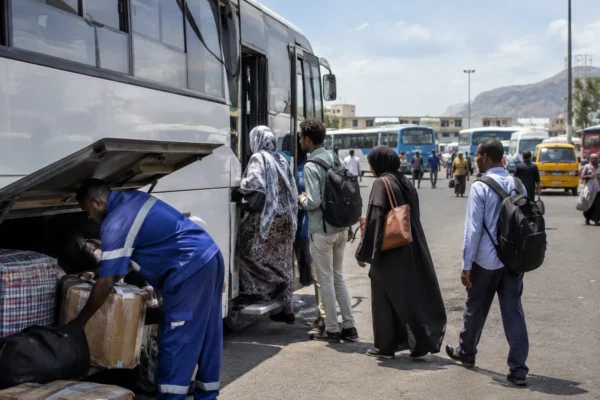
In Obock, in northern Djibouti, arrivals from Yemen continue after arduous crossings of the Bab el-Mandeb Strait. The country is now preparing to receive more than 10,000 people if fighting continues to drive families towards the African shore.
New pressure on the Horn of Africa
The Bab el-Mandeb Strait links the Red Sea to the Gulf of Aden. It separates Djibouti from Yemen’s western coast by just a few dozen kilometres. This proximity quickly turns a crisis in Yemen into a direct concern for the Horn of Africa.
Djibouti already hosts refugees from Somalia, Ethiopia and Yemen. New arrivals are mainly assisted in the Obock region before being transferred to the Markazi refugee village. The site still has limited capacity, as needs for water, shelter, healthcare and schooling grow.
The country is a member of the Intergovernmental Authority on Development (IGAD), a regional organisation that coordinates, among other things, responses to forced displacement in the Horn of Africa. The situation in Yemen adds to a long series of crises that are already placing demands on the region’s administrations and host communities.
Nearly 3,000 arrivals in less than a week
The United Nations High Commissioner for Refugees (UNHCR) said that nearly 3,000 people had arrived in Djibouti in less than a week in mid-September 2026. They landed in places including Obock, Khor Angar, Moulhoule and Godoria.
A UNHCR operational update put the number of arrivals at precisely 2,935 as of the morning of 17 September, after eight consecutive days of movements. About 60% of those recorded were women and children. The figure confirms the scale of the displacement, while also underscoring that the data may change as more people arrive and registration operations continue.
The crossings are made in small boats. Several families arrive exhausted, with few belongings and sometimes after being separated from relatives. Others are reportedly still stranded on the Yemeni coast, owing to a lack of fuel or insecurity preventing departures.
UNHCR and the Djiboutian authorities are preparing for the arrival of more than 10,000 people. This projection is not a definitive tally. It is a planning scenario based on continued violence and expected changes in maritime conditions.
Fighting is also displacing people within Yemen
The main impact of the escalation, however, remains visible in Yemen. More than 100,000 people are believed to have already left their homes in areas affected by the fighting, particularly along the western coast.
Displacement is affecting several governorates, including Al Hudaydah, Taiz, Lahj, Aden, Abyan, Marib, Al-Dhale and Shabwa. These movements do not mean that all families can reach a safe place. Roads are disrupted, resources are dwindling and humanitarian access remains difficult in some areas.
For several years, the conflict in Yemen has pitted rival authorities and their allied forces against each other. The Houthis control much of the north and west of the country, while the internationally recognised government and various armed groups hold positions in the south and east. The military landscape remains fragmented. This complicates negotiations and makes population movements particularly unpredictable.
The latest displacement adds to a protracted crisis. Millions of Yemenis are already living away from home after more than a decade of conflict, economic crisis and deteriorating public services. Displaced families often have to choose between staying in an exposed area and taking dangerous sea routes.
Djibouti’s reception capacity is limited
The response depends on more than the number of people landing on the coast. It also requires rapid registration, medical referrals, temporary accommodation and access to clean water. Children need schooling, while vulnerable people must be able to receive appropriate protection.
UNHCR says the Markazi site can still accommodate about 5,000 refugees. An arrival exceeding that capacity would quickly put existing infrastructure under strain. A lack of space could affect living conditions, while a concentrated population would make access to healthcare and sanitation more difficult.
The effects will not be the same for everyone. Newly arrived families will need immediate assistance. Residents of Obock and nearby localities may also face increased pressure on available services. The authorities will therefore need to ensure that the emergency response for refugees does not undermine local stability.
Funding is another critical issue. UNHCR estimates that its operation in Djibouti is only 15% funded. The agency is seeking about $5.1 million to provide reception, registration, protection and essential services. In Yemen, its operation is only 18% funded, with an additional $14 million needed for displaced families.
A regional risk beyond the humanitarian crisis
The deteriorating situation also affects a strategic maritime corridor. Commercial and humanitarian vessels travelling between the Red Sea and the Indian Ocean use the Bab el-Mandeb. Prolonged insecurity could lengthen routes, increase transport costs and delay the delivery of aid to Yemen, Sudan or other crisis zones.
Djibouti thus finds itself at the intersection of two dynamics. The country must respond to a humanitarian emergency on its territory. It must also safeguard a maritime area essential to regional trade and relief operations.
The coming weeks will be decisive. UNHCR expects crossings could accelerate after mid-October 2026, when conditions at sea may become more favourable for departures. Developments in the fighting on Yemen’s coast, Markazi’s reception capacity and aid funding will be the main indicators to watch.