Algeria
 Egypt
 Libya
 Morocco
 Sudan
 Tunisia
 Benin
 Burkina Faso
 Cabo Verde
 Côte d'Ivoire
 Ghana
 Guinea
 Guinea-Bissau
 Liberia
 Mali
 Mauritania
 Niger
 Nigeria
 Senegal
 Sierra Leone
 The Gambia
 Togo
 Central African Republic
 Chad
 DR Congo
 Equatorial Guinea
 Gabon
 Republic of the Congo
 São Tomé and Príncipe
 Burundi
 Comoros
 Djibouti
 Eritrea
 Ethiopia
 Kenya
 Madagascar
 Malawi
 Mauritius
 Mozambique
 Rwanda
 Seychelles
 Somalia
 South Sudan
 Tanzania
 Uganda
 Angola
 Botswana
 Eswatini
 Lesotho
 Namibia
 South Africa
 Zambia
 Zimbabwe
In Yaoundé, crafts seek a place in the battle for added value
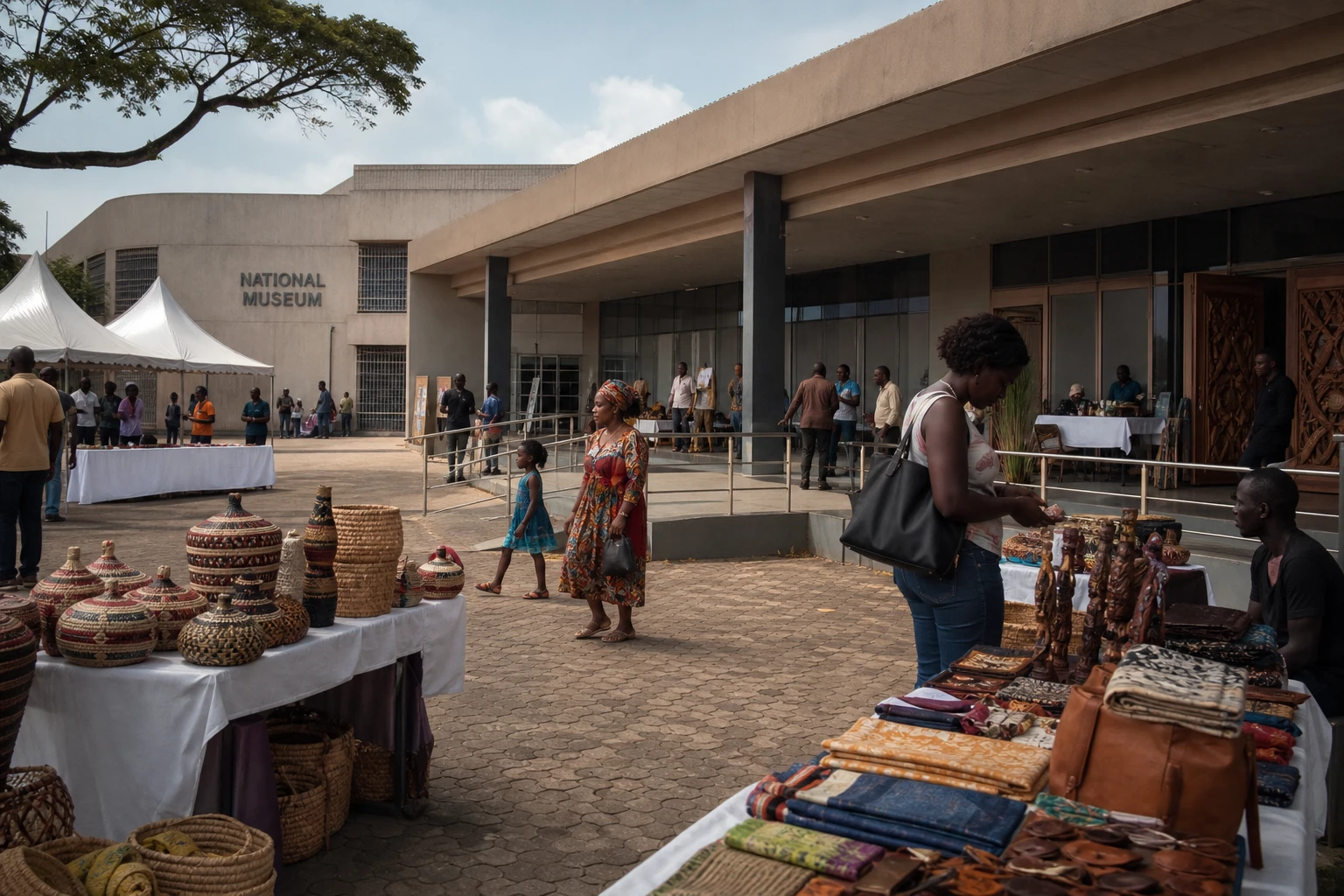
In workshops and markets, African crafts often carry more than an object: they convey a skill, a memory and sometimes a family income. In Yaoundé, the 9th edition of the Cameroon International Crafts Fair is putting this reality centre stage, with a clear ambition: to make local know-how an economic lever, not just a cultural showcase. The event is being held at the National Museum of Yaoundé from 27 July to 5 August 2026, under the theme “Between tradition and modernity: how can craft innovation be stimulated?”.
The choice of venue is no accident. The National Museum, in the heart of the Cameroonian capital, gives the fair both heritage significance and political weight. The sector is under the high patronage of the President of the Republic and overseen by the Ministry of Small and Medium-Sized Enterprises, Social Economy and Handicrafts, confirming the state’s role in organising a sector that remains highly fragmented. In a country with tens of thousands of artisanal production units, the challenge is no longer simply to produce, but to organise, sell and finance more effectively.
A biennial fair turned marketplace
SIARC is more than a simple exhibition. The fair’s official website describes it as the leading biennial event for Cameroon’s crafts sector. It brings together artisans, entrepreneurs, institutions, professional buyers and partners around a shared goal: making crafts a driver of sustainable development, innovation and competitiveness. The ministry’s official communications also highlight three priorities: wealth creation, jobs and promoting Made in Cameroon.
The 2026 edition builds on an established approach. When launching its communications campaign, the ministry had already announced a fair featuring sales exhibitions, business meetings, training workshops and technological applications for craft trades. In other words, the sector no longer wants merely to display finished pieces; it wants to create commercial opportunities, attract buyers and test more robust value chains.
The number of exhibitors gives a sense of the event’s scale. Several consistent sources cite more than 600 national and international artisans. The figure is more than symbolic: it shows that a fair launched at national level is now being conceived as a platform for exchanges across the continent. A previous edition in 2021 already brought together 600 Cameroonian artisans and foreign delegations, signalling gradual growth.
Côte d’Ivoire as guest of honour sends a signal of South-South openness
For this 9th edition, Côte d’Ivoire has a prominent role. Ivorian authorities have confirmed their participation as guest country of honour, with a delegation led by Kalil Konaté, Minister of Trade, Industry and Crafts. The delegation includes ten national craft champions, presented as ambassadors of Ivorian know-how.
This goes beyond protocol courtesy. It reflects a broader vision of cooperation between Yaoundé and Abidjan: enabling skills, techniques and commercial opportunities to circulate between two economies where crafts remain closely linked to informal employment, small family businesses and local urban markets. The Ivorian side notes that crafts account for nearly 19.5% of the country’s GDP, making the sector a strategic source of income and jobs.
Cameroon is not simply seeking to host the event. It aims to establish itself as a regional hub for know-how. The fair is also expected to welcome other foreign delegations, including Algeria, announced as a guest country of honour alongside Côte d’Ivoire in SIARC’s official materials. This openness gives Cameroon a role as a bridge between Central, West and North Africa in the creative industries and craft trades.
What the event means for artisans, cities and households
For Cameroonian artisans, the stakes are tangible. They need access to more stable orders, business contacts, training and overseas markets. The ministry says the sector now has 72,508 artisanal production units listed in municipal registers, while the ministry’s 2024 statistical yearbook records 3,602 new APUs registered in 2024. These figures point to two things at once: crafts are growing, but the sector remains highly dispersed and unevenly organised.
Organisation is also critical for cities. In Yaoundé, the fair supports hotels, transport, restaurants and local services for a few days. Beyond the capital, it sends a signal. Regions are being invited to select their best representatives and help them move upmarket. Adamawa, for example, recently selected 40 artisans for the 2026 edition, showing that preparations for the fair are already reaching beyond the administrative centre across the country.
For households, the stakes are broader still. When the crafts sector is thriving, it absorbs some youth employment, adds value to local raw materials and supports incomes that circulate quickly through the local economy. This is particularly evident in leather, textiles, wood, ceramics and leather goods, where combining tradition and innovation can turn a locally consumed product into an exportable good. The Cameroonian government explicitly links the sector to local processing and industrialisation.
Regional significance as the continent seeks value chains
SIARC 2026 is more than a Cameroon news story. At a time when the African Union and the African Continental Free Trade Area are encouraging the movement of goods produced on the continent, crafts offer a case study. They show how sectors that are still largely unmechanised can join broader value chains without losing their identity. The presence of buyers, investors and foreign delegations points in that direction.
The event also has regional significance. In Central Africa, where economies often remain dependent on imports, crafts can support a modest but useful form of productive sovereignty: producing everyday objects, decorative items, furniture, accessories and cultural products locally. The Yaoundé fair is testing precisely this ability to connect heritage, design and trade.
The event’s closing on 5 August will show whether this edition confirms the sector’s move upmarket or remains a fine showcase. But one thing is already clear: in Yaoundé, the debate is no longer solely about preserving craft skills. It is about their place in Cameroon’s economy, their circulation within the CEMAC region and their ability to enter the continental market without losing their local roots.