
 Algeria
 Egypt
 Libya
 Morocco
 Sudan
 Tunisia
 Benin
 Burkina Faso
 Cabo Verde
 Côte d'Ivoire
 Ghana
 Guinea
 Guinea-Bissau
 Liberia
 Mali
 Mauritania
 Niger
 Nigeria
 Senegal
 Sierra Leone
 The Gambia
 Togo
 Central African Republic
 Chad
 DR Congo
 Equatorial Guinea
 Gabon
 Republic of the Congo
 São Tomé and Príncipe
 Burundi
 Comoros
 Djibouti
 Eritrea
 Ethiopia
 Kenya
 Madagascar
 Malawi
 Mauritius
 Mozambique
 Rwanda
 Seychelles
 Somalia
 South Sudan
 Tanzania
 Uganda
 Angola
 Botswana
 Eswatini
 Lesotho
 Namibia
 South Africa
 Zambia
 Zimbabwe
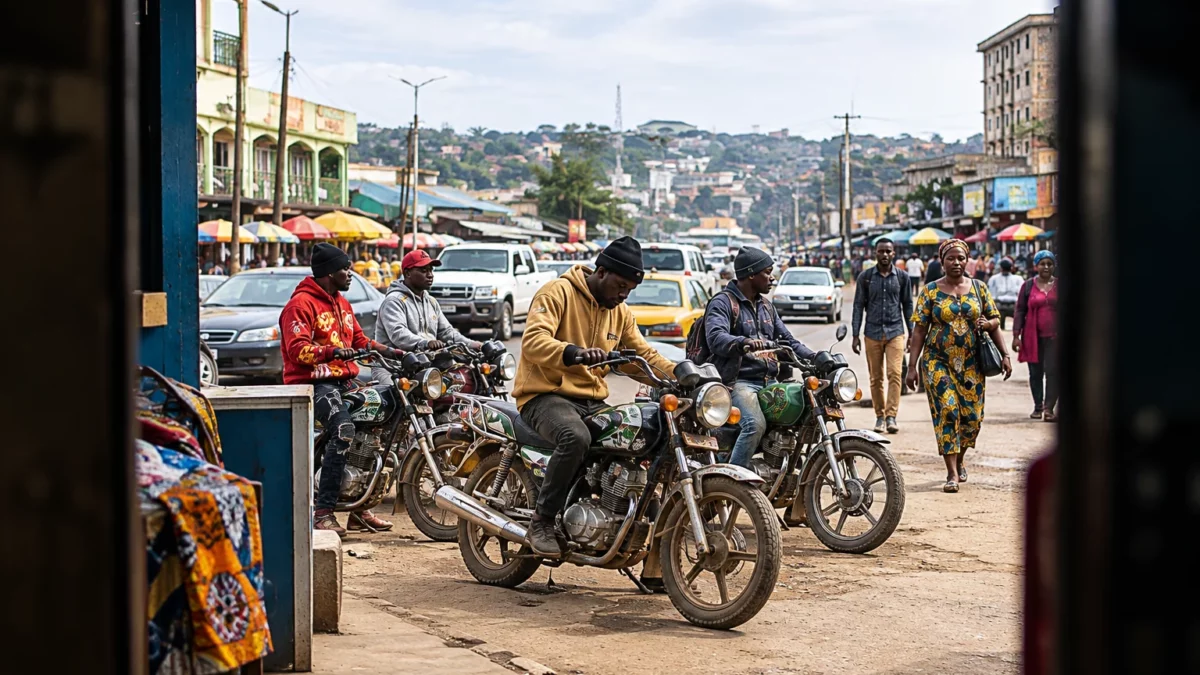
In Yaoundé, motorcycle taxis are both a daily means of transport and a livelihood for many drivers. From Monday 16 November 2026, checks announced in the Mfoundi department are due to verify whether drivers and motorcycles have the required documents. The issue is a practical one: to identify people and vehicles more effectively without making it harder for those seeking to regularise their situation to work.
A rule already set out in the national framework
The checks follow several announcements by authorities in the Centre region. On 5 November, Governor Naseri Paul Béa called on drivers to comply with the rules. Awareness-raising meetings were subsequently held in Mfoundi municipalities, including Yaoundé IV, according to reports in the Cameroonian press.
The sector is not without rules. Decree No. 2008/3447/PM of 31 December 2008 provides, in particular, for the registration of motorcycles and the assignment of an identification number by the municipality where they are operated. The text therefore gives municipalities a role in regulating the activity. The specific requirements reiterated to drivers in Yaoundé also include personal identification papers and documents relating to the vehicle.
The process is not limited to Yaoundé IV. Authorities have also announced measures concerning city taxis, while the Minister of Territorial Administration, Paul Atanga Nji, spoke in late October of strengthening motorcycle registration. These announcements are part of a broader effort to regulate traffic and urban safety, but their arrangements are not necessarily the same from one municipality to another.
Checking documents, identifying drivers
16 November marks the start of the announced checks and penalties for mototaxi drivers who are not compliant. Local authorities are asking drivers to present an identity document or, for foreign nationals, a residence permit, as well as the documents required for their motorcycle and their activity. Available reports mention, in particular, a driving licence, insurance, registration and a numbered vest.
The scheme is presented as an identification operation. Some reports refer to biometric identification, but the public information consulted does not detail how this data collection will work, what data will be recorded or what safeguards are planned. The stated aim — establishing who is driving which motorcycle — must therefore be distinguished from the technical arrangements, which remain to be specified.
At Yaoundé IV town hall, the operation’s coordinator, Julio Tsoungui, says the requirements also apply to Cameroonians without a national identity card. He presents the measure as general compliance enforcement, rather than a check targeting any particular nationality. This clarification matters: the scheme must be applied on the basis of verifiable administrative criteria, not suspicions directed at a category of drivers.
For his part, union representative Célestin Bama denounces the presence of unidentified drivers and accuses some associations of facilitating their activity. He also claims that foreign nationals are working without residence permits. These are the union representative’s assertions; on their own, they do not amount to an established account of the situation. The checks must verify individual cases without turning a general statement into a presumption of guilt.
Regularisation, a test for municipalities
Local authorities say that 9,000 drivers are already registered in Yaoundé IV. This figure, cited in reports on the operation, relates to that municipality and does not give the total for the capital or the country. Nationally, the press article on which the information is based says that only 30% of drivers have reportedly been identified after three years of calls to register. In the absence of an independently published detailed count, this rate should remain attributed to the authorities reporting it.
For compliant drivers, reliable identification can make it easier to take action if a motorcycle is stolen and clarify their status with passengers and law-enforcement officers. A driver interviewed in Yaoundé IV says he came to collect his vest before the checks began. He sees the scheme as a way to better protect the driver and the vehicle.
But the transition to effective checks may also weigh on workers who have not yet gathered all their documents. Motorcycle taxis provide some urban transport, particularly for short journeys or when other options are less convenient. Impounding a motorcycle or taking it to an impound lot can therefore cut a driver’s income and make it harder for passengers to get around. Local authorities had mentioned support with regularisation procedures; how accessible this is and how long it takes will be crucial.
Consistency in the checks will be just as important. The 2008 decree gives municipalities responsibilities for identification, while traffic and transport requirements also involve state services. To avoid conflicting interpretations, drivers need public guidance on the documents required, where to regularise their status and the precise consequences of an offence. The information consulted does not establish a complete schedule of penalties for each breach.
A local issue that extends beyond the capital
Yaoundé is Cameroon’s capital and the country’s administrative centre. Decisions taken in Mfoundi may serve as a reference for other local authorities, but they do not prove that the same measures are already in force everywhere. The regulation of motorcycle taxis depends in part on national rules and municipal decisions, making coordination between administrations particularly important.
Regionally, Cameroon is a member of CEMAC, the Economic and Monetary Community of Central Africa. This operation is not a CEMAC decision: it falls under the authority of the Cameroonian authorities. It does, however, touch on an issue shared by cities across Central Africa, where local transport must balance mobility, road safety, vehicle identification and informal economic activity.
The next stage will be less about announcing checks than about implementing them in practice: effective access to regularisation, comprehensible rules and consistent treatment of drivers. In Yaoundé, the outcome will be measured by the ability to identify motorcycles and their drivers without confusing administrative checks with guilt, or simply shifting the difficulties from one municipality to another.
Regulatory background: Cameroonian decree regulating the operation of motorcycle taxis. Local announcements have also been reported by Cameroon Tribune, Direct Info and Le Monde Professionnel.



