
 Algeria
 Egypt
 Libya
 Morocco
 Sudan
 Tunisia
 Benin
 Burkina Faso
 Cabo Verde
 Côte d'Ivoire
 Ghana
 Guinea
 Guinea-Bissau
 Liberia
 Mali
 Mauritania
 Niger
 Nigeria
 Senegal
 Sierra Leone
 The Gambia
 Togo
 Central African Republic
 Chad
 DR Congo
 Equatorial Guinea
 Gabon
 Republic of the Congo
 São Tomé and Príncipe
 Burundi
 Comoros
 Djibouti
 Eritrea
 Ethiopia
 Kenya
 Madagascar
 Malawi
 Mauritius
 Mozambique
 Rwanda
 Seychelles
 Somalia
 South Sudan
 Tanzania
 Uganda
 Angola
 Botswana
 Eswatini
 Lesotho
 Namibia
 South Africa
 Zambia
 Zimbabwe
In Yaoundé, an ordinary object was enough to trigger a case that says far more than it seems
In Cameroon, a forgotten accessory can become a matter of state, at least for a few days. In Yaoundé, four journalists were detained on 16 September 2026 while covering an official ceremony at the Congress Centre, then held in custody for several days before being released without charge, according to information verified by several Cameroonian media outlets and picked up by regional publications.
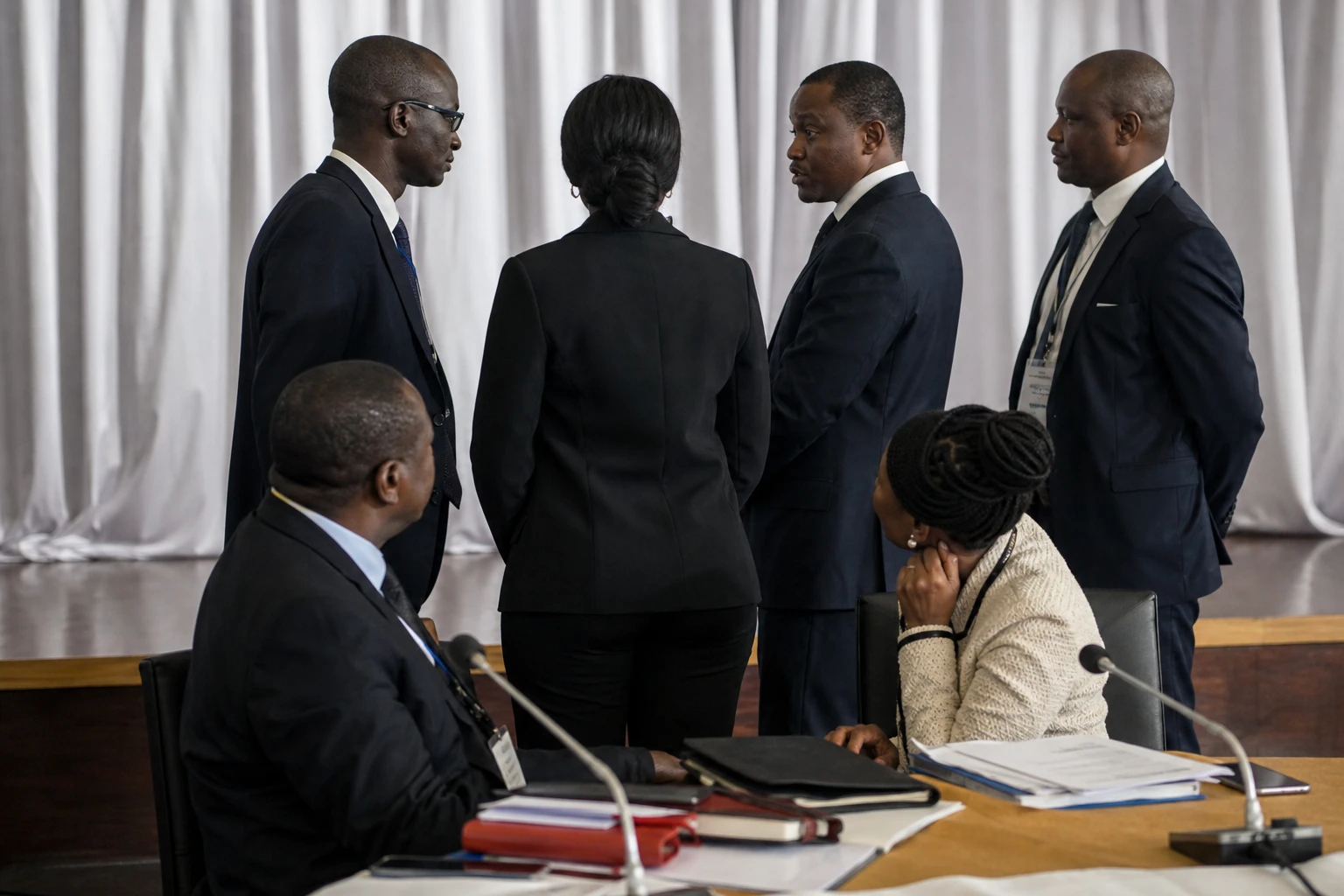
The venue is no coincidence. The Yaoundé Congress Centre regularly hosts high-level institutional events. This time, the ceremony marked the close of a programme linked to the Islamic Development Bank, and was attended by Economy Minister Alamine Ousmane Mey. The initial focus was the work of the journalists present. It was quickly overshadowed by suspicion over the theft of glasses, before escalating into a more serious procedure.
What the facts show: a brief investigation, a longer detention
According to reports in the local press, the journalists were initially suspected of involvement in the disappearance of the minister’s glasses. The following day, the glasses were found in Alamine Ousmane Mey’s private vehicle, ruling out the initial reason given. But the procedure did not stop there. Investigators then cited possible unauthorised entry into a closed-door meeting, before the four professionals were eventually released without charges.
This sequence matters. It reveals how fragile the safeguards surrounding the practice of journalism can be when access to an official venue, the movement of people and the handling of a material incident become entangled in the same police operation. It also says something else: in Cameroon, the line between covering a public event and being suspected of wrongdoing remains blurred in practice.
Economy Minister Alamine Ousmane Mey is one of the key figures in Cameroon’s economic coordination. His portfolio covers planning, regional development and the management of major projects. The fact that the incident took place in a ministerial and diplomatic setting therefore gives the case significance beyond that of a simple news story.
A local case, but a regional signal about the space available to journalists
Cameroon has one of the most extensive media landscapes in Central Africa. But the sector’s vitality coexists with a recurring climate of tension. RSF ranks the country 133rd in its 2026 World Press Freedom Index, in an African environment where political pressure, newsrooms’ economic difficulties and security restrictions weigh on many media outlets.
In this context, the glasses case served as a litmus test. It was a reminder that an arrest can stem from a trivial reason and then continue beyond the initial checks. It also showed how quickly a local incident can become a national issue when it touches on the freedom to report, the credibility of law enforcement and the way the authorities treat media professionals.
Institutionally, the debate goes beyond the judicial police. It also involves the responsibility of the administrative authorities, the public prosecutor’s office, the Ministry of Communication and, more broadly, the image the state wants to project of its relationship with the media. In a country where journalists cover governance, the economy and security every day, each arrest of this kind sets an example. Local newsrooms know that uncertainty can sometimes weigh as heavily as punishment.
For the journalists concerned, the consequences are tangible: days of freedom lost, work interrupted, reputations exposed, equipment and travel disrupted. For the authorities, the challenge is the opposite: to show that procedures are proportionate, checks are swift and the practice of journalism is not treated as an offence. In a capital such as Yaoundé, where ministries, embassies, international organisations and major economic events are concentrated, this kind of case blurs the clarity of the framework in which the press operates.
How this episode matters beyond Cameroon
The case spread well beyond Yaoundé. Media outlets in Gabon, Benin and Burkina Faso picked it up, often with a mixture of irony and concern. This regional coverage is not merely anecdotal. It shows that working conditions for journalists in Central and West Africa remain a cross-border issue, closely watched by neighbouring newsrooms and press freedom organisations.
For Cameroon, the stakes are broader still. The country is going through a political and institutional period in which economic issues, relations with lenders, consultations with the IMF and the management of public communications regularly converge in Yaoundé. In this context, a case pitting journalists against law enforcement over a material detail becomes a test of trust. It raises questions about the institutions’ ability to distinguish between control, security and respect for the work of the press.
Its continental significance is clear. Across Africa, press freedom is not tested only in major political crises. It is also tested in everyday situations: a public ceremony, journalistic coverage, an arrest deemed disproportionate, followed by a delayed release. These are often the episodes that reveal the real level of protection afforded to reporters. In Cameroon, the glasses case has above all served as a reminder of one simple thing: in public spaces, reporting should never become grounds for suspicion.



