Algeria
 Egypt
 Libya
 Morocco
 Sudan
 Benin
 Burkina Faso
 Cabo Verde
 Côte d'Ivoire
 Ghana
 Guinea
 Guinea-Bissau
 Liberia
 Mali
 Mauritania
 Niger
 Nigeria
 Senegal
 Sierra Leone
 The Gambia
 Togo
 Cameroon
 Central African Republic
 Chad
 DR Congo
 Equatorial Guinea
 Gabon
 Republic of the Congo
 São Tomé and Príncipe
 Burundi
 Comoros
 Djibouti
 Eritrea
 Ethiopia
 Kenya
 Madagascar
 Malawi
 Mauritius
 Mozambique
 Rwanda
 Seychelles
 Somalia
 South Sudan
 Tanzania
 Uganda
 Angola
 Botswana
 Eswatini
 Lesotho
 Namibia
 South Africa
 Zambia
 Zimbabwe
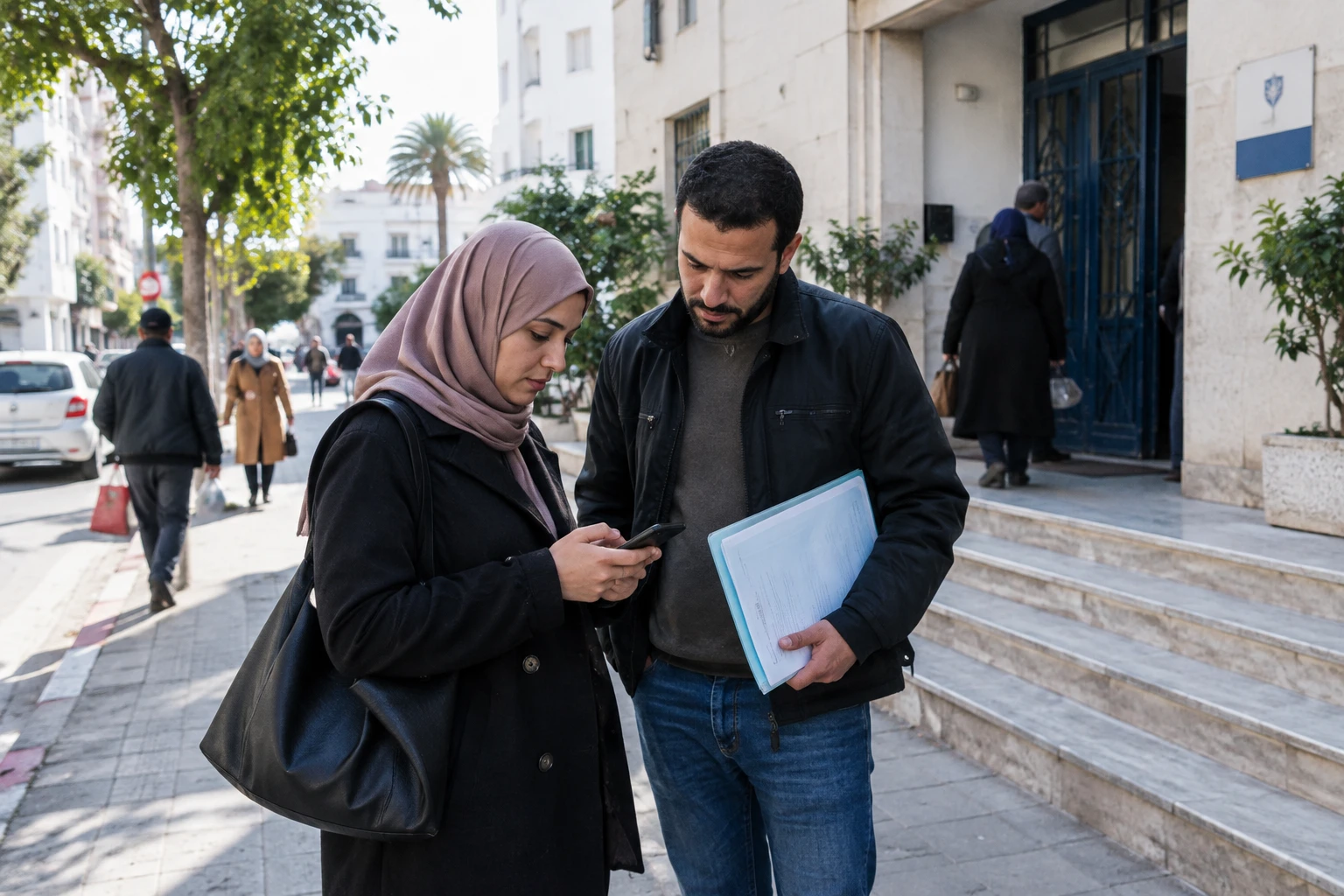
A certificate already held by the administration should no longer force a Tunisian to queue up to obtain it. That is the practical promise of digital exchange between public services. But interconnection will only be useful if it works everywhere, protects data and remains accessible to people who are less connected digitally.
An administrative project that goes beyond simply putting services online
In Tunis and across the regions, public procedures still rely on forms, supporting documents and databases that do not always communicate with one another. In 2023, the World Bank noted that many Tunisian procedures remained paper-based, with information fragmented across several systems. It also highlighted connectivity gaps, which are particularly detrimental to some regions and groups.
Digitisation means offering procedures in digital form. Interoperability goes further: it enables different computer systems to exchange information according to common rules. Users no longer have to carry data themselves when one public body can obtain it from another.
This reform builds on a process already under way. Tunisia has been digitising some services for several years, particularly in education and social protection. In 2023, the World Bank described initiatives linking the ministries of Social Affairs, Health and Technologies around a unique social identifier. These projects show that interconnection is not merely a theoretical prospect, even if its rollout remains gradual.
Platform announced, legal framework already in place
On 14 October 2026, the Presidency of the Government said work was continuing to establish a platform enabling participating public bodies to exchange data automatically and instantly. The stated aim is to reduce the number of documents requested from citizens and businesses, and to simplify their procedures.
The project is based on a legal framework adopted in 2020. Decree-Law No. 2020-31, dated 10 June, governs electronic exchanges between administrations and users, as well as between public bodies. Decree No. 2020-777 of 5 October that year sets out how it is to be implemented. The legislation stipulates, among other things, that administrations must not ask users for documents they already hold or can obtain through the platform.
The law also establishes safeguards: data exchanges must be logged, data protected and access controlled. The National Centre for Computing is designated as the operator responsible for the interoperability platform. A Tunisian portal dedicated to these exchanges already outlines the process for connecting IT services. The October announcement therefore concerns the continuation of the system’s development; it does not in itself mean that all public services are already connected.
In practice, an administration checking information could consult it directly with the relevant body, rather than asking the person concerned for a paper certificate. For a business, the same principle could limit repeated document requests across separate procedures. The benefit will nevertheless depend on which services are actually connected and which procedures are covered.
Time savings will depend on access and trust
For users, the first benefit is time: fewer journeys, photocopies and repeated requests. People living far from a service counter could gain particular advantages, if procedures can genuinely be completed remotely. Businesses, especially those dealing with several administrations, could also reduce processing times and costs.
But a digital procedure does not automatically become accessible. The quality of the connection, the availability of equipment and people’s familiarity with digital tools all affect their ability to use an online service. If physical counters close before support solutions are available, older people, people with disabilities and those with limited connectivity risk facing new obstacles. The aim must therefore be to make access simpler, not to shift the difficulty from a queue to a screen.
The circulation of data also raises questions of trust. Who accesses which information? For what procedure? How can incorrect data be corrected? The 2020 framework provides for exchanges to be logged and access to their history to be controlled. Implementation must make these safeguards clear and effective, while preventing errors, unauthorised access and service interruptions.
Finally, administrations will need to harmonise their practices and maintain reliable databases. A platform cannot, by itself, correct incomplete or contradictory information. Public-sector employees will need clear guidance, training and technical resources. Without these, digital systems risk reproducing existing delays in another form.
A national issue with a Maghreb dimension
For Tunisia, this reform concerns the day-to-day functioning of the state and the relationship between administrations, residents and economic stakeholders. It also matters beyond the capital: regional and local services will need the same tools and adequate connectivity to prevent the benefits from being concentrated in Tunis or major urban centres.
At regional level, Tunisia is a member of the Arab Maghreb Union (AMU), which also includes Algeria, Libya, Morocco and Mauritania. The announced interconnection applies first to Tunisian administrations; it is not a regional system. It nevertheless highlights how important more compatible public services and secure data management are as economic exchanges and cross-border procedures develop.
The next step to watch is concrete: which bodies will be connected, for which services and according to what timetable? Results will be measured by the number of supporting documents actually eliminated, processing times and users’ access in the regions. It is at this level that the promise of interconnection can be assessed.
For further information, see TAP’s update on the Tunisian platform, the Tunisian decree-law on electronic data exchange, the reference to implementing Decree No. 2020-777, the Tunisian interoperability portal and the World Bank’s analysis of digital public services in Tunisia.