Algeria
 Egypt
 Libya
 Morocco
 Sudan
 Tunisia
 Benin
 Burkina Faso
 Cabo Verde
 Côte d'Ivoire
 Ghana
 Guinea
 Guinea-Bissau
 Liberia
 Mali
 Mauritania
 Niger
 Nigeria
 Senegal
 Sierra Leone
 The Gambia
 Cameroon
 Central African Republic
 Chad
 DR Congo
 Equatorial Guinea
 Gabon
 Republic of the Congo
 São Tomé and Príncipe
 Burundi
 Comoros
 Djibouti
 Eritrea
 Ethiopia
 Kenya
 Madagascar
 Malawi
 Mauritius
 Mozambique
 Rwanda
 Seychelles
 Somalia
 South Sudan
 Tanzania
 Uganda
 Angola
 Botswana
 Eswatini
 Lesotho
 Namibia
 South Africa
 Zambia
 Zimbabwe
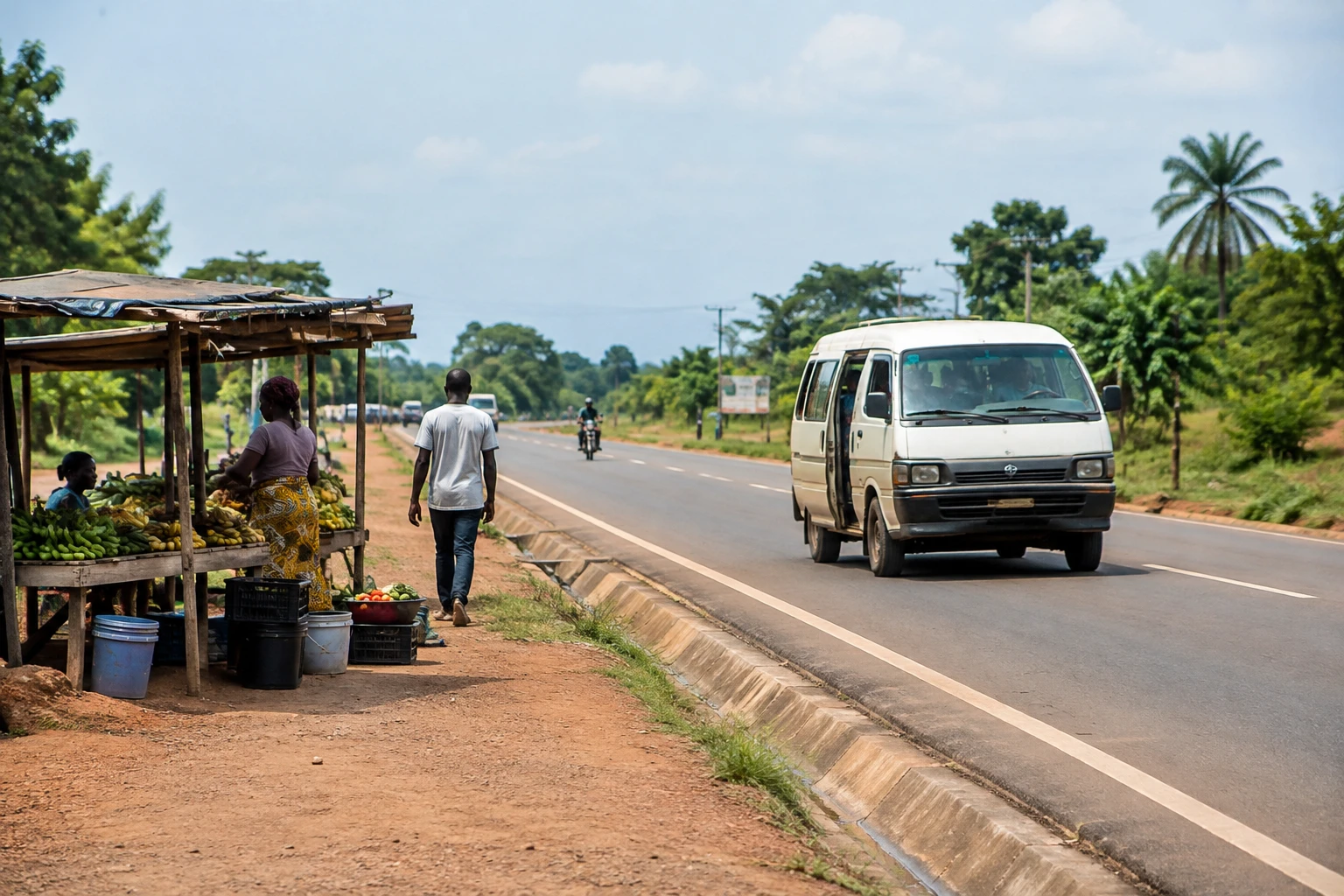
For a woman farmer in Blitta 2, a passable road can transform the journey to the market, school or health centre. In Togo, the reopening of a rural road highlights a practical issue: the kilometres built matter, but so do their maintenance and everyday usefulness.
32-kilometre link reopened in Blitta 2
On 21 October 2026, a ceremony marked the reopening of a 32-kilometre stretch in the commune of Blitta 2, in the Centrale region. The road connects several localities, including Atikpai, Foudjayé, Niamtougou Copé, Tcharébaou, Aféma and Sala Kopé. The works cost 980 million CFA francs, according to information published at the handover.
Authorities present the road as a way to ease travel between six villages, transport agricultural produce to markets, and make it easier to reach schools and health services. These expected benefits, however, depend on the road’s actual condition through the seasons and on regular maintenance.
The reopening comes as the first phase of the Rural Roads Support Programme (PAPR) is reported to have been completed. Figures released cite a target of 935 kilometres and a cost of 23.21 billion CFA francs. The second phase, meanwhile, provides for a further 846 kilometres, with a budget of 35.54 billion CFA francs announced.
Figures to track beyond the announcements
Available data do not always describe the same stage of progress. A Togolese media outlet reports that the first phase covers 935.35 kilometres and the second 846.2. But an official Togolese publication dated 24 October 2026 refers to more than 600 kilometres rehabilitated in the Centrale and Kara regions, with nearly 250 kilometres still under construction.
These figures may relate to different scopes or reporting dates. They nevertheless underscore the need to distinguish between kilometres planned, works completed and sections actually open to traffic. The documents consulted do not make it possible to fully reconcile these figures. It would therefore be premature to present the 935 kilometres as fully delivered without clarifying the counting method and the outstanding handovers.
The programme was launched in 2017. It targets, among other areas, cotton and coffee-cocoa production zones. Its funding combines contributions from the Togolese state, Germany’s development bank KfW and the French Development Agency (AFD). In 2022, Togo-Presse reported the signing of funding agreements for the second phase, including an AFD loan and a KfW grant. AFD says PAPR I and II form part of a long-term programme focused on rural mobility, access to markets and services.
Rural roads, a link in the local economy
For farmers, traders and transport operators, an improved link can cut detours and make journeys more predictable. It can also ease access to inputs and the sale of harvests. But the impact cannot be measured by kilometres alone: it depends on transport costs, the condition of drainage structures and municipalities’ ability to identify and address damage.
The effects are not uniform. Villages directly served by the road may become more accessible, while localities away from the route remain dependent on other tracks. Producers who sell regularly at markets may benefit from the link sooner than households far from commercial networks. And a rural road does not replace health services or schools: it makes them easier to reach, provided those services are available.
The challenge is also institutional. Works funded by external partners need to be accompanied by clear public monitoring of costs, contractors, schedules, handovers and maintenance budgets. Publishing comparable progress reports would enable residents to verify what has been delivered and public authorities to identify sections that are deteriorating.
A Togolese issue with regional implications
Togo is a corridor between the Gulf of Guinea and the landlocked countries of West Africa’s hinterland. Rural roads are not international transit routes, but they connect production areas to main roads and markets. Their quality can therefore help goods move around the country and, indirectly, support regional trade.
ECOWAS, the Economic Community of West African States, has an objective of integrating markets and transport systems. At national level, however, the immediate challenge is closer to home: ensuring that rural communes have passable connections and that investment benefits areas beyond the stretches officially opened.
The next step to watch will be the actual delivery of the 846 kilometres announced for the second phase, as well as the publication of data that make it possible to compare targets, completed works and maintenance. In Blitta 2, the reopening of the road is a tangible result. Its value will be measured over time, in daily life, for the residents and activities it is meant to connect.
For financial context, see the AFD rural roads programme fact sheet and Togo-Presse’s account of second-phase funding.