Algeria
 Egypt
 Libya
 Morocco
 Sudan
 Tunisia
 Benin
 Burkina Faso
 Cabo Verde
 Côte d'Ivoire
 Ghana
 Guinea
 Guinea-Bissau
 Liberia
 Mali
 Mauritania
 Niger
 Nigeria
 Senegal
 Sierra Leone
 The Gambia
 Togo
 Cameroon
 Central African Republic
 Chad
 DR Congo
 Equatorial Guinea
 Gabon
 Republic of the Congo
 São Tomé and Príncipe
 Burundi
 Comoros
 Djibouti
 Eritrea
 Kenya
 Madagascar
 Malawi
 Mauritius
 Mozambique
 Rwanda
 Seychelles
 Somalia
 South Sudan
 Tanzania
 Uganda
 Angola
 Botswana
 Eswatini
 Lesotho
 Namibia
 South Africa
 Zambia
 Zimbabwe
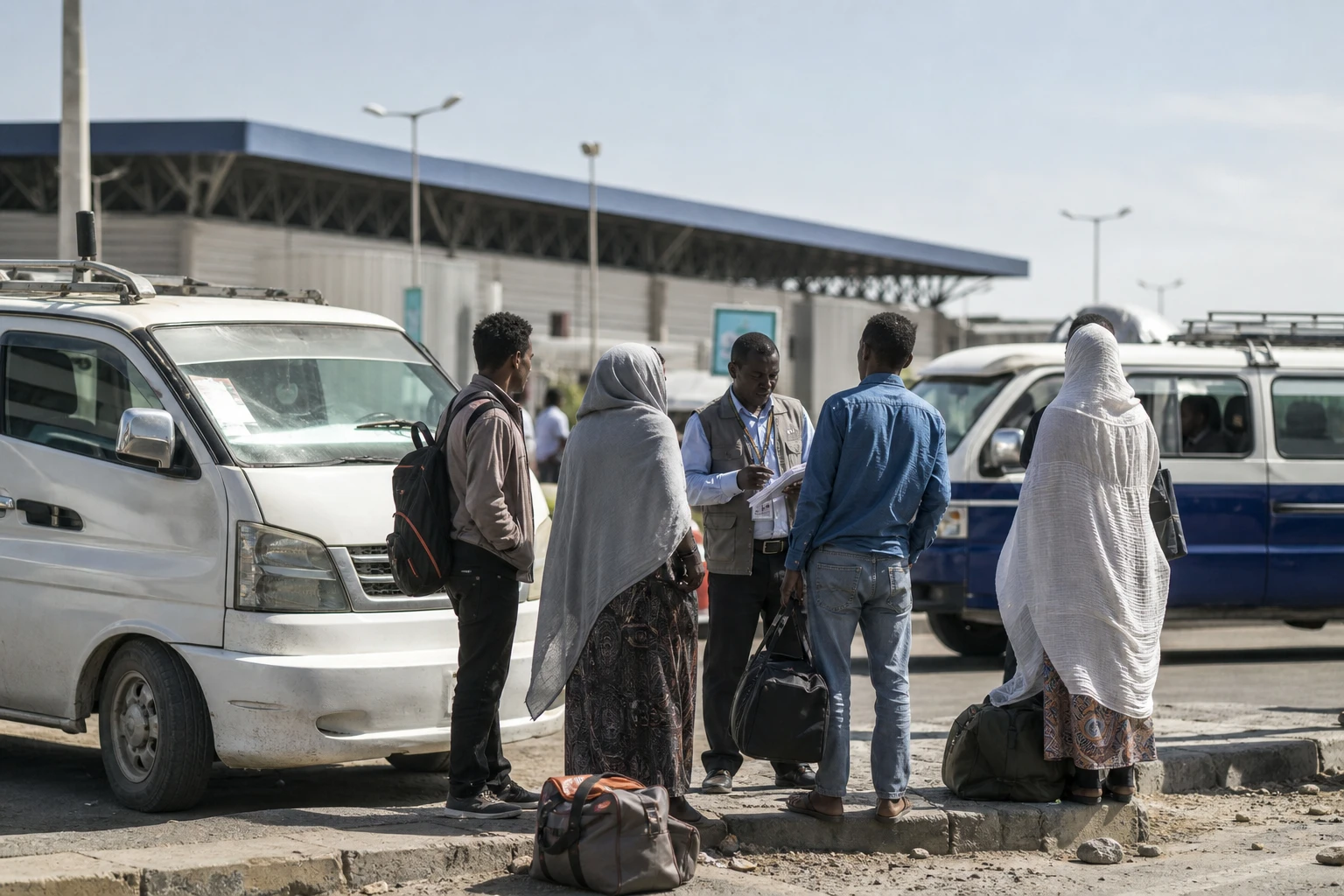
In Mekelle, a civilian facility has become the main indicator of a military shift that is still difficult to assess. Ethiopian federal forces reportedly retook Alula Aba Nega airport, while control of the Tigray capital remains uncertain.
Airport at centre of a new crisis
Residents of Mekelle said on Saturday 3 October 2026 that the Ethiopian federal army had regained control of Alula Aba Nega airport. An Ethiopian general, quoted anonymously, said the facility was « totally » under military control. The statement has not, however, been publicly confirmed by the federal government.
The reported recapture comes days after fighters linked to the Tigray People’s Liberation Front, the TPLF, took the airport. The political and military movement governs the Tigray region and opposed the federal government during the 2020–2022 war.
On 23 September, Tigrayan forces had also occupied the airports in Axum and Shire, according to the African Union Commission. Ethiopian Airlines had then suspended commercial flights to Mekelle, Axum and Shire.
The national carrier did not present the suspension as a political decision. It attributed it to the security situation. But in a region where roads remain precarious and communications can be cut, the halt to flights quickly reduces access to healthcare, administrative services and commercial networks.
Control of Mekelle remains unclear
The situation in the regional capital remains confused. Available information is based mainly on local accounts and anonymous security sources. Disruptions to telephone and internet networks are making independent verification difficult.
It has not been established whether the airport changed hands following direct fighting. Nor is it possible at this stage to confirm the extent of federal control over Mekelle’s neighbourhoods. Taking an airfield does not necessarily mean securing lasting control of the city.
Sources cited by several news agencies say federal units and Tigrayan forces favourable to the government have advanced towards the regional capital. This adds a particular dimension to the confrontation: not all forces fighting the TPLF are said to come from the national army.
The government of Prime Minister Abiy Ahmed has yet to issue a detailed statement on the airport’s recapture. The TPLF, for its part, had not publicly acknowledged losing the facility in information available on Saturday 3 October.
Tensions return after Pretoria agreement
The escalation is testing the peace agreement signed in Pretoria, South Africa, on 2 November 2022. The agreement ended two years of war between federal forces, their allies and Tigrayan forces.
The agreement provided for a permanent cessation of hostilities and a disarmament process. It also paved the way for the gradual return of public services and air links in Tigray. The resumption of flights to Mekelle had been a tangible sign of normalisation after a long period of isolation.
The African Union Commission still regards the Pretoria agreement as the central framework for resolving the crisis. Its chairperson, Mahmoud Ali Youssouf, called on 23 September for restraint, an end to actions that could worsen the situation, and the swift resumption of direct dialogue.
The African Union is particularly concerned about a regional chain reaction. Fighting reported in southern Tigray and the Afar region is bringing tensions closer to strategic corridors linking northern Ethiopia to Djibouti and the Red Sea. These routes carry goods, humanitarian aid and imported products.
Civilians face renewed isolation
For Mekelle’s residents, the stakes go beyond control of a runway. The airport connects the Tigray capital to Addis Ababa and the rest of the country. Its closure limits travel options for patients, students, traders and families separated by the conflict.
The consequences are not the same for everyone. Government departments and formal businesses can sometimes arrange road routes or use private transport. Low-income households, small traders and rural communities depend more heavily on public transport and regional markets.
Humanitarian organisations also face logistical constraints. Any restrictions on roads or flights slow the delivery of medicines, medical equipment and essential goods. In Tigray, this vulnerability is compounded by destruction inherited from the previous war and the slow pace of reconstruction.
However, the available information does not make it possible to establish a new casualty toll. No reliable figure for possible casualties during the airport’s recapture has been confirmed by two independent sources. Any estimate should therefore be treated with caution.
A test for Ethiopia and the Horn of Africa
The Tigray crisis is unfolding in a country already facing other centres of violence, particularly in Oromia and Amhara. For Addis Ababa, a lasting loss of control over Mekelle would represent a major political and military challenge. For the Tigrayan authorities, the ability to hold regional infrastructure remains a means of applying pressure in their dealings with the federal government.
The developments also concern the Intergovernmental Authority on Development, IGAD, the regional organisation for the Horn of Africa. A new war in Ethiopia could affect trade with Djibouti, relations with Eritrea and border security with Sudan.
The next indicators are clear: official confirmation of control of the airport, whether Ethiopian Airlines flights resume, the situation in Mekelle’s neighbourhoods and whether discussions under the Pretoria agreement are reopened.
For now, caution is warranted. The reported recapture of Alula Aba Nega airport is an important military signal, but it is not enough to establish who will retain control of Mekelle or whether Tigray is sliding into a new open war.