Algeria
 Egypt
 Libya
 Morocco
 Sudan
 Tunisia
 Benin
 Burkina Faso
 Cabo Verde
 Côte d'Ivoire
 Ghana
 Guinea
 Guinea-Bissau
 Liberia
 Mali
 Mauritania
 Niger
 Nigeria
 Senegal
 Sierra Leone
 The Gambia
 Togo
 Cameroon
 Central African Republic
 Chad
 DR Congo
 Equatorial Guinea
 Gabon
 Republic of the Congo
 São Tomé and Príncipe
 Burundi
 Comoros
 Djibouti
 Eritrea
 Ethiopia
 Kenya
 Madagascar
 Malawi
 Mauritius
 Mozambique
 Rwanda
 Seychelles
 Somalia
 South Sudan
 Uganda
 Angola
 Botswana
 Eswatini
 Lesotho
 Namibia
 South Africa
 Zambia
 Zimbabwe
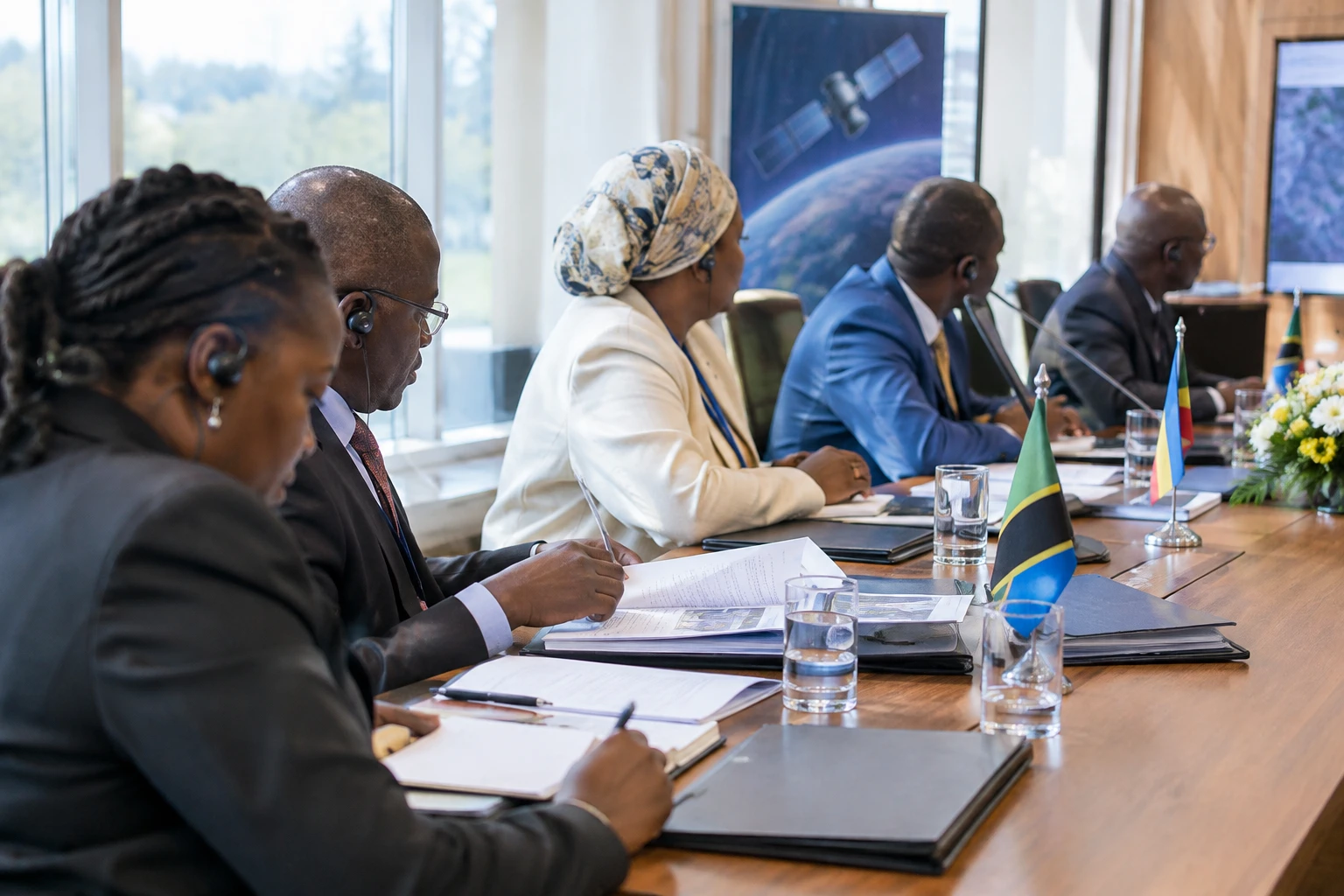
A satellite can help forecast drought, monitor crops or detect floods. But for Tanzania, the challenge goes beyond putting a spacecraft into orbit: it also means building institutions, expertise and local capacity to turn data into useful decisions.
The country is already making progress on several fronts. Its growing ties with Moscow open up a new avenue for cooperation, while Tanzanian universities are taking part in satellite projects with international partners. The challenge will be to connect these initiatives to the practical needs of the country, its public authorities and its people.
A partnership announced, details still awaited
On 28 October 2026, on the sidelines of the Russia-Africa summit in Moscow, Roscosmos, Russia’s space agency, and Tanzania’s Ministry of Information, Communication and Information Technology signed a framework memorandum on space cooperation. Roscosmos director general Dmitry Bakanov said Russia was ready to provide technical and methodological support for the creation of a Tanzanian national space agency.
According to announcements reported by Space in Africa and Ugandan outlet ChimpReports, Roscosmos is targeting the launch of a Tanzanian Earth-observation satellite in March 2027. The partners are also considering ground stations to receive data, joint working groups and specialist training. The date and broad outlines have been reported by several media outlets, but details of the spacecraft, its manufacturer, the programme’s cost and the detailed timetable have not been made public.
This caveat matters. A memorandum sets a framework for cooperation; it does not necessarily specify funding, the division of tasks or guarantees for the transfer of expertise. These factors will determine Tanzania’s ability to make lasting use of the tools and infrastructure announced.
A national strategy already taking shape
The agreement with Moscow forms part of a trajectory set in motion before the summit. In February 2026, the government presented a five-year plan for space programmes covering 2025-2030. Entitled “From Mount Kilimanjaro, the Peak of Africa, to Space”, it aims to structure governance, research, skills and the sector’s economic applications, according to Tanzanian daily Daily News.
The ministry is also preparing a national space policy and legislation to regulate these activities. A dedicated agency could coordinate projects, but its creation remains to be carried out. Tanzania had already raised the prospect of such an institution in earlier plans; the deadline set for the 2024-2025 financial year was not met, Space in Africa reports.
Meanwhile, Tanzanian higher education institutions are developing their expertise. The Dar es Salaam Institute of Technology and Côte d’Ivoire’s Institut national polytechnique Félix Houphouët-Boigny won a 2024 selection under the KiboCUBE programme, run by the United Nations Office for Outer Space Affairs and Japan’s JAXA. Their nanosatellite, TanSat-1, is part of a university project distinct from the remote-sensing satellite discussed with Russia, according to the UN Office for Outer Space Affairs’ annual report.
Applications that affect communities
Satellite imagery and measurements can be used to monitor changes in crops, water resources, forests, mines and areas exposed to climate hazards. Their usefulness, however, depends on access to data, its quality and the ability of public authorities and researchers to interpret it. Farmers, particularly in rural areas, will not benefit automatically from a satellite: observations will need to be translated into accessible services, alerts and advice.
The government is incorporating space into an economic resilience strategy. The World Bank estimates that, without adaptation measures, the effects of climate change could reduce Tanzania’s economic growth by 4% by 2050. This is a projection, not a foregone outcome. Better-suited data could contribute to planning, but it cannot replace infrastructure, meteorological services, or agricultural and prevention policies.
Another programme illustrates these applications: the SAT-CARE project, supported by the International Fund for Agricultural Development, provides $2.268 million to develop digital tools based on satellite data for resilient agriculture. IFAD documentation indicates an expected benefit for 5,000 smallholder farmers. The project shows that access to technology and its local application matter as much as launching a spacecraft.
Cooperation to be judged over time
For Dodoma, the country’s political capital, cooperation with Russia could speed up access to equipment, launches and training. But the partnership’s value will also depend on the role given to Tanzanian engineers, universities and businesses: who will control the data, who will maintain the equipment and what expertise will remain in the country after the initial stages? With financial and industrial arrangements unspecified, these questions remain open.
The regional dimension also matters. Tanzania is a member of the East African Community (EAC), which brings together eight countries and is headquartered in Arusha. Compatible, shared satellite data could be of interest to neighbouring countries for monitoring watersheds, crops or cross-border weather events. This requires common rules on formats, access and data protection, as well as cooperation between regional institutions.
Across Africa, the project adds to the efforts of several states to develop satellites, train specialists and reduce their dependence on foreign services. The next concrete milestone will be the launch announced for March 2027. By then, the establishment of a legal framework, details of the satellite and commitments to transfer expertise will help determine whether the agreement becomes an operational programme — and whether its benefits reach beyond institutions to the sectors that need them.