Algeria
 Egypt
 Libya
 Morocco
 Sudan
 Tunisia
 Benin
 Burkina Faso
 Cabo Verde
 Ghana
 Guinea
 Guinea-Bissau
 Liberia
 Mali
 Mauritania
 Niger
 Nigeria
 Senegal
 Sierra Leone
 The Gambia
 Togo
 Cameroon
 Central African Republic
 Chad
 DR Congo
 Equatorial Guinea
 Gabon
 Republic of the Congo
 São Tomé and Príncipe
 Burundi
 Comoros
 Djibouti
 Eritrea
 Ethiopia
 Kenya
 Madagascar
 Malawi
 Mauritius
 Mozambique
 Rwanda
 Seychelles
 Somalia
 South Sudan
 Tanzania
 Uganda
 Angola
 Botswana
 Eswatini
 Lesotho
 Namibia
 South Africa
 Zambia
 Zimbabwe
Compensation that goes beyond simply paying out money
In Tanda, in eastern Côte d’Ivoire, the issue is about more than a cheque. It concerns how a major mining project enters a region, compensates for losses and leaves a lasting mark on local economies. In Côte d’Ivoire, where Yamoussoukro is the capital but Abidjan is the centre of finance and much of the services sector, the question of mining compensation is also a question of trust.
The Assafo-Dibibango project is already well advanced. Endeavour Mining obtained environmental authorisation for the project in 2025, then presented the results of a definitive feasibility study for Assafou, on the Tanda-Iguela property, in April 2026. The company describes it as a project set to become one of its major assets in Côte d’Ivoire.
What the agreement signed in Abidjan provides for
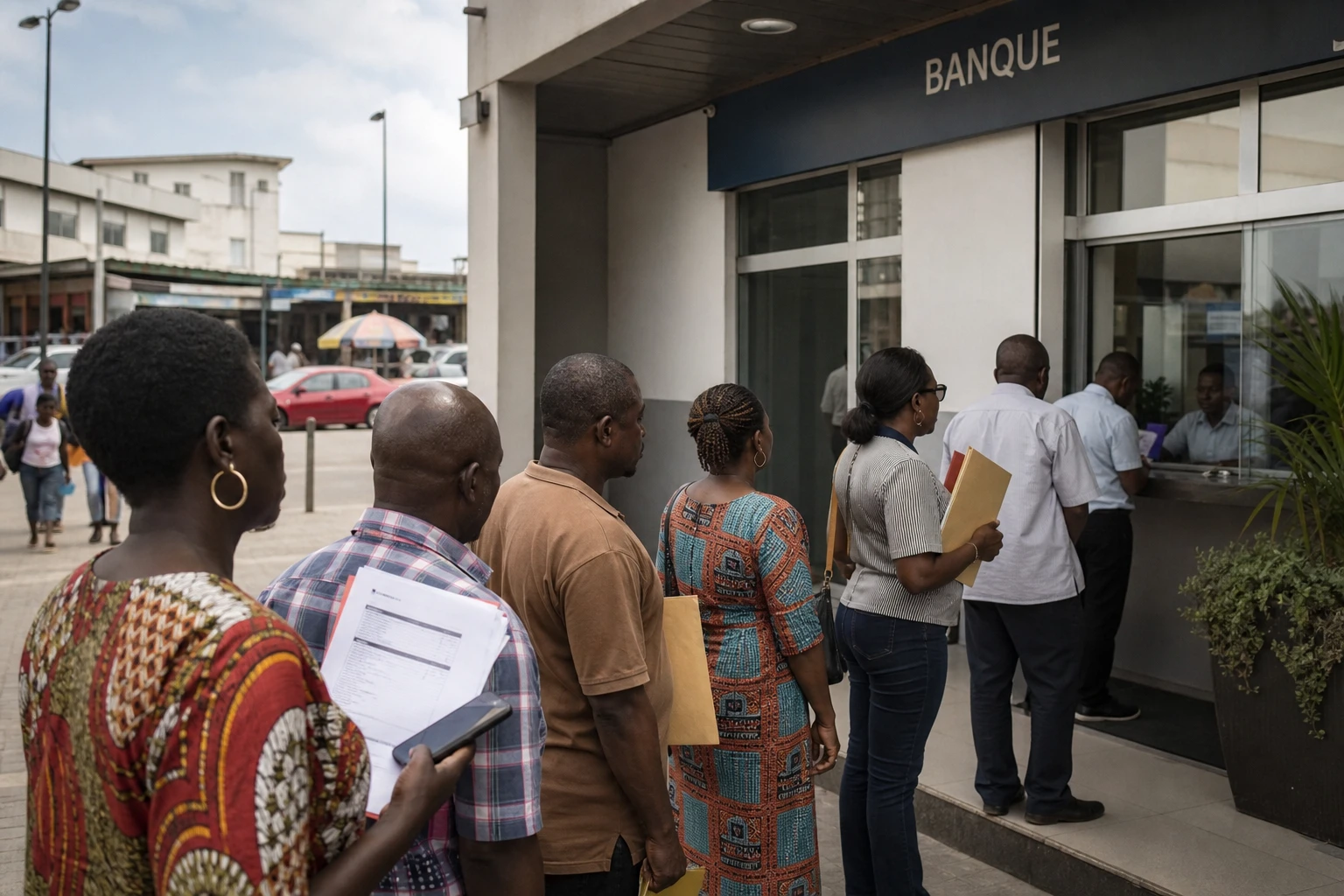
On 26 August 2026, AFG Bank Côte d’Ivoire and the Société des Mines d’Assafo-Dibibango, Endeavour Mining’s local subsidiary, signed an agreement in Abidjan to organise the banking process for paying compensation owed to populations affected by the project. The scheme covers more than 1 150 beneficiaries and involves a sum of more than CFAF 28 billion.
According to information published about the project, the bank is to open dedicated accounts, secure the flow of funds and track payments. This structure aims to reduce the risks associated with cash payments, while making funds more accessible to households often far from conventional banking services. AFG Bank says it wants to help bring a population that remains partly excluded from the financial system into the banking sector.
Endeavour presents the partnership as a way to better support communities in Tanda with a national banking partner that has a significant territorial network. AFG Bank Côte d’Ivoire highlights its 88 points of presence and digitalisation strategy, inherited from its absorption of the former Banque Populaire de Côte d’Ivoire’s operations.
Why banking changes the nature of compensation
The choice of bank payments is not a technical detail. It turns compensation into a structured financial operation. For beneficiaries, this can make payments easier to trace, limit distribution errors and provide initial access to banking services. For companies, it strengthens compliance and their social responsibility credentials. For the state, it makes it possible to better monitor a flow that exceeds CFAF 28 billion in this case.
But the issue remains sensitive. In mining areas, expectations concern the speed of payments, the clarity of eligibility criteria and the inclusion of displaced people, farmers and informal businesses. The resettlement and compensation plan mentioned by SMAD is specifically intended to address these vulnerabilities. As long as details of individual amounts and the timetable are not made public, genuine transparency will depend on the quality of implementation on the ground.
The territory of Tanda, in the Gontougo region, is thus at the intersection of several forces. There is the industrial logic, with a gold project presented as one of the country’s most ambitious. There is the local perspective, involving villages, land and potentially affected agricultural incomes. And there is the institutional dimension, as the environmental impact assessment was approved by the Ministry of the Environment, under the supervision of the National Environment Agency, placing the project within Côte d’Ivoire’s regulatory framework.
A signal for Côte d’Ivoire’s gold sector and the region
In Côte d’Ivoire, gold has become a major indicator of economic diversification. The expansion of Assafo-Dibibango shows that the country is seeking to combine extraction, environmental compliance and local financial inclusion. The message extends beyond Tanda: major mining projects are now judged as much on their ability to compensate, document and redistribute as on their ability to produce.
The significance is also regional. Endeavour Mining is already active in Senegal, Burkina Faso and Côte d’Ivoire, three West African countries linked by mining supply chains, labour mobility and debates over the local value generated by extractive resources. In this region, compensation and banking schemes are becoming comparable benchmarks, particularly as people seek greater clarity about where revenues from the subsoil go.
What happens next will depend on implementation. The disbursement timetable, the quality of banking support, the handling of disputed cases and the ability to maintain dialogue with communities will show whether this partnership is merely a payment mechanism or a more robust model of local governance. In Côte d’Ivoire and across West Africa, this is often where the credibility of major mining projects is decided.