Algeria
 Egypt
 Libya
 Morocco
 Tunisia
 Benin
 Burkina Faso
 Cabo Verde
 Côte d'Ivoire
 Ghana
 Guinea
 Guinea-Bissau
 Liberia
 Mali
 Mauritania
 Niger
 Nigeria
 Senegal
 Sierra Leone
 The Gambia
 Togo
 Cameroon
 Central African Republic
 Chad
 DR Congo
 Equatorial Guinea
 Gabon
 Republic of the Congo
 São Tomé and Príncipe
 Burundi
 Comoros
 Djibouti
 Eritrea
 Ethiopia
 Kenya
 Madagascar
 Malawi
 Mauritius
 Mozambique
 Rwanda
 Seychelles
 Somalia
 South Sudan
 Tanzania
 Uganda
 Angola
 Botswana
 Eswatini
 Lesotho
 Namibia
 South Africa
 Zambia
 Zimbabwe
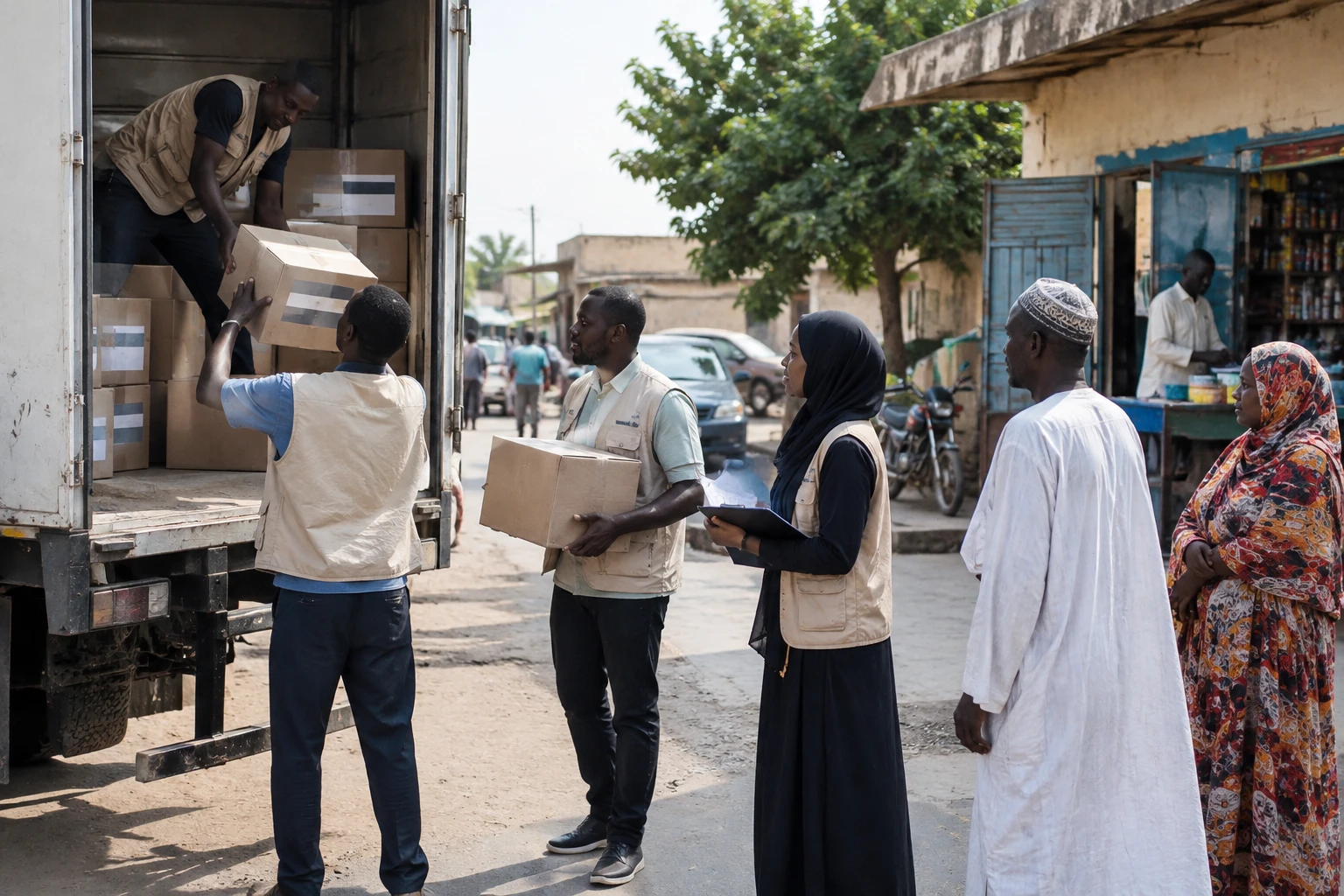
An aid truck that fails to reach Kadugli means food supplies missing from families already cut off from trade routes. In South Kordofan, convoy security now determines access to assistance as much as the availability of stocks.
A vital route under strain
Since April 2023, war has pitted the Sudanese army against the Rapid Support Forces (RSF), a paramilitary force. Fighting and movement restrictions have fragmented the country and complicated the delivery of food and medicine. Sudan is a member of IGAD, the Intergovernmental Authority on Development, a regional organisation in the Horn of Africa involved in mediation efforts.
In South Kordofan, Kadugli and Dilling are particularly difficult to supply. Routes linking these towns to major supply centres are exposed to fighting, checkpoints and shifts in control. An analysis by the IPC Famine Review Committee describes contested roads and convoys obstructed by insecurity. The IPC is the international mechanism that classifies the severity of food insecurity.
Deliveries remain possible, but are irregular. In October 2025, the World Food Programme (WFP), the United Nations High Commissioner for Refugees and UNICEF delivered aid to Dilling and Kadugli after months of limited access. The agencies then stressed the need for passage guarantees and lasting corridors, rather than one-off convoys.
Two trucks hit, one driver killed
On 3 October 2026, an air strike hit two trucks chartered by the WFP on the road between Dilling and Kadugli. The vehicles were carrying food supplies and displayed visible humanitarian markings. One driver was killed, according to the WFP, which said the precise circumstances and the extent of damage to the cargo remained to be established.
The agency called for a swift and impartial investigation and for those responsible to be held accountable. The previous day, on 2 October, another WFP truck hit an explosive device in Dilling after a delivery. France’s foreign ministry confirmed the dates and the death, and condemned the attack. At this stage, the public information consulted does not make it possible to attribute the 3 October strike to a particular side.
The WFP says humanitarian personnel, civilian property and aid convoys must be protected under international humanitarian law, the rules applicable to armed conflicts. The organisation says it intends to continue operations in Sudan, while calling on the parties to ensure safe and unhindered passage.
The human cost extends beyond international staff
The attack is part of a wider trend. According to the Aid Worker Security Database, which records violent incidents targeting aid workers, at least 350 humanitarian workers were killed worldwide in 2025. The figure is cited by the International Rescue Committee. The organisation notes that almost all the victims were employees recruited in their own countries.
This reality matters in Sudan: local teams, drivers and Sudanese partners carry out an essential share of operations on the ground. They know the communities and routes, but remain exposed to the dangers of their everyday environment. When roads become impassable or too dangerous, the consequences extend beyond organisations: residents lose access to distributions, markets and sometimes healthcare.
The effects vary according to location and livelihoods. In isolated towns such as Kadugli, a drop in deliveries can make food scarcer and push up prices. Households that depend on markets or informal incomes often have fewer reserves than those able to stockpile or bring in goods by other routes. Rural areas, also affected by insecurity, are difficult to reach and document.
Protection must be put into practice on the ground
In Paris, the National Humanitarian Conference on 6 October 2026 put the protection of aid teams at the centre of discussions. The meeting, organised by the French authorities with humanitarian organisations, took place three days after the strike in South Kordofan. France’s foreign minister, Jean-Noël Barrot, spoke in particular about the risks posed by drones and the need to strengthen accountability for those responsible for attacks.
For Sudanese people, the immediate stakes are tangible: a convoy can represent several weeks’ worth of supplies, but it cannot replace regular access. In October 2025, UN agencies had already said that a single operation would not be enough to meet needs in Dilling and Kadugli. The recurrence of incidents therefore makes it harder to plan stocks, routes and distributions.
At the regional level, insecurity on Kordofan’s routes also affects trade and movement between Sudan and its neighbours, particularly South Sudan. For IGAD and the African Union, protecting convoys is therefore linked to humanitarian access and de-escalation of the conflict. The next decisive developments will be the outcome of the investigation requested by the WFP and the parties’ ability to guarantee repeated, safe and predictable passage to isolated localities.
Information on the strike and the victim was confirmed by the World Food Programme and France’s foreign ministry. The access context in Kordofan is documented by the IPC Famine Review Committee and the WFP. The global toll of aid workers killed is reported by the International Rescue Committee. The conference date is confirmed by France Diplomatie.