Algeria
 Egypt
 Libya
 Morocco
 Tunisia
 Benin
 Burkina Faso
 Cabo Verde
 Côte d'Ivoire
 Ghana
 Guinea
 Guinea-Bissau
 Liberia
 Mali
 Mauritania
 Niger
 Nigeria
 Senegal
 Sierra Leone
 The Gambia
 Togo
 Cameroon
 Central African Republic
 Chad
 DR Congo
 Equatorial Guinea
 Gabon
 Republic of the Congo
 São Tomé and Príncipe
 Burundi
 Comoros
 Djibouti
 Eritrea
 Ethiopia
 Kenya
 Madagascar
 Malawi
 Mauritius
 Mozambique
 Rwanda
 Seychelles
 Somalia
 South Sudan
 Tanzania
 Uganda
 Angola
 Botswana
 Eswatini
 Lesotho
 Namibia
 South Africa
 Zambia
 Zimbabwe
A front fraying in Kordofan
In Sudan, every shift of allegiance among armed ranks says something broader than a simple change of sides. It tells of a conflict wearing down men, alliances and territory. In North Kordofan, this attrition is now visible as much on the front line as in defections.
The region has become a strategic hub. It connects Khartoum, Omdurman and the centre of the country to routes leading towards Darfur. The fighting there therefore affects military routes, as well as commercial and humanitarian networks. The UN has already reported mass displacement in the Kordofans, while the African Union says it is following with concern the deterioration in security around El-Obeid, the capital of North Kordofan.
RSF fighters defect to the army
On Sunday 2 August, a group of 45 Rapid Support Forces (RSF) fighters arrived in Omdurman, the twin city of Khartoum, where they were received by units of the Sudanese army. The men arrived with heavy weapons, military vehicles and ammunition, according to information corroborated by local and international media. The three commanders leading the group are reportedly from Bara, in North Kordofan, a town whose control remains contested.
The reasons cited by the defectors point to two familiar realities of this war: internal tensions and the question of pay. They cited tribal discrimination and unpaid wages. At the same time, several sources describe mounting military pressure on the RSF in North Kordofan, following recent gains by the army and its allies along the Bara–Um Sayala–Jabra al-Sheikh axis.
This defection is not an isolated case. In May, other commanders, including Ali Rizqallah, known as “Al-Savana”, and Al-Nour al-Qubba, had already left the RSF to join the army. Human Rights Watch, for its part, noted that the departure of these paramilitary movement figures does not erase their responsibility for serious alleged abuses. The latest defection chiefly shows that part of the RSF chain of command is weakening under pressure on the ground.
Military pressure, tribal divisions and a war of attrition
On the ground, the Sudanese army is seeking to turn these defections into a tactical advantage. Its message is clear: the more men and commanders the RSF lose, the more their ability to hold Kordofan erodes. Observers also point to a longer war, in which gains are measured not only in towns retaken, but in loyalty networks broken, supply lines cut and morale weakened.
North Kordofan is where this dynamic is most evident. The area protects access to El-Obeid, a vital crossroads between northern, central and western Sudan. When the army advances along this axis, it secures roads, restores flows and reduces the adversary’s room for manoeuvre. Conversely, when the RSF attack there, they threaten civilians, markets, transport and humanitarian aid. The IRC warned in July that an offensive on El-Obeid would expose hundreds of thousands of people to a humanitarian catastrophe.
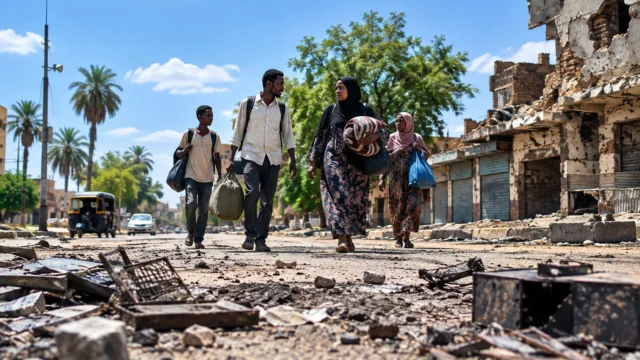
This war of attrition is already taking a toll on the population. In Kordofan, the UN reported tens of thousands of new displacements at the start of the year, followed by worsening food insecurity. Across the country, UN agencies now say about 13 million people have been forced to flee their homes since the conflict began, in what remains one of the world’s largest crises.
Another warning from North Darfur
At the same time, a drone strike targeted North Darfur on Sunday 2 August. The Emergency Lawyers group said at least 35 people had been killed and attributed the attack to the regular army. The Associated Press reported the same toll and attribution, while noting that the figure was given by a human rights organisation, in a context of fighting where independent verification remains difficult.
This coincidence matters. It shows that the war in Sudan is no longer confined to a single front line. It combines defections, drones, local sieges, forced displacement and fragmented command structures. Khartoum, Omdurman, El-Obeid and the cities of Darfur are now part of the same theatre of war, where each local victory can prompt a response elsewhere.
At the regional level, the stakes extend beyond Sudan itself. The African Union, IGAD and the so-called Quintet mechanism are calling for an inclusive political process, but military realities continue to set the pace. As long as front lines shift faster than negotiations, every new defection will be read as an indication of weakness, but also as a political signal. Sudan is thus entering a phase in which the outcome will be decided as much in military headquarters as in the towns of the interior.