
 Algeria
 Egypt
 Libya
 Morocco
 Sudan
 Tunisia
 Benin
 Burkina Faso
 Cabo Verde
 Côte d'Ivoire
 Ghana
 Guinea
 Guinea-Bissau
 Liberia
 Mali
 Mauritania
 Niger
 Nigeria
 Senegal
 Sierra Leone
 The Gambia
 Togo
 Cameroon
 Central African Republic
 Chad
 DR Congo
 Equatorial Guinea
 Gabon
 Republic of the Congo
 São Tomé and Príncipe
 Burundi
 Comoros
 Djibouti
 Eritrea
 Kenya
 Madagascar
 Malawi
 Mauritius
 Mozambique
 Rwanda
 Seychelles
 Somalia
 South Sudan
 Tanzania
 Uganda
 Angola
 Botswana
 Eswatini
 Lesotho
 Namibia
 South Africa
 Zambia
 Zimbabwe
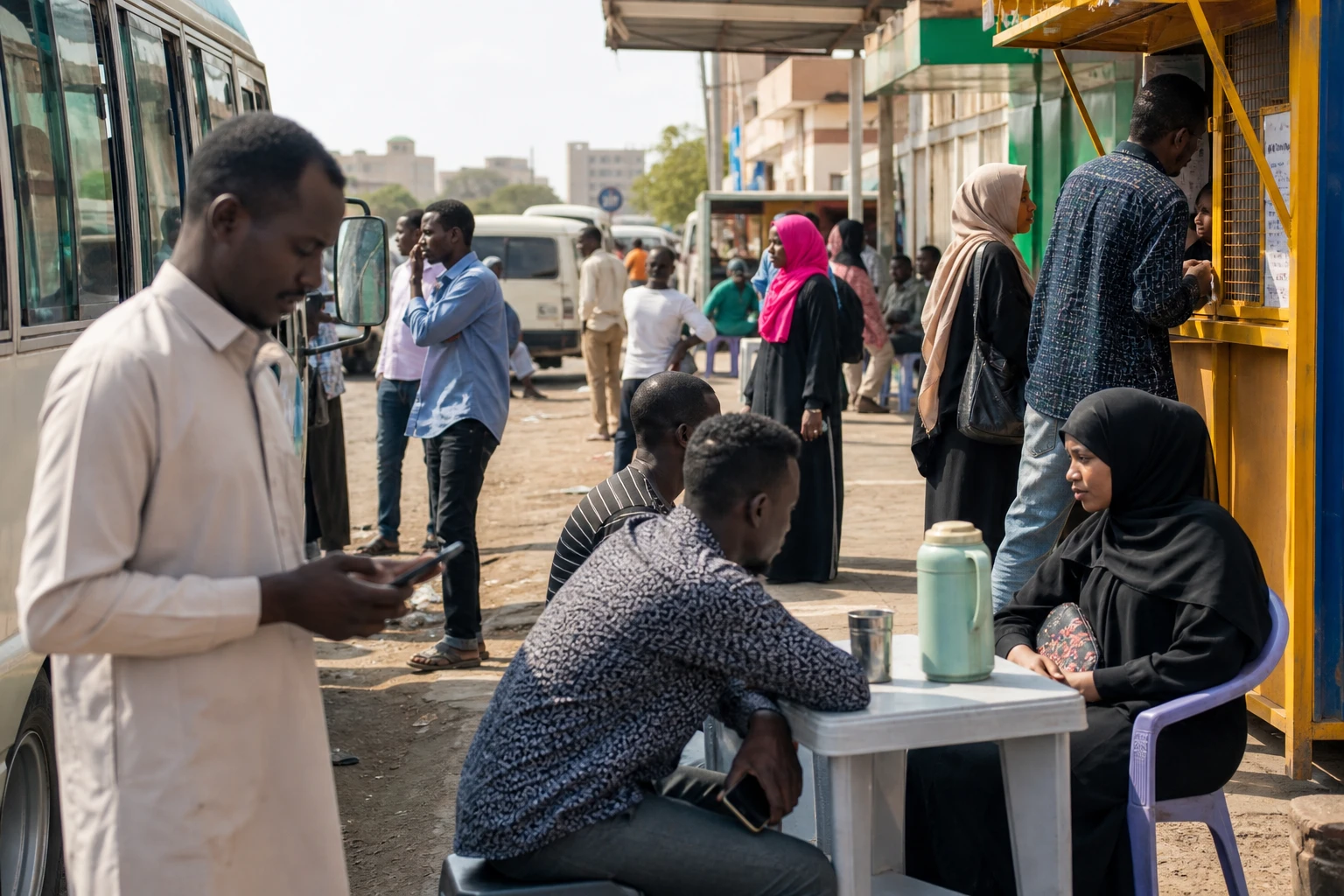
A shifting front around Khartoum
In Sudan, the war can no longer be reduced to a front line. It shifts, strikes in bursts, then returns from the air. When drones hit the capital and fighting intensifies in Blue Nile, the message is clear: no area is entirely safe, not even places the belligerents believe they have secured.
This dynamic affects Sudanese people far beyond the cities directly targeted. It disrupts trade routes, blocks population movements and further weakens communities already exposed since the war began between the Sudanese Armed Forces and the Rapid Support Forces (RSF), a powerful paramilitary group descended from former counter-insurgency militias. In Khartoum, the battle is also symbolic: whoever controls the capital controls, or claims to control, the legitimacy of the state.
Blue Nile again becomes a military hub
In the country’s south-east, Blue Nile State has once again become a major flashpoint. The area matters because it lies on the border with Ethiopia and close to supply routes linking south-eastern Sudan with the rest of the country. The towns of Geissan and Kurmuk, in particular, are military gateways. They provide a means to threaten roads, open logistical corridors and exert influence over control of the hinterland.
Since the start of 2026, several observers have described the area as a new theatre of war, marked by repeated attacks, incremental advances and increased use of drones. Field sources had already reported offensives in the spring and early summer by a coalition of the RSF and elements of the Sudan People’s Liberation Movement-North, Abdelaziz al-Hilu faction. The ACAPS analysis centre, for its part, warned in May 2026 that escalating fighting in Blue Nile could trigger mass displacement towards urban centres and neighbouring states. See also ACAPS’s analysis of Blue Nile.
Geissan and Kurmuk, towns of transit and pressure
On 13 August 2026, the RSF announced that it had taken Kurmuk, two days after claiming Geissan. In its account, it said it had seized weapons, ammunition, military vehicles and tanks. The Sudanese army, for its part, has made no public statement about any possible loss. Local authorities have, however, reported three days of drone attacks, some of which were said to have been described as strategic or kamikaze, as well as artillery fire.
These towns are not minor place names. Kurmuk has changed hands several times since the spring of 2026, and Geissan serves as a foothold in the race to control south-eastern Blue Nile. In June, local media reports had already said that the army had repelled several assaults in the area. Then, in July, it announced that it had retaken Kurmuk. The events of mid-August therefore point less to a linear conquest than to a war of attrition, marked by successive recaptures and swift counter-offensives.
The Blue Nile front also has a regional dimension. The border with Ethiopia is long, difficult to monitor and highly porous to military and commercial flows. Khartoum regularly accuses Addis Ababa of allowing the RSF to use its territory as a base, an allegation Ethiopia has repeatedly denied. The issue therefore goes beyond bilateral relations: it affects security across the Horn of Africa, where the balance between Sudan, Ethiopia, Eritrea and South Sudan remains delicate.
Kordofan, drones and a strategic road west
At the same time, the North Kordofan front remains highly active. The Sudanese army says it has halted an RSF attack on Jabra al-Sheikh, Bara and other areas recently retaken by its troops. The stakes are tangible: these positions command the road linking Omdurman, in the Khartoum metropolitan area, to Al-Obeid, the capital of North Kordofan. In other words, it is a vital military, logistical and commercial artery for the country’s centre.
The use of drones is changing the nature of the fighting. It allows the RSF to strike far beyond its ground lines, wear down enemy defences and maintain pressure even when it is retreating on the ground. The army is responding with counter-offensives and messaging focused on regaining territorial initiative. In this war, the appearance of control matters almost as much as the territory itself. Both sides know that every town retaken, every bridge held and every depot hit shapes the political narrative of the conflict.
What this phase reveals about Sudan’s war
The heart of the problem lies in the fragmentation of power. Sudan is facing not just a front line, but a protracted contest between regular forces, allied groups, local networks and purported or claimed external support. The African Union reiterated its commitment to Sudan’s unity and territorial integrity in June 2026, while IGAD, the regional organisation for the Horn of Africa, continued discussions on resolving the crisis and returning to an inclusive political process. See the African Union’s position and IGAD’s efforts.
For civilians, the consequences are immediate: more displacement, reduced access to healthcare, cuts to supply routes and constant fear of air strikes. For local authorities, every enemy advance weakens administration, revenues and the chain of command. For the armies, control of Blue Nile and North Kordofan will determine the balance between the centre, the periphery and the borders.
The continental implications are clear. Sudan remains a junction between the Nile Valley, the Horn of Africa and the eastern Sahel. As the conflict becomes more mobile, the risk also increases of spillover into neighbouring countries, arms trafficking and new waves of displaced people. The next developments to watch are therefore the Sudanese army’s response, Addis Ababa’s positions and regional mediation efforts, as they will show whether the current escalation remains local or becomes a sustained new phase of the war.



