Algeria
 Egypt
 Libya
 Morocco
 Tunisia
 Benin
 Burkina Faso
 Cabo Verde
 Côte d'Ivoire
 Ghana
 Guinea
 Guinea-Bissau
 Liberia
 Mali
 Mauritania
 Niger
 Nigeria
 Senegal
 Sierra Leone
 The Gambia
 Togo
 Cameroon
 Central African Republic
 Chad
 DR Congo
 Equatorial Guinea
 Gabon
 Republic of the Congo
 São Tomé and Príncipe
 Burundi
 Comoros
 Djibouti
 Eritrea
 Ethiopia
 Kenya
 Madagascar
 Malawi
 Mauritius
 Mozambique
 Rwanda
 Seychelles
 Somalia
 South Sudan
 Tanzania
 Uganda
 Angola
 Botswana
 Eswatini
 Lesotho
 Namibia
 South Africa
 Zambia
 Zimbabwe
Sudan’s front line shifts towards strategic transit routes
In a war that has continued since April 2023, control of a road or a base can matter as much as control of a capital. In Blue Nile state, in south-eastern Sudan, the stakes are not only military: they also concern routes to Ethiopia, logistical support and the Sudanese army’s ability to retain control of an increasingly fluid front.
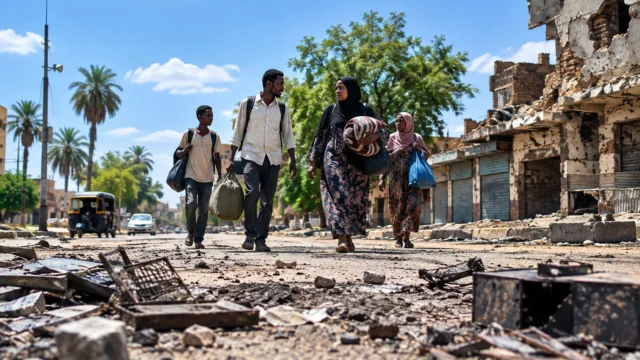
This shift is part of a conflict that has already displaced millions of people and disrupted the country’s economy. The United Nations says Sudan remains the world’s largest displacement crisis, with more than 12 million displaced people according to its consolidated 2024 figures, while the World Health Organization was still citing 13.6 million displaced people in early 2026.
Blue Nile, Kordofan and the Ethiopian border: a central theatre
Blue Nile is not a peripheral front. It is a contact region, bordering a porous frontier with Ethiopia and lying close to routes linking south-eastern Sudan with the rest of the country. In recent months, fighting has shifted towards the states of Kordofan and Blue Nile, as the army and the Rapid Support Forces, or RSF, seek to open new pressure points against each other.
In this area, the border is more than a line on a map. It also serves as a supply corridor, a temporary refuge and strategic depth. That is precisely what makes any advance in Blue Nile so sensitive for Khartoum and the Ethiopian authorities, whose stance has been closely watched since Sudanese allegations of cross-border logistical support.
What the warring parties say
The RSF said on 28 August 2026 that it had taken control of the Bakori and Surkum bases in Blue Nile, in coordination with elements of the Sudan People’s Liberation Movement-North, an armed force active in some parts of the country. A Sudan Tribune report confirmed the claim, noting that the paramilitaries said they had seized weapons and equipment.
The Sudanese army, meanwhile, announced the arrival of the first group of its joint forces in Blue Nile state to reinforce the front. It also says it deployed an elite brigade of the Security and Intelligence Service along the route to Bakori. At the same time, it said it had shot down three drones it deemed hostile, which had come from the Ethiopian border. These claims remain attributed to the army unless and until independent verification can fully confirm them.
What the Ethiopian border reveals
Interest in the border is not based solely on reports of fighting on the ground. On 27 August 2026, Yale University’s Humanitarian Research Lab published an analysis reporting increased military activity around the Asosa base in Ethiopia, near Sudan. The lab described the arrival of numerous vehicles and logistical equipment over a few days, in a sequence suggesting a worrying build-up.
Earlier media reports and investigations had already documented suspicions of logistical support for the RSF from the Ethiopian side of the border. A Reuters investigation, later reported by several media outlets, referred in February 2026 to a secret camp in Ethiopia for training RSF fighters. This sequence is fuelling questions about the regional reach of Sudan’s war.
Another political signal was the visit by Mohamed Hamdan Dagalo, known as Hemedti, to Addis Ababa and his meeting with Ethiopian Prime Minister Abiy Ahmed, seen as a marker of the intersection between Sudan’s war and regional calculations. Such a visit matters because it sends a message about networks of support, mediation or tolerance surrounding the conflict.
The stakes for Khartoum, Blue Nile and the region
For the Sudanese army, holding Blue Nile means preventing the RSF from turning the country’s south-east into a lasting gateway. For the RSF, the apparent aim is the opposite: to widen the front, multiply pressure points and force the army to disperse its forces between Blue Nile and Kordofan. This strategy of stretching an opponent is common in wars of manoeuvre: it not only brings territorial gains, but also wears down the adversary.
For Sudanese civilians, the consequences are immediate. Every change of control around Ed Damazin, Bakori or Surkum can disrupt markets, roads, access to healthcare and daily travel. Border areas often experience the effects of war sooner than political capitals because they face restrictions on movement, road closures and the risk of reprisals all at once.
The war is also becoming a regional affair. Ethiopia, Eritrea, Chad, South Sudan and the wider Horn of Africa are affected by Sudan’s conflict through the movement of weapons, fighters and refugees. This is one reason why the Intergovernmental Authority on Development, IGAD, and the African Union are still seeking to maintain channels of dialogue, despite repeated political consultations and limited results on the ground.
Sudan’s war is becoming increasingly regional
The Blue Nile case highlights a clear shift in Sudan’s conflict: the front lines are no longer confined to Khartoum or El Fasher. They are spreading into border areas, where surveillance is difficult and the military balance depends as much on external alliances as on forces on the ground. Sudan, an IGAD member and a central actor in the Horn of Africa, is therefore seeing its internal war weigh on the security of the entire region.
What happens next will depend on the two sides’ ability to hold their lines and on the true scale of external or cross-border support. But one thing is already clear: in Blue Nile and Kordofan alike, Sudan’s war is changing its geography without changing its logic. It remains a struggle for territory, strategic depth and control of routes.