Algeria
 Egypt
 Libya
 Morocco
 Sudan
 Tunisia
 Benin
 Burkina Faso
 Cabo Verde
 Côte d'Ivoire
 Ghana
 Guinea
 Guinea-Bissau
 Liberia
 Mali
 Mauritania
 Niger
 Nigeria
 Senegal
 Sierra Leone
 The Gambia
 Togo
 Cameroon
 Central African Republic
 Chad
 DR Congo
 Equatorial Guinea
 Gabon
 Republic of the Congo
 São Tomé and Príncipe
 Burundi
 Comoros
 Djibouti
 Eritrea
 Ethiopia
 Kenya
 Madagascar
 Malawi
 Mauritius
 Mozambique
 Rwanda
 Somalia
 South Sudan
 Tanzania
 Uganda
 Angola
 Botswana
 Eswatini
 Lesotho
 Namibia
 South Africa
 Zambia
 Zimbabwe
A new service in an already highly connected archipelago
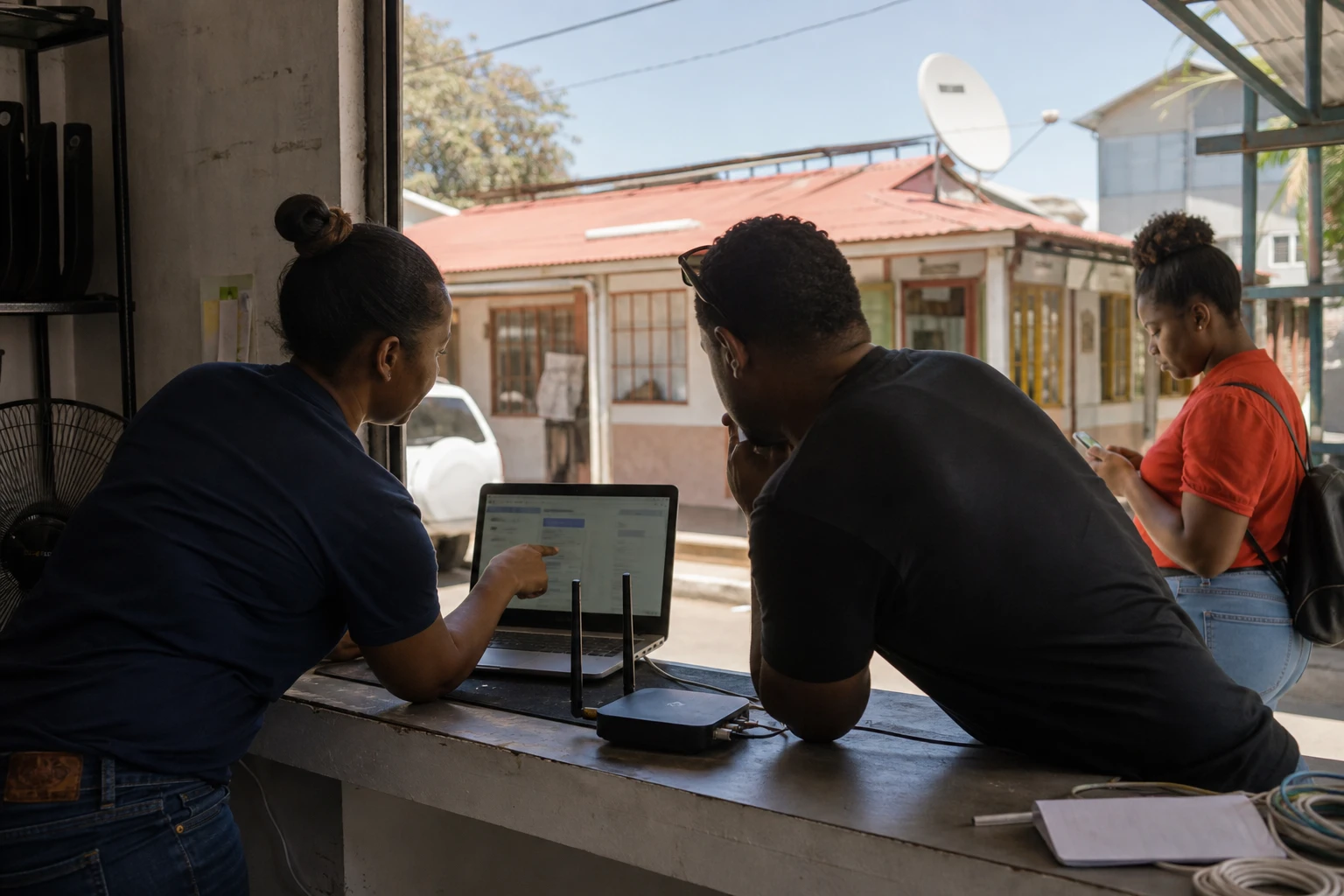
In the Seychelles, the question is no longer simply who can get connected. It is rather how to offer more choice, greater resilience and better coverage across a territory spread over 115 islands. In a country where Internet access is already high, the arrival of a satellite operator such as Starlink does not fill a void. It is aimed above all at gaps in quality, isolated areas and professional uses that require a stable connection.
This development is part of an already advanced digital trajectory. At the end of 2025, about 117,000 people were using the Internet in the archipelago, representing a penetration rate of 87.4%. The Seychelles is therefore among Africa’s most connected markets, even if the reality of broadband access remains more uneven between Mahé, Praslin, La Digue and the more remote islands.
Victoria opens its market to commercial satellite services
The Seychellois government gave the green light in February 2026. On 18 February, the Council of Ministers approved the granting of an Internet operator licence, subject to conditions, to Starlink, allowing the company to provide broadband services and related products in the country. The decision was followed by the commercial launch of the service, announced as effective from 18 July 2026.
The proposal was presented as a public policy initiative, rather than simply the arrival of a provider. In the 2026 budget note, the authorities had already described Starlink as a way to make telecommunications more affordable and accessible, while reducing some living costs. The Seychellois regulatory framework has also been adapted with more recent licensing rules for telecommunications activities, showing that the state prepared to open the market rather than being forced into it.
In practice, the Seychelles becomes the 28th African country covered by the satellite network, according to local reports at the time of the launch. The service is now available in the archipelago, but the approach remains regulated: the authorisation covers the provision of Internet access, not the wholesale deregulation of the sector.
Complement, competition and sovereignty trade-offs
Starlink’s arrival is not a revolution in access, but an additional layer in a market that is already equipped. Existing operators already offer mobile, residential and business services. Airtel Seychelles, for example, markets residential broadband packages and business offers, while Cable & Wireless Seychelles promotes unlimited home subscriptions. The new entrant will therefore have to make its case in an already occupied market, with coverage, latency and service continuity as its selling points.
For the government, the real challenge is twofold. On the one hand, it is about improving access on the less well-served islands, where laying fibre or adding terrestrial relays costs more. On the other, it must ensure that a satellite service does not simply intensify competition in the premium segment without narrowing the digital divide between households, small businesses and public institutions. For the Seychelles, then, the right question is not “Is Starlink arriving?” but “Which uses will this service really serve, and at what prices?”.
Affordability data offer useful context. The International Telecommunication Union puts the price of a 5GB mobile broadband basket at $34.6, still a significant share of gross national income per capita in 2025. This confirms that the country has already achieved mass connectivity, without resolving the question of relative costs for all households and small organisations that rely on tourism, digital services or maritime activities.
In an archipelago where tourism, fishing, shipping and financial services are strategic, connectivity is not a luxury. It is infrastructure for competitiveness. Better coverage can help remote hotels, island schools, peripheral health centres or vessels that need a reliable connection. But it could also widen the gap between those able to pay for a satellite service and those still dependent on more standard offers.
What the archipelago is watching now
The significance of this launch extends beyond Victoria. In island East Africa, where economies are often fragmented by geography, satellite solutions are increasingly being established as a complement to terrestrial networks. The Seychelles is thus joining a broader regional trend: combining fibre, mobile and satellite to reduce digital coverage blind spots.
But the Seychellois experience will be closely watched, because it raises a familiar continental question: how can a strategic market be opened to a new operator without weakening local players or losing control over the terms of access, taxes and service obligations? In small African island states, as in several mainland countries, the answer will matter as much as the arrival of the technology itself. That is where the true measure of success will lie: in actual cost reductions, coverage beyond urban centres and service quality, not merely in the announcement of a new name in the market.