
 Algeria
 Egypt
 Libya
 Morocco
 Sudan
 Tunisia
 Benin
 Burkina Faso
 Cabo Verde
 Côte d'Ivoire
 Ghana
 Guinea
 Guinea-Bissau
 Liberia
 Mali
 Mauritania
 Niger
 Senegal
 Sierra Leone
 The Gambia
 Togo
 Cameroon
 Central African Republic
 Chad
 DR Congo
 Equatorial Guinea
 Gabon
 Republic of the Congo
 São Tomé and Príncipe
 Burundi
 Comoros
 Djibouti
 Eritrea
 Ethiopia
 Kenya
 Madagascar
 Malawi
 Mauritius
 Mozambique
 Rwanda
 Seychelles
 Somalia
 South Sudan
 Tanzania
 Uganda
 Angola
 Botswana
 Eswatini
 Lesotho
 Namibia
 South Africa
 Zambia
 Zimbabwe
A new front in African connectivity
In several African countries, the question is no longer simply whether people have internet. The main issue is having it everywhere, at a sustainable cost and with reliable quality. This is where satellite internet is emerging as a practical response to the limitations of terrestrial networks, especially outside major cities. Data from the International Telecommunication Union show that 4G coverage in Africa still lags behind, with a significant share of the population beyond the reach of the mobile networks most useful for web access.
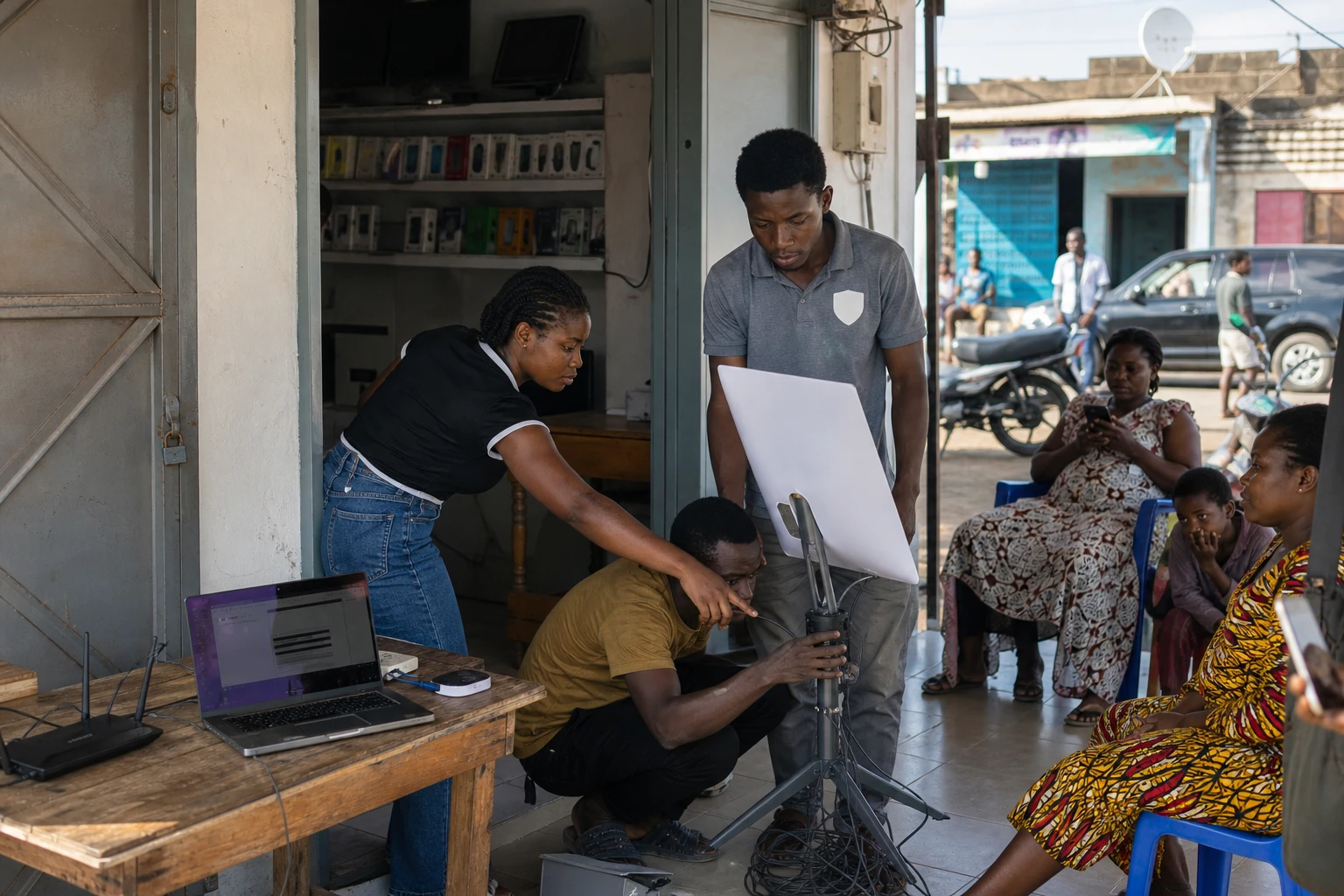
Starlink, SpaceX’s satellite service, is moving into this gap. Its official availability map shows commercial or regulatory operations already under way across much of the continent, with new markets listed as “starting in 2026”. According to specialist African media that followed the map update, Equatorial Guinea has just been added to the list of markets served, bringing the total to about 29 African countries, based on the count then shown.
This progress is not insignificant. It confirms that a private operator backed by a low-Earth orbit constellation is moving faster than many fixed networks in environments where fibre is scarce, roads are spread out and investment costs are high. But it also underlines an obvious point: in Africa, the connectivity battle is as much about infrastructure as it is about regulation, prices and digital sovereignty.
The countries in focus and the timing
The next wave listed by Starlink covers 16 countries: Mauritania, Mali, The Gambia, Guinea, Burkina Faso, Togo, Tunisia, Uganda, Tanzania, Comoros, Namibia, Angola, Congo, Gabon, Cameroon and Mauritius. On the availability map, these states are shown with a launch date from 2026, but no specific date. In other words, the commercial signal is there, but there is no guarantee of an immediate go-live.
This detail matters. Starlink has already shown that its timeline maps can change. Some countries were listed with a nearer deadline before their opening was pushed back, while others moved quickly from “pending” status to actual service. National authorities therefore retain control: authorisation, spectrum, licences, taxation, and sometimes requirements for a local presence or data control.
Central Africa is an illustrative case. Congo, Gabon and Cameroon are among the next markets announced. In this region, capitals already account for most digital activity, while vast areas remain poorly connected. A satellite service can fill part of the gap. On its own, it cannot replace public policy on fibre, backhaul, internet exchange points and lower retail costs.
What the figures say about actual need
ITU data show that Africa is making progress, but slowly. In 2024, 4G coverage across the continent remained well below the global average, and the share of the population with access to at least a 3G-type connection was still incomplete. The ITU also says that internet use in Africa remains at just over one person in three, far below the most connected regions.
Differences between countries remain stark. In the Sahel, Mauritania and Burkina Faso do not have the same level of coverage or rate of internet use. The important thing, then, is not only to compare countries with one another, but to see who actually benefits from a reliable service: urban businesses, government departments, schools, industrial sites, or rural households for whom every gigabyte is still too expensive.
At this stage, Starlink is capitalising on unmet demand. In several African markets, internet users know all too well the service interruptions, high latency, dead zones and inconsistent speeds. Satellite internet is attractive because it offers a simple promise: a connection wherever terrestrial networks struggle to reach or arrive late. The promise is compelling, but it must still translate into affordable prices and a regulated service.
What this means for operators, states and users
For established operators, Starlink changes the landscape without making them disappear. It adds pressure in rural areas, among businesses seeking backup links, and on government departments looking for rapid solutions. It is also prompting some African telecoms groups to form partnerships rather than remain in a head-on confrontation. The agreement announced between Airtel Africa and SpaceX on direct connectivity to mobile devices is a good example.
For states, there are two challenges. On the one hand, they want to expand digital access and support education, healthcare, connected agriculture and public services. On the other, they must protect competition, network security, local tax revenues and their ability to regulate. This is particularly sensitive where digital sovereignty has become a political issue, especially when a single private infrastructure can connect entire areas without using national networks.
For users, the potential benefits are real, but uneven. A provincial SME, an NGO in an isolated area, a school or a clinic could see a significant improvement in quality. However, the cost of equipment and subscriptions remains a major barrier, especially for households. In other words, satellite internet can reduce the digital divide, but cannot eliminate it on its own. Public policies on pricing, connectivity and universal service are still needed.
Expansion to watch closely in 2026
The 2026 period will be decisive in measuring how quickly Starlink can actually expand in Africa. The 16 announced markets will not all become operational at the same pace. Some countries may move quickly. Others will remain held up by authorisations, commercial negotiations or regulatory decisions. This has already happened in several African cases monitored in recent months.
The continental significance therefore goes beyond the arrival of a new operator. It touches on the role of satellite in Africa’s digital architecture, governments’ ability to regulate these new networks, and how African operators reorganise in response to a well-funded global competitor. The real question is not only where Starlink will be available. It is under what conditions, for which uses, and with what impact on the continent’s digital ecosystem.



