Algeria
 Egypt
 Libya
 Morocco
 Sudan
 Tunisia
 Benin
 Burkina Faso
 Cabo Verde
 Côte d'Ivoire
 Ghana
 Guinea
 Guinea-Bissau
 Liberia
 Mali
 Mauritania
 Niger
 Nigeria
 Senegal
 Sierra Leone
 The Gambia
 Togo
 Cameroon
 Central African Republic
 Chad
 DR Congo
 Equatorial Guinea
 Gabon
 Republic of the Congo
 São Tomé and Príncipe
 Burundi
 Comoros
 Djibouti
 Eritrea
 Ethiopia
 Kenya
 Madagascar
 Malawi
 Mauritius
 Mozambique
 Rwanda
 Seychelles
 Somalia
 South Sudan
 Tanzania
 Uganda
 Angola
 Botswana
 Eswatini
 Lesotho
 Namibia
 Zambia
 Zimbabwe

A regional strength that supports the sector, but also leaves it exposed
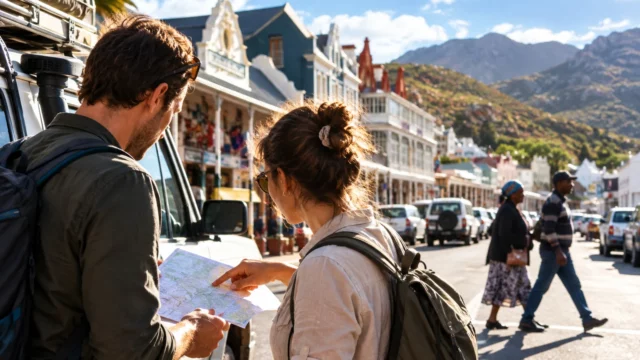
In Pretoria, South African tourism is moving forward on two engines. The first is regional. The second comes from long-haul markets, which are still too small to carry as much weight as neighbouring countries. This reality is often presented as a weakness. It also says something else: South Africa, a country in southern Africa, remains a hub for mobility, where short journeys, cross-border buses and air links support activity vital to hotels, transport and local trade.
The context matters. South Africa’s tourism economy is part of the Southern African Development Community, SADC, a region where workers, families, traders and travellers move around every day. In practice, these are often the flows that drive the figures. They give the market depth, particularly when long distances, air fares and visa constraints still hamper diversification. The South African government acknowledges this, placing air access, digital visas and connectivity at the centre of its tourism roadmap.
July figures confirm the dominance of neighbouring countries
In July 2026, South Africa welcomed 991,696 foreign tourists, up 12.5% year on year, according to the Department of Tourism. In the first seven months of the year, international arrivals reached 6,576,169, an increase of 12.4% compared with the same period in 2025. Arrivals from Africa rose by 14.3%, while visitors from outside the continent increased by 5.7%.
The annual picture confirms the same trend. In 2025, the country welcomed 10.5 million tourists, a record, and three-quarters of these visitors came from SADC countries. Tourists from other African countries accounted for 1.9% of arrivals, compared with 22.8% from markets outside Africa. In other words, the heart of South African tourism remains African, and primarily sub-regional.
July’s figures illustrate this structure. Europe remains the leading source region outside Africa, with 97,461 visitors. North America follows with 41,037 tourists. Among individual markets outside the continent, the United States leads, ahead of the United Kingdom and the Netherlands. France recorded a marked increase, with 12,496 visitors, up 24.9% year on year. This shift does not overturn the sector’s balance, but it shows that a more diverse base is taking shape.
This shift is slow. And that is normal. Regional visitors travel more often, for shorter stays and at lower cost. Long-haul tourists, by contrast, stay longer and often spend more per trip. The first flow supports visitor numbers. The second has a greater impact on revenue per visitor. Both matter to Pretoria, but in different ways.
Diversifying without undermining what already works
South Africa’s strategy is now clear. The government aims to reach 15 million international arrivals by 2030, up from 10.5 million in 2025. It also wants tourism to contribute about 10% of gross domestic product, while boosting direct and indirect employment. These targets feature in budget announcements and the 2025-2030 Tourism Growth Plan.
To achieve them, Pretoria is relying on three levers. First, easier entry, with the Electronic Travel Authorisation already launched in selected pilot markets. Second, air links, which are crucial to attracting visitors from Europe, Asia and the Americas. Finally, safety and the experience on the ground, since a tourism sector with greater ambitions must remain easy to navigate and reassuring for visitors. The government estimates that improved accessibility could generate tens of thousands of additional jobs.
But diversification must not obscure the value of the regional market. SADC neighbours fill hotels, support restaurants, keep businesses running and cushion external shocks. They also provide more regular demand than some long-haul markets, which are subject to economic cycles, geopolitical tensions and exchange-rate fluctuations. In several provinces, small transport businesses, guides, craftspeople and accommodation providers depend directly on this nearby clientele.
For South Africa, then, the risk does not stem solely from statistical dependence. It also lies in a possible political and social imbalance. Pretoria has recently had to reaffirm, at government and diplomatic level, its opposition to violence and hostile rhetoric targeting African foreigners. In a country where tensions around migration regularly return to public debate, the health of tourism also depends on the social climate. A destination can post strong figures and still be vulnerable if its reputation for hospitality deteriorates.
A South African issue, but also a continental one
This issue extends beyond Pretoria. South Africa is one of the continent’s main tourism hubs. Developments there have knock-on effects across southern Africa, for regional carriers, tour operators and the value chains linking Johannesburg, Cape Town, Durban, Harare, Maputo, Maseru and Gaborone. When regional flows are strong, income also circulates between African countries.
There is an important continental perspective here. The AfCFTA, the African Continental Free Trade Area, aims to facilitate the movement of goods and services and, eventually, travellers. Tourism is a useful test of this ambition. If intra-African travel remains simpler and less costly, destinations across the continent will be better able to capture regional demand even before persuading more intercontinental visitors to come.
For now, the message from the figures is clear: South Africa is regaining momentum, and this recovery is driven first and foremost by its neighbours. Diversification is advancing, but in stages. The coming months will show whether new air links, visa reforms and promotional efforts are enough to broaden the visitor base without weakening the African foundation that already sustains the sector.