Algeria
 Egypt
 Libya
 Morocco
 Sudan
 Tunisia
 Benin
 Burkina Faso
 Cabo Verde
 Côte d'Ivoire
 Ghana
 Guinea
 Guinea-Bissau
 Liberia
 Mali
 Mauritania
 Niger
 Nigeria
 Senegal
 Sierra Leone
 The Gambia
 Togo
 Cameroon
 Central African Republic
 Chad
 DR Congo
 Equatorial Guinea
 Gabon
 Republic of the Congo
 São Tomé and Príncipe
 Burundi
 Comoros
 Djibouti
 Eritrea
 Ethiopia
 Kenya
 Madagascar
 Malawi
 Mauritius
 Mozambique
 Rwanda
 Seychelles
 Somalia
 South Sudan
 Tanzania
 Uganda
 Angola
 Botswana
 Eswatini
 Lesotho
 Namibia
 Zambia
 Zimbabwe
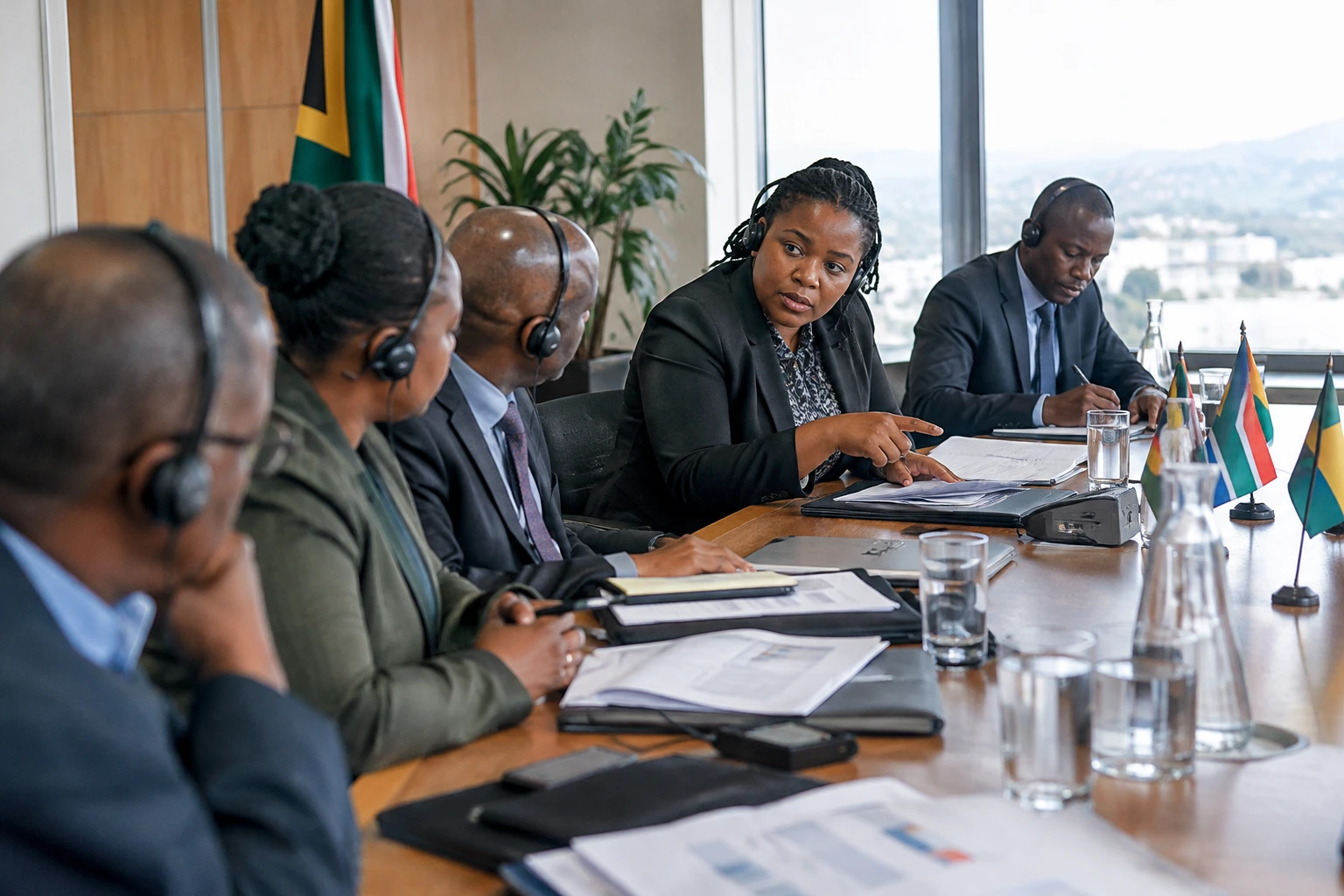
Higher tax revenues can give South Africa’s public finances some breathing room. But they do not, on their own, guarantee more sustainable funding for public services: part of the surplus depends on mining prices, which may fall again.
Budgetary respite driven by commodities
From Pretoria, the government must pursue two objectives at once: fund its priorities and limit borrowing, while growth remains weak. The medium-term budget statement, presented to Parliament on 21 October 2026, updates forecasts between annual budgets. It comes amid an economy in which revenues from businesses and households are not all growing at the same pace.
South Africa is also a central economic player in southern Africa. It belongs to SADC, the Southern African Development Community, which brings together countries committed to economic and trade cooperation. Customs controls and the movement of goods therefore have implications beyond national borders.
Finance Minister Enoch Godongwana announced that gross tax revenue for the 2026/2027 financial year was expected to reach 2,144 billion rand. That is 17.1 billion more than the estimate in the February budget, or about $1.03 billion according to the figure provided. The government attributes the improvement to collections from corporate income tax, dividend tax and VAT. High commodity prices have also boosted mining revenues.
The Treasury then forecasts gross tax revenue rising to 2,530 billion rand in 2029/2030. But the minister warned that the favourable effect of commodity prices was expected to ease over the medium term. This caveat matters: an exceptional windfall linked to metal prices is not as predictable a foundation as revenues supported by broader economic activity.
Revenue up, growth forecast cut
Figures from South Africa’s tax authority, SARS, confirm higher collections in the first half of the year. As at 30 September 2026, its net revenue stood at 992.2 billion rand, 67.4 billion more than a year earlier. SARS said the total was 15.5 billion above the budget estimate for the period. Corporate income tax, domestic VAT and payroll deductions contributed to this performance.
The result does not, however, mean the economy is accelerating. The government cut its real growth forecast to 1.2% for 2026, from 1.6% in the February budget. Real growth measures changes in output after accounting for inflation. Logistical difficulties and infrastructure deficiencies continue to constrain activity, despite improved reliability of electricity supply cited by SARS.
The contrast is clear: public coffers are benefiting from stronger receipts, while activity remains sluggish. For mining companies, higher prices can increase taxable profits. For households, the effect depends more on wages, employment, prices and consumption. Rising VAT collections alone do not show how spending weighs on different income groups.
The projected budget deficit for 2026/2027 has been trimmed slightly, from 4% to 3.9% of gross domestic product. GDP represents the value of all goods and services produced in the country. This revision improves the stated trajectory, but only modestly. The question will be whether the additional revenue actually reduces borrowing needs or is absorbed by spending and debt-servicing costs.
The challenge of more regular revenues
The government is also relying on better tax enforcement. Announced measures include modernising customs procedures, tighter cargo inspections and improved traceability of goods. The authorities are targeting, in particular, the illicit trade in alcohol and tobacco, which evades taxes and competes with compliant operators.
These controls can protect public revenues and businesses that comply with the rules. Their effectiveness will nevertheless depend on implementation: available equipment, coordination between agencies and the ability to track cargo at ports and on roads. Across the region, smoother trade and credible controls need to advance together. Otherwise, national efforts risk displacing illicit routes rather than reducing them.
SARS also says net revenue in the first half of the year exceeded the figure for the same period a year earlier. This increase is a sign of collection, not proof that all tax losses have been recovered. Government announcements alone do not detail the impact already achieved by each new customs measure. It will therefore be necessary to distinguish revenue generated by economic conditions from that resulting from sustained improvements in tax compliance.
A test for the regional economic trajectory
The budget revision gives the government limited room for manoeuvre, but the projected slowdown is a reminder that financial stability cannot replace growth. For residents, the practical issue is whether public services can meet needs without adding to debt in a lasting way. For businesses, the quality of infrastructure and the reliability of trade matter as much as the level of taxes.
Across SADC, developments in South Africa merit attention because trade networks, supply chains and customs revenues are interconnected. But South Africa’s outlook does not sum up that of southern Africa: each member economy remains differently exposed to commodity prices, trade and logistical constraints.
The next revenue data and the annual budget in February 2027 will show whether the improvement holds as the effect of mining prices fades. Until then, two indicators will be decisive: SARS’s ability to turn its enforcement measures into regular revenue, and the economy’s ability to exceed the 1.2% growth forecast for 2026.