Algeria
 Egypt
 Libya
 Morocco
 Sudan
 Tunisia
 Benin
 Burkina Faso
 Cabo Verde
 Côte d'Ivoire
 Ghana
 Guinea
 Guinea-Bissau
 Liberia
 Mali
 Mauritania
 Niger
 Nigeria
 Senegal
 Sierra Leone
 The Gambia
 Togo
 Cameroon
 Central African Republic
 Chad
 DR Congo
 Equatorial Guinea
 Gabon
 Republic of the Congo
 São Tomé and Príncipe
 Burundi
 Comoros
 Djibouti
 Eritrea
 Ethiopia
 Kenya
 Madagascar
 Malawi
 Mauritius
 Mozambique
 Rwanda
 Seychelles
 Somalia
 South Sudan
 Tanzania
 Uganda
 Angola
 Botswana
 Eswatini
 Lesotho
 Namibia
 Zambia
 Zimbabwe

A market signal that goes beyond an agency’s mere promise
In South Africa, the real issue is not just the sovereign rating. It is the cost of lost time. When interest rates remain high, ports slow down and electricity supply falters, businesses, households and public finances pay the price. The prospect of a return to investment-grade status by 2028 therefore means something tangible: it suggests that markets are beginning to believe in a more durable recovery path. Goldman Sachs considers this scenario plausible, although it remains exposed to timing risks.
This assessment comes as the country remains southern Africa’s leading industrial and financial hub, at the heart of SADC, the Southern African Development Community. Pretoria, the seat of the executive, is still seeking to repair key parts of its economy: the budget, freight transport, energy and private investment. The implications therefore extend beyond bond markets alone. They affect the country’s ability to play its role as a regional hub, particularly for exports to neighbouring countries in the sub-region.
Stronger fundamentals, but still fragile
The starting point is well known. South Africa was downgraded to speculative grade by Fitch and S&P in 2017, before Moody’s followed suit in March 2020. All three agencies cited growth that was too weak, rising public debt and political trade-offs they considered detrimental to fiscal stability. Since then, the country has sought to rebuild confidence through fiscal consolidation and structural reforms.
The picture has nevertheless changed since 2025. Statistics South Africa confirmed annual growth of 1.1% in 2025, up from 0.5% in 2024. In the first quarter of 2026, GDP grew by a further 0.5%, marking a sixth consecutive quarter of expansion. The South African Reserve Bank also noted in its June 2026 bulletin that the growth reflected a recovery that remained modest, but had become more consistent.
This improvement rests on several supports. Inflation has eased, the currency has strengthened at times, and activity has picked up in agriculture, financial services, trade and tourism. Above all, electricity is weighing less heavily on economic conditions. Eskom says no load-shedding was implemented for long stretches, with 365 days without power cuts announced in May 2026, followed by 434 days without load-shedding reported in early September 2026. The state-owned company says the availability of the electricity system has recovered after the worst years of the energy crisis.
Logistics reforms and fiscal discipline: the heart of the case
The second pillar, less visible to the general public, lies in ports and rail. The South African government has begun gradually opening freight rail to private operators. In March 2026, the first 11 private rail operating companies were granted access to the national freight network. The transport ministry presents the reform as a way to move minerals, vehicles and agricultural products to overseas markets more quickly. This is crucial in an economy where logistics bottlenecks have long held back exports.
The fiscal message is just as important. Moody’s raised South Africa’s outlook from stable to positive in May 2026, while maintaining its Ba2 rating. Fitch, for its part, raised the sovereign rating to BB in June 2026. In both cases, the agencies highlighted improving public finances and progress on reforms. This does not mean an immediate return to investment-grade status, but it puts the country back on a possible upgrade path, provided fiscal discipline withstands political and social shocks.
The government has set an even more ambitious target. On 20 August 2026, Pretoria relaunched its partnership with the private sector around a goal of growth above 3% a year and the creation of an additional one million jobs by 2030. This horizon is crucial in a country where unemployment remains massive. In other words, the sovereign rating is not the end of the road; it is merely an indicator of the credibility of the path being pursued.
What 2028 would mean for South Africa’s economy
If Goldman Sachs’ scenario materialises, the effects would initially be financial. An improved rating generally reduces the government’s borrowing costs, supports the rand and can attract more investors to local bonds. In time, it also eases pressure on debt-servicing costs. Goldman believes markets still underestimate the likelihood of such a return to investment-grade status. Put simply, the good news is not yet fully reflected in prices.
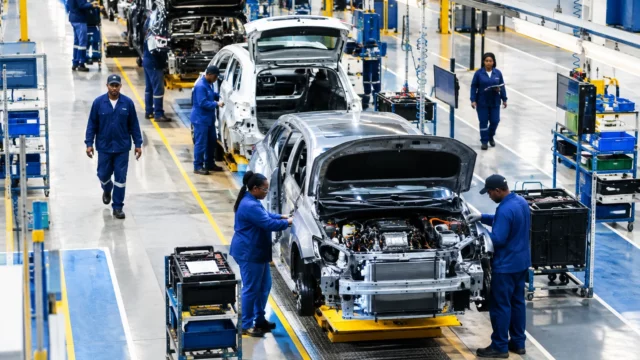
But the most useful effect would probably be industrial. Lower interest rates and more reliable infrastructure can make it easier to finance factories, mines, cold chains, agro-industry and regional trade. This is where SADC comes in. A South Africa that performs better on rail, ports and energy lifts the whole sub-region, because it shapes a significant share of southern Africa’s trade flows.
Nevertheless, it is important to stay clear-eyed. The agencies assess three variables at once: growth, debt and political stability. Growth remains weak relative to the country’s needs. The figures for 2025 and the first quarter of 2026 show an improvement, but not a turning point. The challenge is therefore to turn a cyclical improvement into a lasting trend, without slipping back into the old blockages in the electricity grid, ports or public spending.
The stakes are clear across the continent. South Africa remains a major financial centre within the broader African Union, and an anchor for investors looking at southern Africa and, further afield, the continental single market driven by AfCFTA, the African Continental Free Trade Area. If Pretoria consolidates its trajectory, the signal will be read far beyond its borders: it will show that a heavily indebted African economy can regain credibility through reforms without giving up its productive role or regional ambitions.