Algeria
 Egypt
 Libya
 Morocco
 Sudan
 Tunisia
 Benin
 Burkina Faso
 Cabo Verde
 Côte d'Ivoire
 Ghana
 Guinea
 Guinea-Bissau
 Liberia
 Mali
 Mauritania
 Niger
 Nigeria
 Senegal
 Sierra Leone
 The Gambia
 Togo
 Cameroon
 Central African Republic
 Chad
 DR Congo
 Equatorial Guinea
 Gabon
 Republic of the Congo
 São Tomé and Príncipe
 Burundi
 Comoros
 Djibouti
 Eritrea
 Ethiopia
 Kenya
 Madagascar
 Malawi
 Mauritius
 Mozambique
 Rwanda
 Seychelles
 Somalia
 South Sudan
 Tanzania
 Uganda
 Angola
 Botswana
 Eswatini
 Lesotho
 Namibia
 Zambia
 Zimbabwe
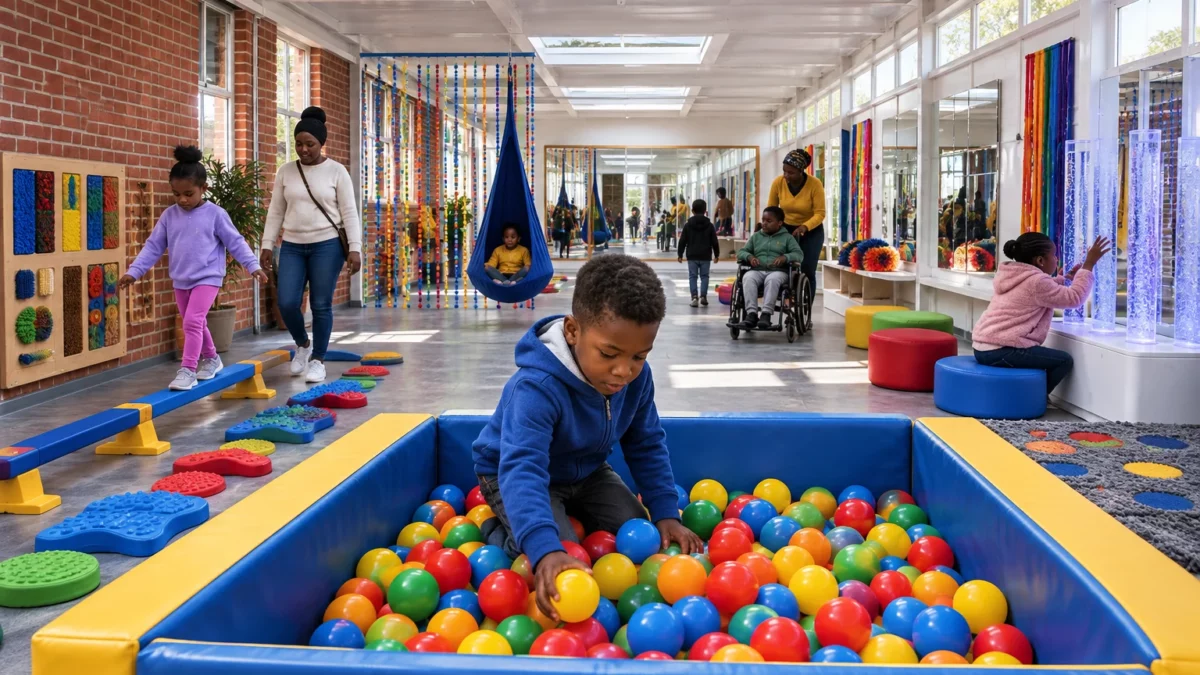
For families supporting a neurodivergent child, support cannot be limited to a medical appointment. In Orange Farm, south of Johannesburg, a sensory space set up in a container offers another source of support: a place to play, move and find a little calm, without having to explain everything straight away.
A place designed with local residents
The room opened in April 2026 at a community centre. The Afrika Tikkun association runs it with Sensory-Space. Local residents took part in its design and made items from recycled materials. The local initiative Orange Farm News reports that the space was designed to welcome children with different sensory needs while remaining accessible to families in the neighbourhood.
Inside, beaded curtains, lights, mirrors and a variety of textures create an environment to explore. A ball pit, a swing and balance courses invite visitors to move. Sessions are free for participants and their parents, according to information provided about the programme.
Sisanda Hani, the mother of a teenager with ADHD and epilepsy, says she has found a place there to ease the pressure of her daily life as a carer. She says she leaves feeling less overwhelmed and is able to talk more calmly with her son. Her account also illustrates a reality that often goes unseen: those supporting someone who is ill also need to be heard and supported.
Njabulo Ntombela, 19, says she has learnt to relax and express her difficulties. She speaks in particular of her worries about the future and continuing her studies. The room does not solve these problems, but it gives her a setting in which to share them and seek help.
A complement to care, not a substitute
The principle is sensory stimulation: sounds, movement, lights and textures can help some people explore their sensations and better regulate their responses. However, the effects vary from person to person. A sensory room is neither a diagnosis nor a medical treatment, and does not replace therapy provided by a professional.
This distinction matters. Programme organisers present the space as a complement to consultations. It can offer an initial setting for support, particularly to people who are not ready to talk or have few opportunities to do so. Children, young adults and carers do not necessarily come for the same reasons, so support needs to be tailored to each person.
Usage figures provided for the facility list 450 pupils aged 6 to 18, 67 young adults and 56 parents or carers. These figures describe attendance reported by the programme; on their own, they do not measure clinical outcomes or changes in participants’ health.
A local response to a national challenge
Access to professionals remains a challenge in South Africa, with disparities in resources between provinces and significant demand for specialist staff. In July 2025, the deputy health minister said that 5% of the national health budget was allocated to mental health services. He also reported that 261 professionals had been recruited through a dedicated grant in 2024-2025, and set a target: for at least 75% of community health centres to have a mental health professional by 2029. These official figures shed light on the constraints that neighbourhood initiatives are trying to address.
The national mental health framework for 2023-2030 aims to strengthen local services, integrate mental health more fully into primary care and support community programmes. It also provides for non-specialist professionals to offer certain psychosocial interventions, with training and supervision, and the option of referral to specialists. The Orange Farm room follows this community-based approach, without being a regulated clinical service.
For families, the benefit is tangible: having a nearby, free and welcoming place can reduce isolation and make it easier to talk. But the presence of such a space does not guarantee access to a psychologist, an occupational therapist or medical follow-up. In a township where travel and availability can make consultations difficult, links with health services remain essential, particularly when someone needs a diagnosis or ongoing support.
Questions of follow-up and replication
The project echoes national policy, but its reach will depend on its continuity. It will be important to know how participants are referred when they need specialist care, who supervises the activities and how their safety is ensured. Funding also matters: a space may open thanks to local commitment, but its maintenance, staff training and coordination with public services require lasting resources.
The question extends beyond Orange Farm. Across southern Africa, public health priorities and available resources vary from one country to another, so this experience cannot simply be replicated throughout the region. It nevertheless highlights a shared challenge: bringing psychosocial support closer to communities while maintaining reliable pathways to professional care.
For South Africa, the next milestones will be implementation of its national plan through 2030 and progress towards the 2029 target for community health centres. The Orange Farm room offers a local approach. Its real contribution will also be judged by the quality of referrals, continuity of service and families’ ability to access professional care when necessary.