
 Algeria
 Egypt
 Libya
 Morocco
 Sudan
 Tunisia
 Benin
 Burkina Faso
 Cabo Verde
 Côte d'Ivoire
 Ghana
 Guinea
 Guinea-Bissau
 Liberia
 Mali
 Mauritania
 Niger
 Nigeria
 Senegal
 Sierra Leone
 The Gambia
 Togo
 Cameroon
 Central African Republic
 Chad
 DR Congo
 Equatorial Guinea
 Gabon
 Republic of the Congo
 São Tomé and Príncipe
 Burundi
 Comoros
 Djibouti
 Eritrea
 Ethiopia
 Kenya
 Madagascar
 Malawi
 Mauritius
 Mozambique
 Rwanda
 Seychelles
 Somalia
 South Sudan
 Tanzania
 Uganda
 Angola
 Botswana
 Eswatini
 Lesotho
 Namibia
 Zambia
 Zimbabwe
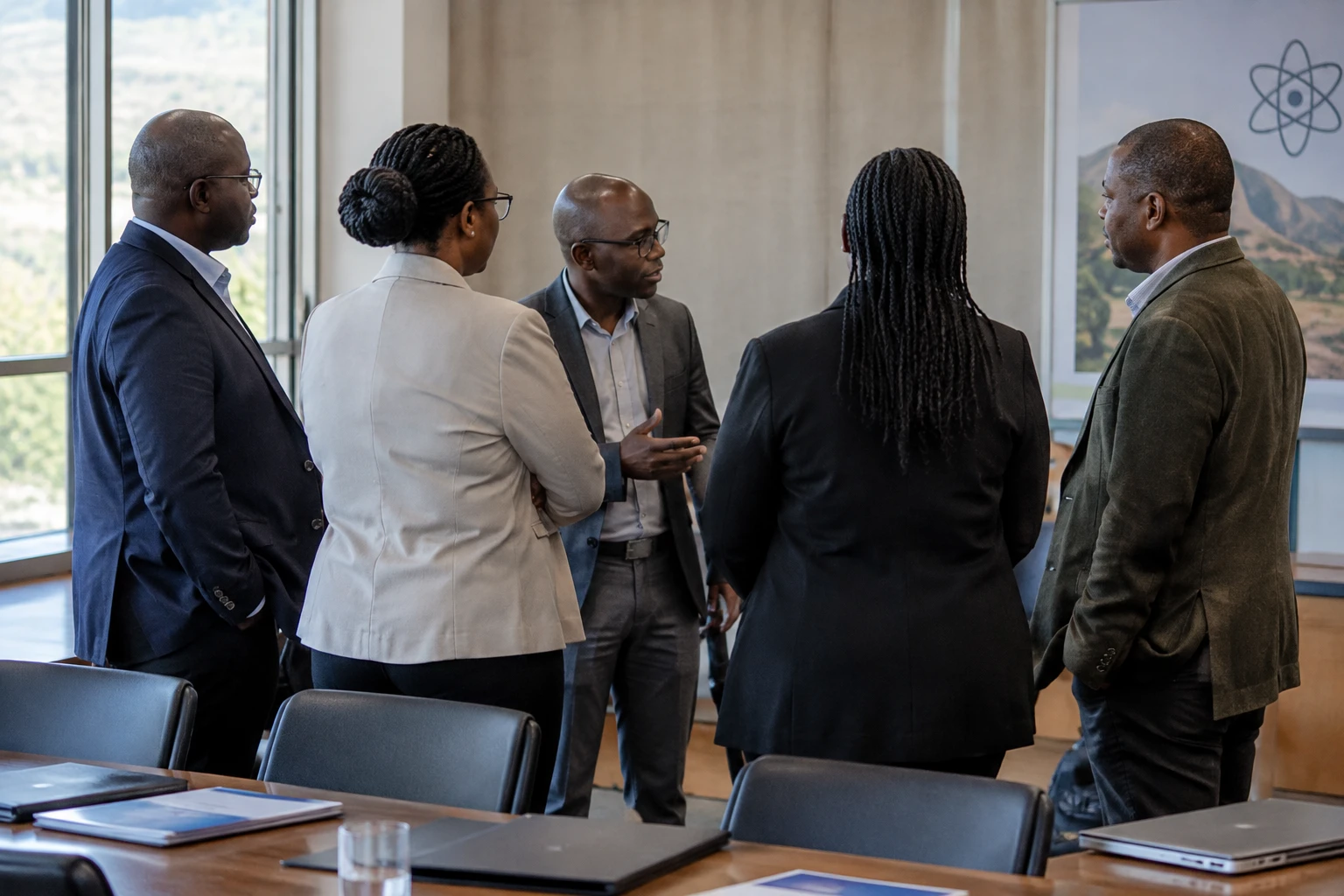
Nuclear fuel designed for next-generation reactors could soon be produced in southern Africa. For South Africa, the stakes go beyond electricity: the country aims to reclaim a place in a strategic industry, while demonstrating that the project can clear its technical, financial and regulatory hurdles.
Joint venture announced at Pelindaba
On 15 October 2026, Quantum Leap Energy (QLE), a US subsidiary of ASP Isotopes, and South Africa’s state-owned Necsa signed a binding framework agreement to develop a HALEU production site at Pelindaba, near Pretoria. It provides for a joint venture owned approximately 80% by QLE and 20% by Necsa. The partners are initially planning a test facility, followed by a commercial-scale plant.
HALEU — high-assay low-enriched uranium — contains more than 5% and less than 20% uranium-235. Some advanced reactors are designed to use this fuel. The project does not, however, mean that South Africa is already producing HALEU: work, testing and permits remain to be completed.
According to information published by the partners and reported by the African business outlet Shore Africa on the Pelindaba project, QLE is to arrange financing and lead operations. Necsa would provide access to the site, its nuclear infrastructure and support on safety and compliance. The US company says it has entered into offtake agreements with TerraPower, an advanced reactor developer. These announced outlets do not determine the production schedule or guarantee actual fuel deliveries.
Industrial revival after three decades
Pelindaba is a historic nuclear site. South Africa operated an enrichment facility there, the Z-Plant, which closed in 1995. The closure was partly prompted by production costs deemed too high. Since then, Eskom, the state-owned power utility, has relied on foreign suppliers for enriched uranium for the Koeberg power station. The International Atomic Energy Agency and the World Nuclear Association document this industrial history.
Koeberg, near Cape Town, remains the continent’s only commercial nuclear power station. But South Africa’s ambition is not limited to keeping its reactors running. The 2025 Integrated Resource Plan puts nuclear power back into national planning and refers to relocating some fuel-cycle activities. In October 2025, the Minister of Electricity and Energy, Kgosientsho Ramokgopa, also advocated a nuclear industrialisation strategy, according to South Africa’s public news agency SAnews.
This direction aligns with Necsa’s statements on reviving skills, research and local production. It nevertheless raises a practical question: what share of the value created will go to South African companies and workers, given that QLE would hold a majority stake and lead operations? The published agreement does not yet specify the total cost, expected jobs or planned skills transfers.
Potential benefits, but still conditional
If the plant is built, the benefits could extend beyond electricity generation to sectors including engineering, maintenance, specialist training and safety services. In time, the joint venture could also reduce reliance on foreign suppliers for certain fuels. For Eskom and consumers, however, this prospect does not immediately change Koeberg’s fuel supply. HALEU is intended for advanced reactor technologies, not simply for the power station’s current fuel.
The benefits would not automatically be spread across the country. Highly specialised jobs and industrial contracts could be concentrated around Pelindaba and Pretoria. The impact on households would depend instead on the project’s success, its cost and any contribution it makes to the electricity system. At this stage, the announcements do not establish a firm commercial timetable or an impact on tariffs.
The regulatory framework will be decisive. Nuclear enrichment requires safety, security and non-proliferation controls, as well as national permits. Necsa says it will provide regulatory support, but this does not replace decisions by the relevant authorities. The announced agreement is therefore a step in industrial development, not final approval for commercial production.
A stake for southern Africa
The project is part of a region where energy co-operation takes place notably through the Southern African Development Community (SADC). Its energy protocol provides a framework for co-operation between states, but the Pelindaba agreement remains primarily a national and commercial partnership. South African HALEU production could be of interest to advanced reactor programmes abroad; it does not, in itself, guarantee regional access to nuclear electricity or fuel.
For the continent, the announcement highlights a broader question: can African countries capture more value in energy supply chains where they already have expertise and infrastructure? South Africa has a long nuclear track record, but a revival requires sustained investment and credible oversight. The next steps to watch are the effective establishment of the joint venture, the announced tests, regulatory approvals and clarity on financing. The project’s industrial significance will be measured against these milestones, rather than the signing alone.



