Algeria
 Egypt
 Libya
 Morocco
 Sudan
 Tunisia
 Benin
 Burkina Faso
 Cabo Verde
 Côte d'Ivoire
 Ghana
 Guinea
 Guinea-Bissau
 Liberia
 Mali
 Mauritania
 Niger
 Nigeria
 Senegal
 Sierra Leone
 The Gambia
 Togo
 Cameroon
 Central African Republic
 Chad
 DR Congo
 Equatorial Guinea
 Gabon
 Republic of the Congo
 São Tomé and Príncipe
 Burundi
 Comoros
 Djibouti
 Eritrea
 Ethiopia
 Kenya
 Madagascar
 Malawi
 Mauritius
 Mozambique
 Rwanda
 Seychelles
 Somalia
 South Sudan
 Tanzania
 Uganda
 Angola
 Botswana
 Eswatini
 Lesotho
 Namibia
 Zambia
 Zimbabwe

A digital gateway, but an issue broader than visas
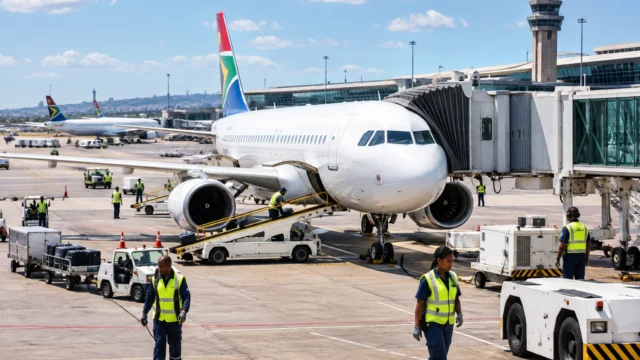
In South Africa, entry into the country is no longer just a matter of counters and stamps. It has become a test of administrative capacity, security and economic appeal. In Pretoria, the government wants to show that a country can screen more effectively without closing itself off, at a time when pressure over immigration remains high and airport queues also shape the country’s image.
The launch of the Electronic Travel Authorisation, or ETA, is part of a broader reform led by the South African government. It concerns migration, but also tourism, trade, investment and the movement of skills. The country belongs to SADC, the Southern African Development Community, so this modernisation of entry procedures also affects regional flows, business travellers and value chains running through Johannesburg, Cape Town and Durban.
What the ETA changes in practice
On 12 August, South Africa officially presented its ETA system as a new digital framework for eligible travellers. The aim is clear: to enable faster, more predictable authorisation that relies less on paper, through online applications, biometric verification, machine learning and electronic monitoring of movements at points of entry. The Department of Home Affairs presents the platform as a tool to combat fraud and improve the screening of applications.
The system did not begin in August. It was first tested on a limited scale during the G20, for travellers from China, India, Indonesia and Mexico. The authorities then began extending it to other categories and points of entry. Official documents also indicate that the portal is ultimately to become part of a broader entry-control ecosystem, alongside the Enhanced Movement Control System, particularly at major international airports and some land border posts.
This development fulfils an older political promise. In his state of the nation address, President Cyril Ramaphosa announced that 2026 would see the ETA extended to all visa-required countries, with digital processing of tourist applications within tighter timeframes. The executive links this reform to the Operation Vulindlela strategy, a structural reform programme led by the Presidency and the Treasury to remove barriers to growth.
Between immigration control and a tourism revival
The political message is twofold. On the one hand, Pretoria wants to show that it is taking back control of irregular immigration, amid a climate in which xenophobic tensions and enforcement operations have become more visible in recent months. In June, the government announced a comprehensive migration management plan, with the Border Management Authority, police and army deployed at points of entry. Official figures published in late July report tens of thousands of coordinated repatriations since mid-June, illustrating the firmness of the current approach.
On the other hand, the South African state is betting on digital technology to avoid penalising travellers who comply with the rules. This is central to tourism, one of the sectors most sensitive to the quality of entry procedures. The Department of Tourism said international arrivals remained strong in June 2026, while Statistics South Africa publishes monthly series on international tourism. Tourism authorities are emphasising the recovery of long-haul markets, an important signal for hoteliers, airlines, event organisers and cities that depend on visitor spending.
President Ramaphosa has also presented the ETA as a reform that goes beyond migration alone. In the official narrative, it is also intended to support trade, investment, the events economy and employment. This logic is consistent with South Africa’s position in the region: the country is a major gateway to southern Africa, an aviation hub and a market where administrative efficiency has a direct impact on formal economic activity.
What the figures say—and what they do not
The authorities have also sought to quantify the expected economic impact. In sector briefing documents, the government has highlighted an increase in international arrivals and gains in some markets during the system’s initial phases. But the political message must be distinguished from the measurable impact. A digital platform makes access easier; it does not replace the underlying conditions: airfares, the quality of air links, perceived security, the stability of public services and the speed with which applications are processed.
The challenge is therefore broader than technology. In Johannesburg, Cape Town and Durban, the ETA could reduce friction for business and leisure travellers. In border areas and the informal economy, the issue is different: effective enforcement of the law, the fight against corruption at crossing points and respect for fundamental rights remain essential, including in the handling of checks and returns. The South African authorities also say their approach must remain constitutional and co-ordinated.
The launch also comes in a country where immigration is often used as an outlet for social tensions. This calls for particular caution. Digitalisation can improve traceability and efficiency. It can also concentrate more power in automated screening systems, making public oversight of the criteria, the categories concerned and the handling of errors all the more important. The authorities say they want to prevent fraud and speed up applications; economic sectors, for their part, are chiefly looking for a clear and stable process.
A South African reform with regional reach
Across southern Africa, South Africa’s ETA sends a signal that other capitals will watch closely. SADC has long sought to reconcile mobility, security and economic integration more effectively. If Pretoria succeeds in automating procedures without making them more rigid, it could strengthen its role as a regional hub. If the system becomes mired in delays, it will instead become another source of friction in an economy already exposed to administrative bottlenecks.
The continental significance is similar. South Africa wants to be seen as a country capable of investing in faster, more traceable public services that are less vulnerable to corruption. This choice resonates with other African initiatives: digital identity, border control, electronic visas and trade facilitation. In the short term, the key developments to watch are the system’s expansion to other airports and visa categories, as well as its alignment with forthcoming SADC decisions and Pretoria’s reform timetable.