Algeria
 Egypt
 Libya
 Morocco
 Sudan
 Tunisia
 Benin
 Burkina Faso
 Cabo Verde
 Côte d'Ivoire
 Ghana
 Guinea
 Guinea-Bissau
 Liberia
 Mali
 Mauritania
 Niger
 Nigeria
 Senegal
 Sierra Leone
 The Gambia
 Togo
 Cameroon
 Central African Republic
 Chad
 DR Congo
 Equatorial Guinea
 Gabon
 Republic of the Congo
 São Tomé and Príncipe
 Burundi
 Comoros
 Djibouti
 Eritrea
 Ethiopia
 Kenya
 Madagascar
 Malawi
 Mauritius
 Mozambique
 Rwanda
 Seychelles
 South Sudan
 Tanzania
 Uganda
 Angola
 Botswana
 Eswatini
 Lesotho
 Namibia
 South Africa
 Zambia
 Zimbabwe
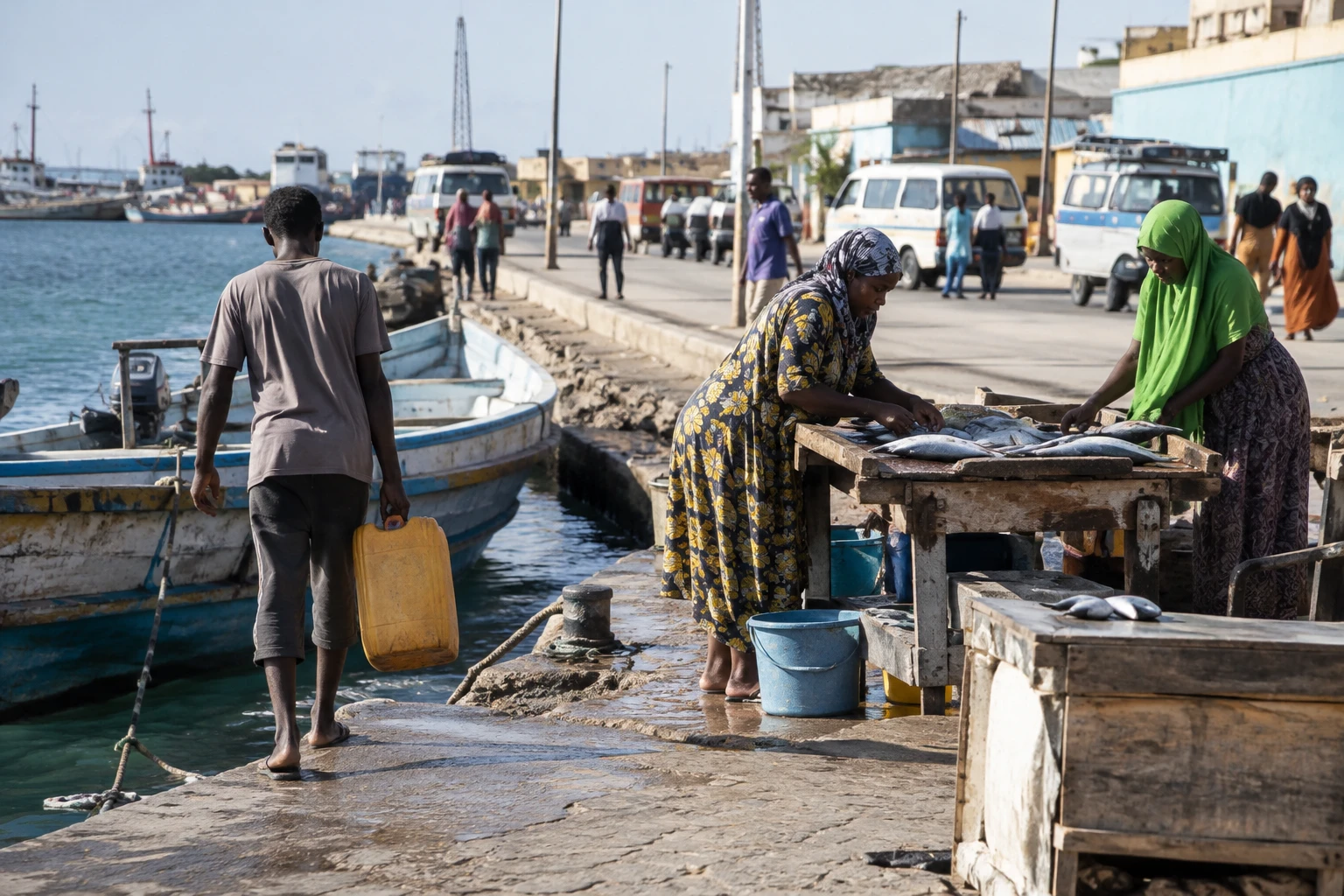
In Kismayo, a trip to sea now depends as much on the price of fuel as on the state of the sea. When filling the tank consumes almost all the proceeds from fishing, the consequences extend beyond the quays: they affect vendors, families and customers who rely on fish for food.
From disruption on shipping routes to Kismayo’s market stalls
Rising costs linked to tensions in the Middle East filtered through to Somali markets in the first half of 2026. Somalia imports a large share of its food and relies on external fuel supplies. Disruptions to maritime transport and higher energy prices therefore quickly feed through into transport and goods costs.
On 30 April 2026, the FAO reported that the price of fuel in Mogadishu had risen from about $0.60 to $1.50 a litre, according to data from the Somali authorities. The organisation linked the surge to supply chain disruptions and their effects on food and water prices. Figures vary by location and period: they do not automatically reflect the price paid by every fisher in Kismayo.
Somalia is a member of IGAD, the regional organisation for the Horn of Africa. Trade disruptions are particularly significant there because regional economies depend on maritime trade, imports and road transport. For the Somali authorities, the challenge is also domestic: connecting ports and markets to cities and remote areas despite limited infrastructure and logistical capacity.
Small-scale fishing squeezed by fuel costs and falling purchasing power
In Kismayo, the de facto capital of Jubaland and the main port in southern Somalia, fishers have described a sharp rise in their expenses. One of them, Mohammed Ahmed, says that 200 litres of petrol, which previously cost him $100, now cost $400. This is his testimony, not a verified average for fishers across the country.
He also says he has gone from fishing almost every day to making two trips a week. When he sells his catch, a large share of the income goes towards financing the next trip. This reduced activity means less fish on market stalls and less income for those who clean, cut up and sell the catch.
The cooperative led by Fadumo Abdi has twelve women traders. She says the group would normally sell about 60 kilos of fish a week for an income of around $100. She describes days without customers and an increase in the selling price, which fishers justify by the cost of fuel. These figures reflect the situation of this cooperative, but are not representative of all of Jubaland.
Vendors are thus caught between two constraints. They have to pay more for their supplies, while their customers have less money. Fadumo Abdi says some of her customers are displaced people. Rising prices therefore affect not only households buying fish: they also undermine the incomes of the women who sell it.
A small share of GDP, but vital to livelihoods
Available estimates put fishing’s contribution at around 2% of Somalia’s gross domestic product. This limited economic weight masks its role in coastal activity. The FAO estimates that nearly half a million people earn income or livelihoods from the sector; this estimate includes jobs linked to the industry and does not mean that all of them fish directly.
Small-scale fishing involves fishers, vendors, processors and people responsible for transport or sales. Fewer trips to sea reduce supply and income at several stages. They may also push consumers towards other foods, which are themselves exposed to import and transport costs. The FAO has noted that these costs are adding to food price pressures in the country.
The shock is hitting an economy already facing other difficulties. Repeated droughts, poor harvests, displacement and trade disruptions are already weighing on access to food. The FAO and partners in the Integrated Food Security Phase Classification (IPC), which assesses the severity of food insecurity, estimated that about six million people faced crisis-level food insecurity or worse between April and June 2026. This figure covers that period and the country as a whole; on its own, it does not measure the impact of higher fuel prices.
In Jubaland, local officials cited by industry figures are also concerned about the lack of jobs for young people. However, the testimonies gathered do not establish that rising costs alone are causing people to leave for other countries or use drugs. These phenomena should be described with caution, without turning individual accounts into a national trend.
Coastal resilience also depends on public policy
Data from the FAO and the Somali Development and Reconstruction Bank describe an industry that contributes modestly to GDP but supports many livelihoods. The Somali and Jubaland authorities have several levers at their disposal: fuel availability, landing infrastructure, cold storage and access to markets. Better equipment can reduce post-catch losses, but it cannot sustainably offset excessively high costs of going to sea.
The vulnerability of fishers also raises the question of economic sovereignty. Somalia’s coastline and marine resources offer opportunities for production and jobs, but coastal communities remain exposed to fluctuations in global prices and weaknesses in the local supply chain. Developing local processing and improving distribution could increase the value retained in these areas, provided fish stocks are protected and small-scale fishers’ access is guaranteed.
At regional level, IGAD monitors the consequences of climate and economic shocks in the Horn of Africa. Rising fuel prices are a reminder that maritime disruptions can quickly translate into transport, production and supply difficulties far beyond ports. For Kismayo residents, the practical indicators will be the number of boats able to put to sea, the price of fish and vendors’ incomes. The next price surveys and market data will show whether the shock is easing or becoming entrenched.
Background sources: FAO assessment of prices and food security in Somalia, FAO data on fishing-related livelihoods, overview of the sector by the Somali Development and Reconstruction Bank and IPC analysis of the food situation in Somalia.