Algeria
 Egypt
 Libya
 Morocco
 Sudan
 Tunisia
 Benin
 Burkina Faso
 Cabo Verde
 Côte d'Ivoire
 Ghana
 Guinea
 Guinea-Bissau
 Liberia
 Mali
 Mauritania
 Niger
 Nigeria
 Senegal
 Sierra Leone
 The Gambia
 Togo
 Cameroon
 Central African Republic
 Chad
 DR Congo
 Equatorial Guinea
 Gabon
 Republic of the Congo
 São Tomé and Príncipe
 Burundi
 Comoros
 Djibouti
 Eritrea
 Ethiopia
 Kenya
 Madagascar
 Malawi
 Mauritius
 Mozambique
 Rwanda
 Seychelles
 South Sudan
 Tanzania
 Uganda
 Angola
 Botswana
 Eswatini
 Lesotho
 Namibia
 South Africa
 Zambia
 Zimbabwe
A reprieve that chiefly highlights the fragility of the arrangement
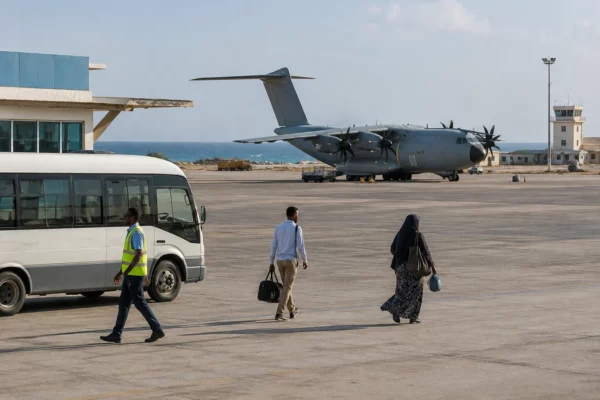
In Mogadishu, every month gained matters. When a stabilisation operation depends so heavily on cargo aircraft, fuel, medical evacuations and supplies, the question is not merely military. It becomes a budgetary issue, then a political one. That is precisely what the developments around AUSSOM, the African Union Support and Stabilization Mission in Somalia, reveal.
The decision under discussion in Washington does not reverse the scaling-down announced over the past several months. It simply grants an additional 12 months to arrange the end of United Nations logistical support for the African mission, from January 2027. In other words, African soldiers are not being withdrawn from the field, but the technical support system that keeps the operation running must be scaled back and then gradually wound down.
Somalia, AUSSOM and the United Nations: a constrained transition
AUSSOM took over from ATMIS at the start of 2025, as part of a gradual transfer of responsibilities to Somali forces. The Security Council subsequently set a ceiling of 11,826 uniformed personnel for the mission, including 680 police officers, and maintained the use of the United Nations Support Office in Somalia, or UNSOS, for administrative and logistical assistance. This support is not symbolic: it covers transport, supplies, medical care, communications and part of the ground-support infrastructure.
The financial underpinning remains substantial. United Nations budget documents put UNSOS’s budget at $499.8 million for 2024-2025, and both the Security Council and UN budgetary bodies have already stressed the need to broaden the donor base and secure multi-year funding. In other words, the problem is not new: Somalia’s transition was designed within a system in which international logistics remain essential, but donors now want to limit their exposure.
This tension has a long history. Since AMISOM, launched in 2007, followed by ATMIS and now AUSSOM, security in Somalia has rested on a hybrid structure: African troops, political leadership by the African Union, and funding largely from outside the continent. The model has helped prevent a total security vacuum. It has also created structural dependence, particularly on decisions made beyond the continent.
What the transition means for Mogadishu and African contributors
For the Somali government, the challenge is clear: take control without allowing recaptured territory to become insecure again. The African Union also stresses that the handover must remain “conditions-based”, with Somali forces supported in the fight against al-Shabaab and in protecting strategic infrastructure. This is crucial, because a poorly calibrated withdrawal would mean not so much a political victory as operational weakening.
For troop-contributing countries such as Uganda, Kenya, Djibouti, Ethiopia and Egypt, the question is different: they want to know who will pay for what comes next. The Kampala summit at the end of July put funding at the heart of discussions. The AU advocated a more autonomous solution, calling for greater use of the Peace Fund, implementation of the 0.2% levy on certain imports and increased national contributions. The debate extends beyond Somalia. It concerns the financial credibility of the African Union as a whole.
The position of the AU Commission, led by Mahmoud Ali Youssouf, points in the same direction. The message to member states is unequivocal: Western funding that has supported African missions in Somalia for nearly 20 years can no longer be taken for granted. The organisation is therefore trying to persuade its members to shoulder more of the burden, drawing on mechanisms agreed in Addis Ababa as far back as 2016 but still implemented unevenly.
The issue is all the more sensitive because the withdrawal of logistical support does not concern the United States alone. It reflects a broader trend: partners want a more autonomous African operation, but do not always accept the need to fund its full cost. At the same time, Washington has signalled that it no longer wants to carry UNSOS over the long term, with its budget weighing heavily amid financial constraints. This equation presents the AU with a practical, not theoretical, test: proving that a continental mission can survive on more predictable resources, less dependent on ad hoc decisions by Western capitals.
Regional significance: a test for East Africa and the African Union
For East Africa, the stakes go beyond Somalia. A lasting stabilisation of Mogadishu is essential to the security of the IGAD area, the Horn of Africa’s intergovernmental organisation, and its neighbours, which are exposed to the movement of weapons, fighters and illicit trade. If the transition fails, pressure will fall back on neighbouring states and local economies, already constrained by insecurity along transport corridors, rising logistics costs and the vulnerability of ports, roads and markets.
For the African Union, the issue is broader still. The AUSSOM funding crisis serves as a case study for all African peace operations. The continent has debated genuine strategic autonomy for years, but such autonomy cannot exist without stable revenue or budgetary discipline. The 0.2% import levy, the strengthening of the Peace Fund and the search for predictable support are intended precisely to reduce dependence on external decisions. Somalia is thus becoming a test case: either Africa succeeds in financing part of its collective security itself, or it remains at the mercy of temporary extensions and withdrawals negotiated outside the continent.
The timetable already gives a sense of the challenge. The transition phase begins in January 2027, with a one-year window to avoid an operational shock. By then, Mogadishu, the African Union, troop-contributing countries and international partners will have to decide whether AUSSOM remains a sustainable mission or becomes an illustration of a model that has reached its limits. In either case, the next stage will be measured not only in diplomatic statements, but in the Somali forces’ actual ability to hold the ground, centre by centre, district by district.