Algeria
 Egypt
 Libya
 Morocco
 Sudan
 Tunisia
 Benin
 Burkina Faso
 Cabo Verde
 Côte d'Ivoire
 Ghana
 Guinea
 Guinea-Bissau
 Liberia
 Mali
 Mauritania
 Niger
 Nigeria
 Senegal
 The Gambia
 Togo
 Cameroon
 Central African Republic
 Chad
 DR Congo
 Equatorial Guinea
 Gabon
 Republic of the Congo
 São Tomé and Príncipe
 Burundi
 Comoros
 Djibouti
 Eritrea
 Ethiopia
 Kenya
 Madagascar
 Malawi
 Mauritius
 Mozambique
 Rwanda
 Seychelles
 Somalia
 South Sudan
 Tanzania
 Uganda
 Angola
 Botswana
 Eswatini
 Lesotho
 Namibia
 South Africa
 Zambia
 Zimbabwe
In Freetown, electoral reform rekindles debate over democratic trust
In Sierra Leone, the rules of the electoral game are never a mere technical detail. They determine how a transfer of power is prepared, the place given to women and the way parties accept, or do not accept, the verdict at the ballot box. In a country where political competition remains fierce, every constitutional adjustment immediately bears on the credibility of the vote.
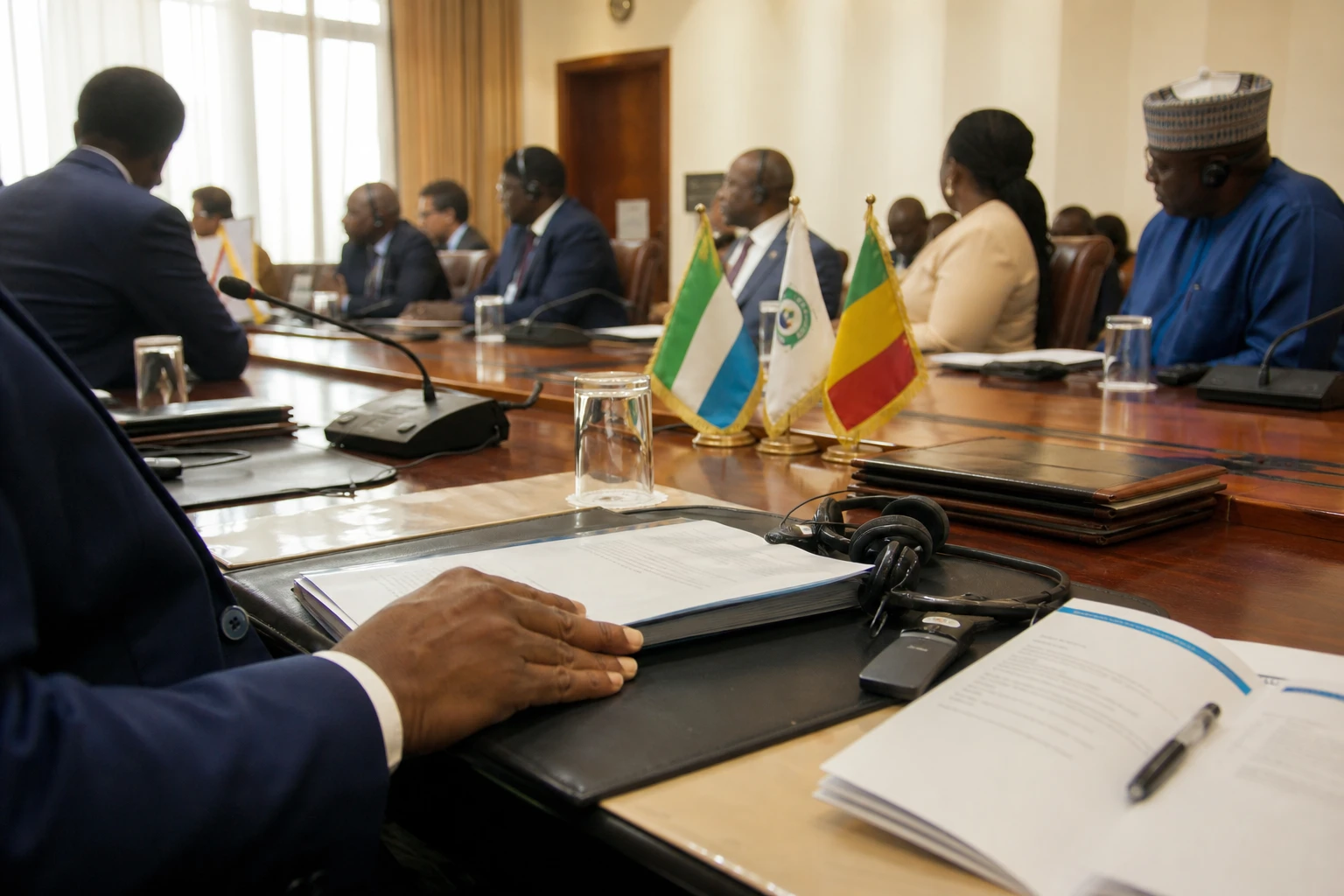
This phase is part of a broader review launched in Freetown several months ago, involving public consultations, parliamentary work and exchanges with regional partners. The process has been shaped in particular by the report of the constitutional review commission and recommendations from the tripartite dialogue on electoral reforms. ECOWAS is also following the matter closely, amid a West African landscape marked by fragile political consensus.
What parliament has approved
According to available parliamentary material and information corroborated by local media and institutional channels, MPs have approved a reform affecting several areas at once: the presidential election, the composition of the Assembly and women’s presence in political leadership positions. The bill replaces the former 55% threshold with a national simple-majority system, while adding a territorial condition: a candidate must also secure at least 20% of the vote in two-thirds of constituencies to avoid a run-off.
The same package introduces proportional representation for parliamentary elections. In practice, this changes how seats are distributed among parties and reduces the weight of the traditional first-past-the-post system. The bill also maintains a minimum requirement of 30% women among the candidates or officials concerned, a threshold already established by the Gender Equality and Women’s Empowerment Act and regularly championed by women’s organisations and MPs.
The governing majority backed the bill. The opposition, meanwhile, raised concerns about its content and the process, arguing that the reform should ensure greater clarity and consensus before being imposed as the new electoral framework. This tension is not isolated: since the 2023 general elections, confidence in the electoral system has remained a major point of friction between the government, the opposition and the institutions responsible for arbitration.
A political calculation as much as an institutional adjustment
President Julius Maada Bio has urged elected representatives to support these changes, even as he begins his final term and will be unable to stand again in 2028 under the current constitutional rules. That matters. It helps explain why the timing of the reforms has become so sensitive. For the government, the aim is to organise the next transition on a clearer basis. For the opposition, the priority is to prevent a reform presented as technical from reshaping the political advantage of one camp.
The choice of proportional representation also has social implications. In a country where regions, provincial capitals and rural areas do not carry equal weight in the balance of power, this electoral system could create more space for smaller parties, local coalitions and minority voices. But if the implementing rules are too vague, it could also make the result harder to interpret for voters who are already wary. That is where everything hinges: the reform could either broaden inclusion or multiply disputes if the mechanisms for allocating seats are not precisely defined.
The question of women in politics is clearer. Sierra Leone has already made legislative progress with the Gender Equality and Women’s Empowerment Act. But within parties, access to nominations, campaign leadership and negotiating positions remains a practical barrier. The 30% quota enshrined in the constitutional reform therefore seeks to turn a principle into a political obligation. It is an important step, but its effectiveness will depend on how party organisations implement it and whether the electoral administration can monitor candidate lists.
What this says about Freetown and West Africa
At the regional level, Sierra Leone is sending a signal being watched well beyond Freetown. ECOWAS, which has made constitutional stability and electoral credibility central issues, is following the reforms closely. Its involvement in monitoring the national dialogue shows that in West Africa the question is no longer simply how to hold elections, but how to build an accepted framework before the vote. That is a crucial distinction.
The country occupies a particular place in this regional moment. In 2026, Freetown and Lungi hosted major ECOWAS meetings, enhancing Sierra Leone’s diplomatic profile. In this context, electoral reform is not merely a domestic issue. It also contributes to the image the country projects: that of a state seeking to strengthen its institutions after the tensions of the previous electoral cycle.
The next point to watch will be the practical implementation of the bill. This will mean tracking the final publication of the amendment, any additional ratification requirements if certain provisions fall under the protected clauses of the 1991 Constitution, and then the electoral decrees or regulations that will specify how seats are calculated and the women’s quota monitored. In Sierra Leone, as elsewhere in West Africa, political balances often become clear only at the implementation stage.
For citizens in Freetown and the provinces alike, the issue is straightforward: will this reform bring institutions closer to voters, or will it open a new phase of political negotiation ahead of 2028? The answer will depend less on the stated principles than on the precision of the rules, party discipline and the confidence Sierra Leoneans place in the process.