Algeria
 Egypt
 Libya
 Morocco
 Sudan
 Tunisia
 Benin
 Burkina Faso
 Cabo Verde
 Côte d'Ivoire
 Ghana
 Guinea
 Guinea-Bissau
 Liberia
 Mali
 Mauritania
 Niger
 Nigeria
 Senegal
 The Gambia
 Togo
 Cameroon
 Central African Republic
 Chad
 DR Congo
 Equatorial Guinea
 Gabon
 Republic of the Congo
 São Tomé and Príncipe
 Burundi
 Comoros
 Djibouti
 Eritrea
 Ethiopia
 Kenya
 Madagascar
 Malawi
 Mauritius
 Mozambique
 Rwanda
 Seychelles
 Somalia
 South Sudan
 Tanzania
 Uganda
 Angola
 Botswana
 Eswatini
 Lesotho
 Namibia
 South Africa
 Zambia
 Zimbabwe
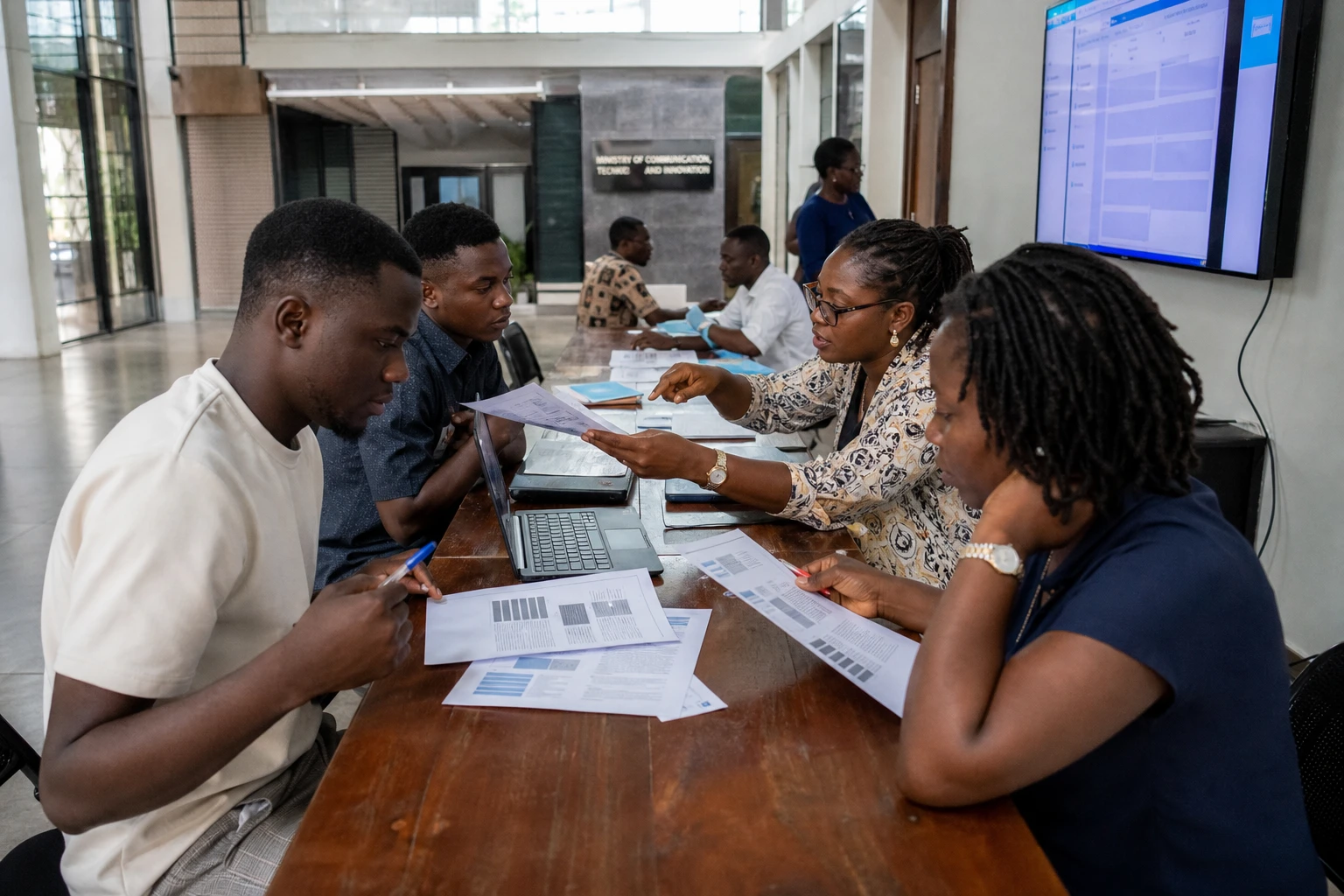
In Freetown, digital training becomes a tool of sovereignty
In many African countries, the question is no longer simply whether campuses have computers. It is who designs the tools, who maintains them and who retains control of the data. In Sierra Leone, this debate is taking a very concrete form: training students in digital public goods so that technology is not merely consumed, but also produced to meet local needs.
The country is part of a broader trajectory. Sierra Leone co-founded the Digital Public Goods Alliance in 2019 with Norway, UNICEF and India’s iSPIRT, an alliance that promotes open, reusable and interoperable digital solutions. The global framework students are now being introduced to, the DPG Standard, is part of this effort.
Eleven student projects assessed against an international standard
In Freetown, the Ministry of Communication, Technology and Innovation organised the first academic exhibition dedicated to Digital Public Goods. Eleven solutions designed by students were selected for assessment against the DPG Standard. The event builds on a momentum already evident at the country’s universities, where open digital technology is now integrated into teaching modules.
The associated university programme brings together the ministry, UNICEF, the United Nations University and Limkokwing University. Under the initiative presented by the partners, more than 1,100 students are receiving training in software development, technical documentation, interoperability and digital standards. Fourteen students were selected as university champions at four institutions, and more than half are women, an important detail in a sector still marked by significant gender imbalances.
This focus on students is not incidental. It shows that Sierra Leone is not simply seeking to expand short courses. It is also trying to establish a shared technical culture, with people capable of producing services useful to government departments, schools, hospitals and local authorities. In a country where the digital ecosystem is still taking shape, this approach may matter as much as major infrastructure projects.
Public policy aligns education, government and innovation
The shift under way in Freetown builds on national decisions already taken. In November 2025, the ministry approved the first open-source software policy for the public sector. The document advocates open solutions that cost less in the long term and are better suited to an administration seeking to retain control of its tools. A few days earlier, Sierra Leone and Nigeria held a bilateral mission on the digital economy in Freetown, a sign that the issue extends beyond academia.
The Medium-Term National Development Plan 2024–2030, launched in January 2024, places technology among national priorities. At the same time, the government is seeking to link training, employment and public services. This is also the thinking behind the innovation investment fund announced by the authorities, designed to support the skills needed to develop and sustain these digital tools.
In education, needs remain enormous. UNICEF says digital solutions must help children and adolescents learn, including in areas where connectivity is weak or uneven. This constraint is crucial in Sierra Leone, where digital access remains heavily concentrated in urban centres, chief among them Freetown. Across the country, the challenge is therefore not just technological. It is also geographical.
What the figures show: a skills gap, but also an opportunity
The continental picture helps explain the appeal of this strategy. In Africa’s Development Dynamics 2024, the African Union says only 5% of young Africans have intermediate digital skills and that the continent accounts for just 1.3% of global GitHub users, on a platform that has become a key reference point for developers. These figures point to a skills deficit, but also to immense scope for progress in countries that invest early in training.
Against this backdrop, Sierra Leone is trying to turn a shortfall into a strategic advantage. Training students in digital public goods means preparing developers who can work with open standards, document their code and build reusable solutions. In other words, tools that do not disappear when a pilot project ends. This approach is valuable for African administrations, which often depend on imported systems that are costly or difficult to adapt.
A signal for West Africa and the continent’s digital policies
The initiative reaches far beyond Freetown’s campuses. In West Africa, ECOWAS has for several years been seeking to accelerate digital integration, the movement of services and the harmonisation of frameworks. An initiative such as Sierra Leone’s is therefore of interest to the whole region, as it builds skills compatible with interoperability and, in turn, with regional markets and cross-border services.
For Sierra Leone’s authorities, the stakes are also political. If students trained in Freetown succeed in creating stable solutions, the country will be able to strengthen its public services without relying entirely on closed platforms. For young people, the stakes are more immediate: access to skilled jobs in a digital economy that is still small but set to expand. For universities, finally, the initiative tests a new role: producing graduates able to code, document, audit and share.
What happens next will depend on the long term. It remains to be seen whether student projects move from demonstrations to tools deployed in public services, whether the open-source software policy translates into concrete procurement and use, and whether Freetown can genuinely become a regional testing ground. On a continent where a shortage of digital skills continues to hold back innovation, this next phase will show whether Sierra Leone can go beyond a mere announcement.