Algeria
 Egypt
 Libya
 Morocco
 Sudan
 Tunisia
 Benin
 Burkina Faso
 Cabo Verde
 Côte d'Ivoire
 Ghana
 Guinea
 Guinea-Bissau
 Liberia
 Mauritania
 Niger
 Nigeria
 Senegal
 Sierra Leone
 The Gambia
 Togo
 Cameroon
 Central African Republic
 Chad
 DR Congo
 Equatorial Guinea
 Gabon
 Republic of the Congo
 São Tomé and Príncipe
 Burundi
 Comoros
 Djibouti
 Eritrea
 Ethiopia
 Kenya
 Madagascar
 Malawi
 Mauritius
 Mozambique
 Rwanda
 Seychelles
 Somalia
 South Sudan
 Tanzania
 Uganda
 Angola
 Botswana
 Eswatini
 Lesotho
 Namibia
 South Africa
 Zambia
 Zimbabwe
One corridor, two capitals and a reality broader than diplomacy
Between Dakar and Bamako, the issue is not just political. It is also logistical, economic and security-related. When the route comes under strain, it is drivers, traders, importers and households who feel the cost first.
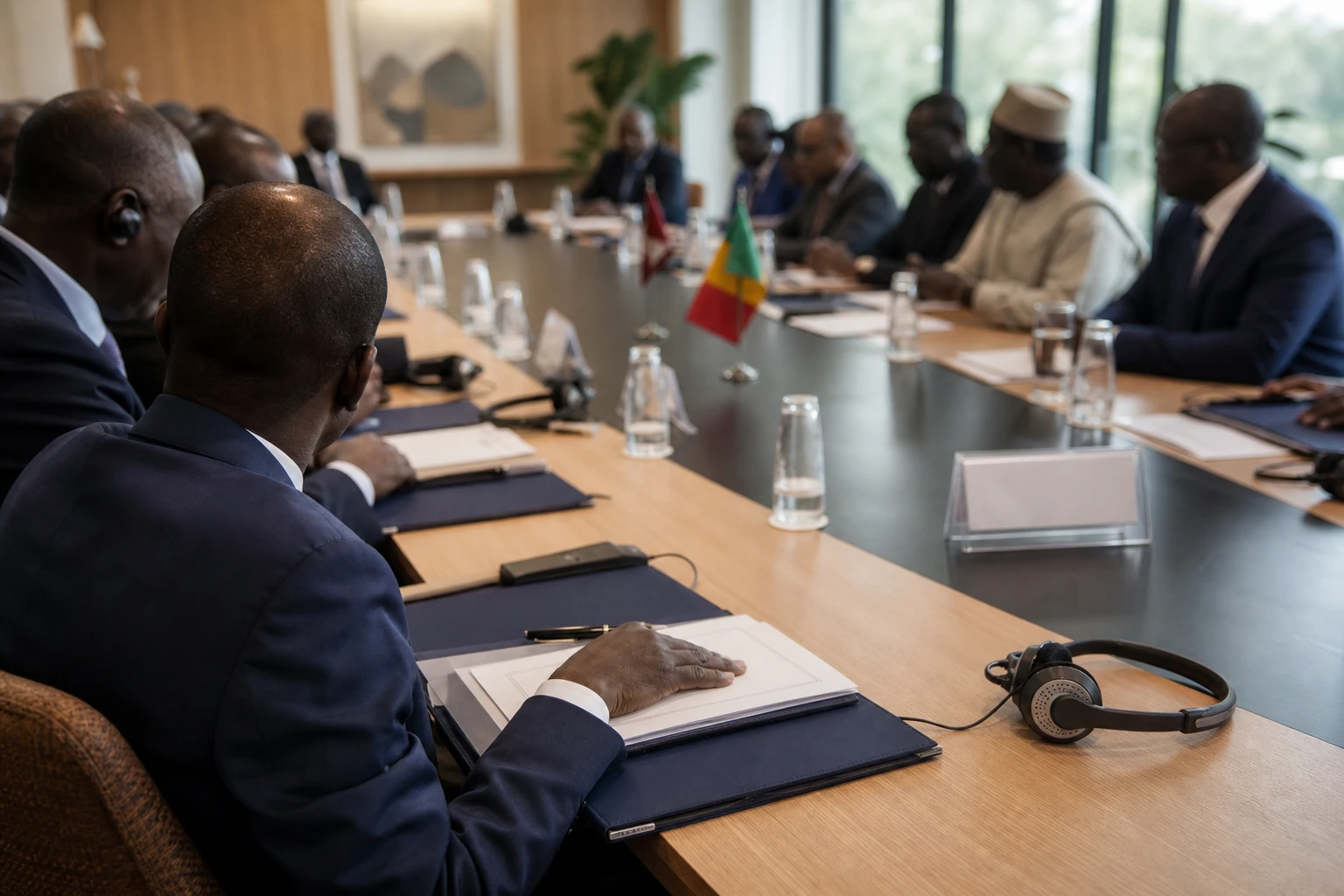
That is what gives the recent exchanges between Senegal and Mali particular significance. Senegalese President Bassirou Diomaye Faye, head of state since 2 April 2024, travelled to Bamako for a working and solidarity visit, according to several sources. It is an important signal at a time when West Africa is undergoing institutional realignment, with ECOWAS on one side and the Alliance of Sahel States, comprising Mali, Burkina Faso and Niger, on the other.
The understated but decisive weight of Senegal-Mali ties
Senegal and Mali are linked by a longstanding route, but above all by a very tangible dependence. The port of Dakar remains a major outlet for Malian trade. The Dakar-Bamako corridor plays a central role in supplying landlocked Mali and in Senegal’s port activity. The World Bank estimates that around 70% of Mali’s imports used this corridor, a figure that explains why any disruption is quickly felt on both sides of the border.
This helps explain the significance of the visit to Bamako. Dakar cannot treat relations with Mali as a mere diplomatic matter. They are also about securing flows, the port’s competitiveness and economic stability in the regions along the route, particularly in eastern Senegal. The Senegalese presidency has also regularly emphasised a diplomacy based on regional dialogue and practical cooperation, rather than gestures for show.
What the two presidents put on the table
In Bamako, discussions focused on very practical issues: securing the Dakar-Bamako corridor, energy cooperation and shared security challenges in the Sahel. This framing matters, as it shows that closer ties are not, in themselves, aimed at Mali’s return to ECOWAS institutions. Rather, the goal is to organise a minimal but useful coexistence between neighbours, despite the political rupture caused by military transitions in Mali, Burkina Faso and Niger.
The regional timetable also lends this initiative significance. On 19 July 2026, ECOWAS handed its rotating presidency to Bassirou Diomaye Faye at the Freetown summit. Senegal therefore finds itself in a singular position: speaking on behalf of a weakened West African organisation while maintaining a direct channel with AES states. This dual role demands a measured approach. Above all, it means avoiding postures that close doors without solving problems.
Security, trade and political balance
Security weighs heavily on the issue. In western Mali, particularly around Kayes, attacks and blockades attributed to Jama’at Nusrat al-Islam wal-Muslimin have repeatedly disrupted road routes linking Bamako to the ports on the West African coast. Amnesty International has documented attacks on fuel convoys and blockades aimed at choking supplies to the Malian capital. News agency reports also described a tightening of restrictions on roads leading to Bamako in spring 2026.
In this context, closer ties between Dakar and Bamako address an immediate need. For Mali, the priority is to secure a vital artery. For Senegal, it is to preserve a strategic trade outlet and prevent a weakened neighbour from becoming a lasting source of instability on its eastern border. Border communities do not read diplomatic communiqués. They watch fuel prices, road conditions and the movement of convoys.
Politically, the visit also signals a change in tone. The early years of the Sahel crisis were marked by sanctions, ruptures in established policy and deep polarisation between ECOWAS and the military juntas in power. Several West African capitals are now seeking more of a modus vivendi. That does not mean full normalisation. It means that neither side can do without the other for long without paying a high economic and security cost.
A development to watch beyond the bilateral meeting
This rapprochement will say much about West Africa’s next phase. If discussions produce concrete measures, however modest, they could serve as a model for other relations between ECOWAS and AES states. Conversely, if they remain at the level of intentions, the corridor will continue to bear the shocks of the Sahel crisis, with immediate effects on prices, delivery times and operators’ confidence.
The significance of this episode therefore extends beyond the Dakar-Bamako relationship. It touches on the future of regional integration in West Africa, the security of trade across a space where administrative borders do not always match economic realities, and leaders’ ability to discuss trade, security and sovereignty in the same breath. That is where the next regional balance will be decided, in very practical terms.