Algeria
 Egypt
 Libya
 Morocco
 Sudan
 Tunisia
 Benin
 Burkina Faso
 Cabo Verde
 Côte d'Ivoire
 Ghana
 Guinea
 Guinea-Bissau
 Liberia
 Mali
 Mauritania
 Niger
 Nigeria
 Senegal
 Sierra Leone
 The Gambia
 Togo
 Cameroon
 Central African Republic
 Chad
 DR Congo
 Equatorial Guinea
 Gabon
 Republic of the Congo
 São Tomé and Príncipe
 Burundi
 Comoros
 Djibouti
 Eritrea
 Ethiopia
 Kenya
 Madagascar
 Malawi
 Mauritius
 Mozambique
 Rwanda
 Seychelles
 Somalia
 South Sudan
 Tanzania
 Uganda
 Angola
 Botswana
 Eswatini
 Lesotho
 Namibia
 Zambia
 Zimbabwe
A first contract that gives an industrial bet commercial substance
In Pretoria, announcements about cleaner fuels have been coming one after another for years. But moving from the laboratory to the market remains the real hurdle. For a group such as Sasol, this step matters more than a mere public-relations exercise: it shows that a certified product can finally be sold through an identified commercial channel, with customers, traceability requirements and international outlets.
On 15 September 2026, Sasol announced a sustainable jet fuel supply agreement with White Desert, a tourism operator specialising in expeditions between Cape Town and Antarctica. The South African company describes the contract as its first commercial sale of SAF, the acronym for sustainable aviation fuel. The first flight powered by this fuel is scheduled for November, aboard an Airbus A340-600.
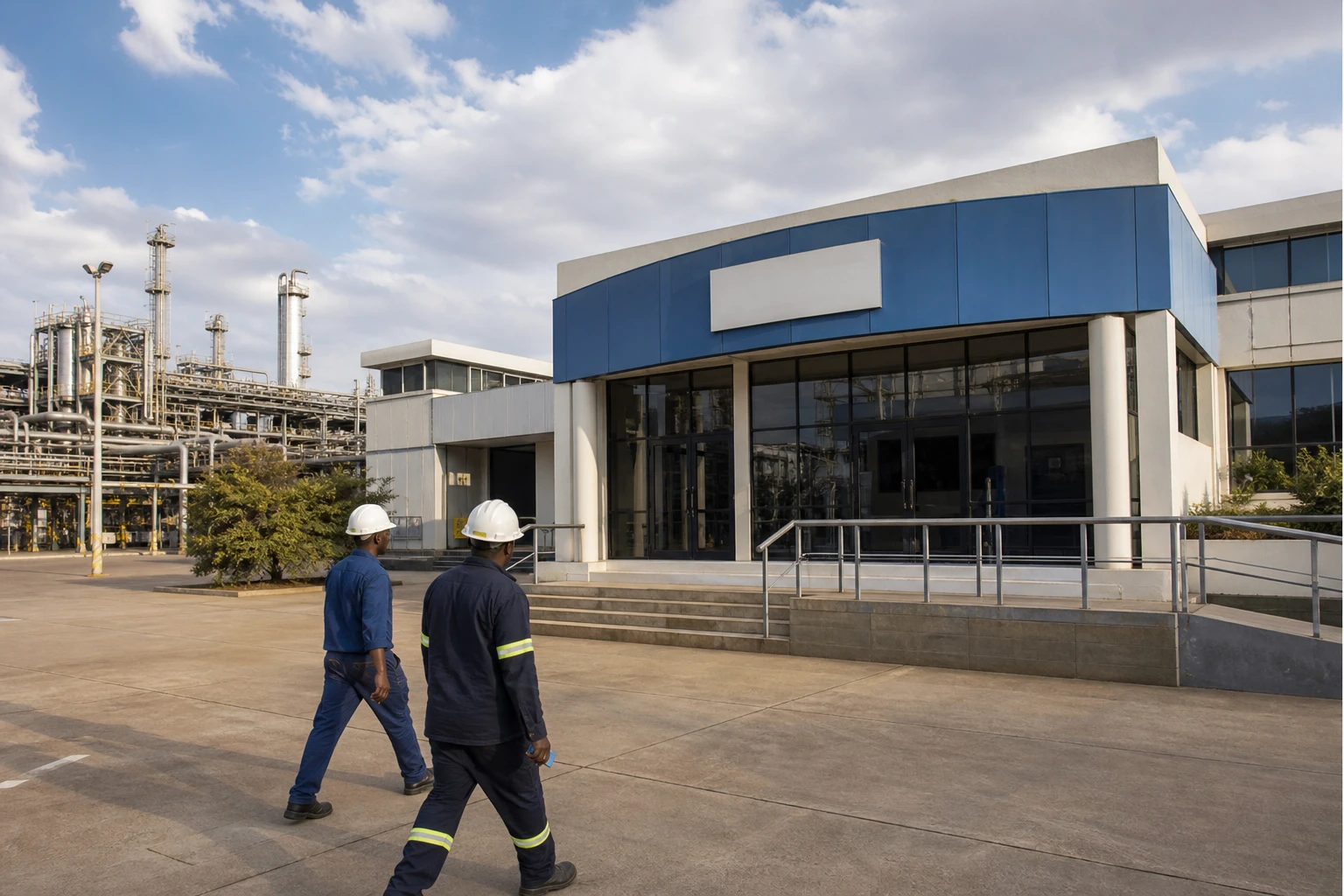
The product comes from the Natref refinery, located in South Africa and operated as part of Sasol’s petrochemical portfolio. Natref processes 108,500 barrels of crude oil a day, and Sasol is gradually introducing a hybrid model there, based on co-processing used cooking oils and vegetable oils in a conventional refining chain. This method avoids building a separate unit, reducing the industrial leap required to produce SAF in the short term.
Certification, regulation and the shift towards demanding markets
The real turning point came on 23 April 2026. On that day, Sasol said Natref had become the first refinery in Africa to obtain product sustainability certification for certain fuel production chains, following a final audit by TÜV SÜD under the ISCC PLUS standard. This accreditation covers, among other products, SAF and renewable diesel made through co-processing. Without this kind of certification, access to regulated markets remains very limited.
The regulatory context gives this shift its full significance. The European Union has adopted the ReFuelEU Aviation Regulation, which requires the gradual increase of sustainable fuel use in aviation, with a threshold of 2% from 2025, then 6% in 2030 and 70% in 2050. EASA and the European Commission say the standard is intended to structure the market and secure SAF supplies over the long term. For a South African producer, this gateway to Europe is therefore no minor matter.
White Desert is not a mass-market customer. That is precisely what makes the agreement credible at this stage. The operator runs a weekly rotation between Cape Town and Antarctica during the southern summer season, from November to February. It had already been using SAF for its Antarctic operations since 2021 and says it wants to expand its use in coming seasons. In other words, Sasol is not entering through the largest market, but through a premium segment that is smaller, more visible and already familiar with the technology.
What the contract says about South Africa and southern Africa
For South Africa, the stakes go beyond the product being sold. The country is seeking to turn a heavy industrial base, still closely tied to hydrocarbons and coal, into an asset for the transition. Sasol has already made clear that its ambition is not based solely on a test flight or a symbolic customer, but on increasing volumes, subject to demand. The group expects to produce one to two million litres this year, then around 16 million in 2027 and up to 100 million litres by 2030.
This trajectory has a tangible impact on the South African ecosystem. It could boost the collection of used oils, build new supply chains and create value around port logistics, refining and quality control. It also puts South Africa in a different position from that of a mere import market: Pretoria could become a regional supplier of higher-value products in southern Africa, where SADC has long promoted more integrated approaches to energy development.
The regional signal matters because the continent is not starting from scratch. In Kenya, Kenya Airways and Rubis Energy Kenya signed a memorandum of understanding in May 2026 to develop a dedicated SAF refinery in Nairobi, described as the first in East Africa. This shows the sector advancing through national projects, often still modest in scale, but now linked to a continent-wide drive to build expertise. South Africa, Kenya and other hubs could thus create an African network of sustainable fuels rather than relying solely on imports from Europe.
One major constraint remains: the SAF market is still small, expensive and heavily regulated. The challenge is therefore not just to produce, but to do so at a cost compatible with airlines, specialist operators and, eventually, broader commercial flights. That is where certification, reliable feedstock supplies and stable demand become decisive. In South Africa, the question is also social and territorial: how can this new value be captured without concentrating the benefits in a few large groups or undermining competing uses for recovered oils and fats?
Across the continent, this contract is a test. It will show whether Africa can participate not only in global SAF consumption, but also in its certified production. Above all, it will show whether countries with refining infrastructure, a strong chemicals industry and logistical access to international air routes can turn expertise inherited from the oil industry into a skill that serves the transition. The real issue now is no longer the announcement. It is the ability to meet volumes, standards and deadlines.