
 Algeria
 Egypt
 Libya
 Morocco
 Sudan
 Tunisia
 Benin
 Burkina Faso
 Cabo Verde
 Côte d'Ivoire
 Ghana
 Guinea
 Guinea-Bissau
 Liberia
 Mali
 Mauritania
 Niger
 Nigeria
 Senegal
 Sierra Leone
 The Gambia
 Togo
 Central African Republic
 Chad
 DR Congo
 Equatorial Guinea
 Gabon
 Republic of the Congo
 São Tomé and Príncipe
 Burundi
 Comoros
 Djibouti
 Eritrea
 Ethiopia
 Kenya
 Madagascar
 Malawi
 Mauritius
 Mozambique
 Rwanda
 Seychelles
 Somalia
 South Sudan
 Tanzania
 Uganda
 Angola
 Botswana
 Eswatini
 Lesotho
 Namibia
 South Africa
 Zambia
 Zimbabwe
In Yaoundé, a religious visit that goes beyond the church
In Yaoundé, protocol often says more than a long speech. When a leading religious figure is received at Nsimalen International Airport, the welcome is never merely spiritual. It also touches on diplomacy, the country’s history and the place of churches in Cameroonian society.
Cameroon is home to a religious mosaic in which Catholicism, historic Protestant denominations, evangelical churches and Islam coexist, with varying influence across regions. Anglicanism remains a relatively small but highly visible family in the anglophone West and in some urban circles. The Anglican Diocese of Cameroon belongs to the Church of the Province of West Africa, one of the constituent provinces of the worldwide Anglican Communion.
Sarah Mullally’s visit, as spiritual head of the Church of England and Archbishop of Canterbury, therefore takes place in a setting where religion, colonial history and the anglophone question remain closely linked. The ecclesiastical province covers several West African countries, including Cameroon, and the archbishop is making the trip at the invitation of the province’s primate.
What we know about the visit and why it matters beyond worship
According to Cameroon’s Ministry of External Relations, Sarah Mullally’s visit was prepared in Yaoundé at a meeting chaired on 20 July 2026 by minister Lejeune Mbella Mbella. The announced stay runs from 31 July to 4 August 2026. This timetable was confirmed by the office of the Archbishop of Canterbury, which announced a ten-day tour of Ghana and Cameroon starting on 26 July 2026.
Her arrival in Cameroon marks the first stage of the visit in the country. In public remarks reported in Yaoundé, Sarah Mullally described her trip as a pastoral visit, intended to pray, worship with the Anglican Church and encourage its ministry. Such language is standard in religious diplomacy, but it carries particular significance here. In recent years, Cameroon has experienced a succession of security and social tensions, especially in the North-West and South-West regions.
The country continues to face the anglophone crisis, a conflict rooted in political, legal and identity-based demands in the historically anglophone regions. The United Nations still describes the situation in Cameroon as a complex humanitarian and security crisis, marked by persistent insecurity and structural vulnerabilities. The anglophone conflict is therefore not a distant backdrop: it continues to shape daily life, travel, schooling, the local economy and trust between communities.
This also explains the attention paid to cities such as Buea and Limbe in the South-West, which have been announced as stops on her Cameroon tour. In this area, churches remain places of service, listening and, at times, mediation. They welcome worshippers, as well as displaced families, young people who have dropped out of school and communities seeking spaces for peace.
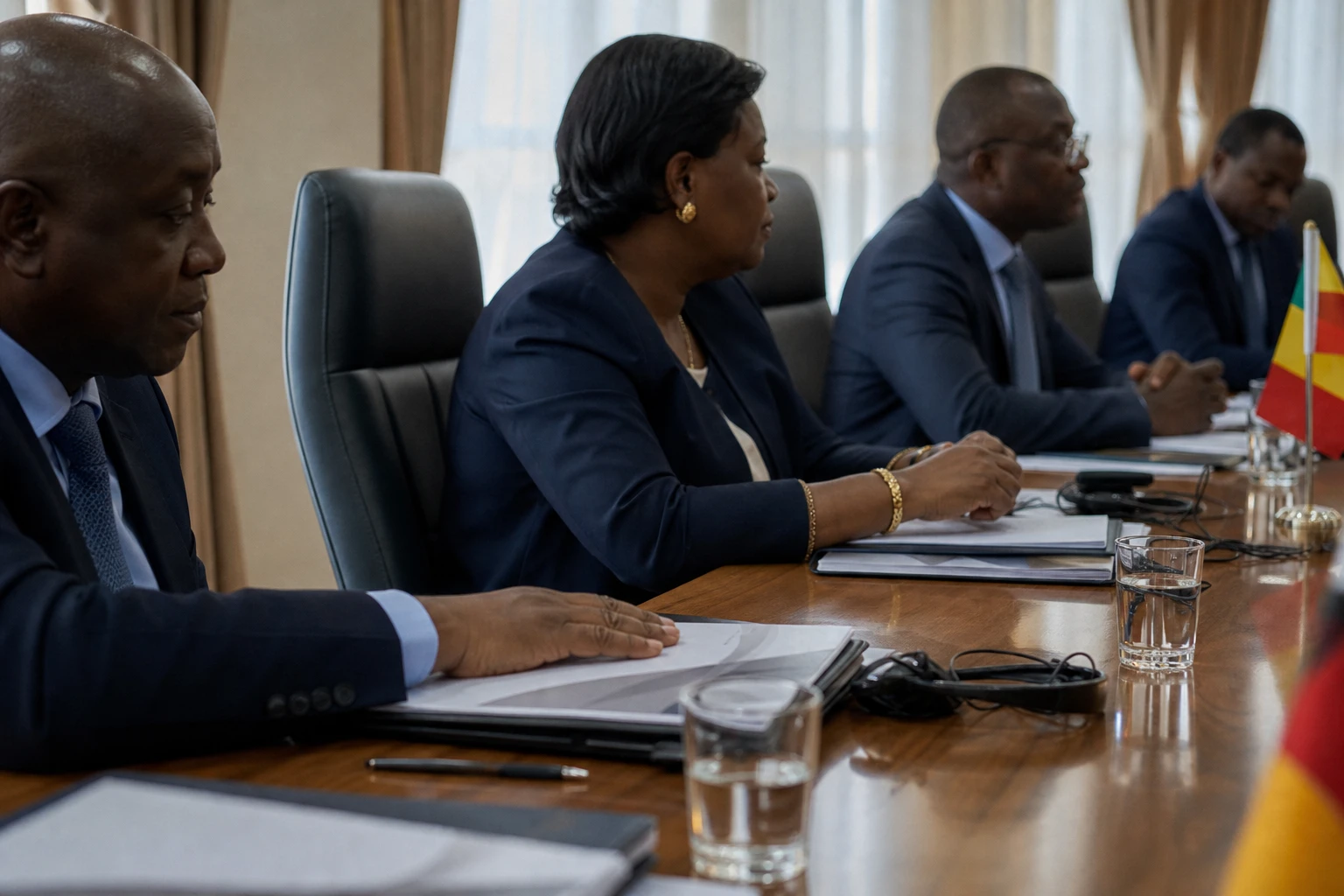
The welcome in Yaoundé also has institutional significance. The presence among the officials of Paul Atanga Nji, the Minister of Territorial Administration, shows that the state regards the visit as a public event, rather than simply an internal visit to a religious community. In a country where the authorities closely monitor large religious gatherings, this signal matters. It reflects the place of churches in Cameroonian social life, as well as the government’s interest in channels of influence capable of reaching diverse populations.
For Anglican worshippers, the visit is first and foremost symbolic. It raises their profile in a country where they are a religious minority. For communities in the South-West, it can also be seen as a mark of attention to territories too often reduced to their security dimension alone. In a region often portrayed through the lens of clashes, the arrival of an international religious leader is a reminder that pastoral life, educational networks and hopes for reconciliation also exist.
A signal for Cameroon and anglophone Africa
Sarah Mullally’s visit resonates beyond Cameroon because it concerns a church community with deep roots in Africa. The Anglican Communion has a strong presence on the continent, and several of its African provinces play a major role in internal debates within global Anglicanism. Africa’s influence there is longstanding, structural and often doctrinally conservative.
In this context, the presence of the first woman to lead the Church of England has particular significance. It comes as the Anglican Communion faces tensions over authority, doctrine and governance. The debates are well known, but their impact in Africa varies from one province to another and according to local sensibilities. Cameroon is not at the centre of the most visible splits, but it is part of a setting where the balance between orthodoxy, provincial autonomy and the historic link to Canterbury is closely watched.
For Yaoundé, this kind of visit is also a way to assert its role as a regional crossroads in Central Africa. The Cameroonian capital regularly hosts diplomatic, religious and institutional gatherings. This strengthens its status as a place for dialogue at a time when the country is seeking to combine political stability, management of the anglophone crisis and the maintenance of regional balances within CEMAC, the Central African Economic Community.
The next few days will be decisive, with planned stops in the South-West and discussions with local church leaders. If the visit is pastoral in form, in substance it will be read as a discreet test of the capacity to listen to a prolonged crisis. In Central Africa, as elsewhere on the continent, churches are never entirely removed from political tensions. They bear their effects, but they can also provide spaces for discussion that civil institutions sometimes struggle to open.



