Algeria
 Egypt
 Libya
 Morocco
 Sudan
 Tunisia
 Benin
 Burkina Faso
 Cabo Verde
 Côte d'Ivoire
 Ghana
 Guinea
 Guinea-Bissau
 Liberia
 Mali
 Mauritania
 Niger
 Nigeria
 Senegal
 Sierra Leone
 The Gambia
 Togo
 Cameroon
 Central African Republic
 Chad
 DR Congo
 Equatorial Guinea
 Gabon
 Republic of the Congo
 Burundi
 Comoros
 Djibouti
 Eritrea
 Ethiopia
 Kenya
 Madagascar
 Malawi
 Mauritius
 Mozambique
 Rwanda
 Seychelles
 Somalia
 South Sudan
 Tanzania
 Uganda
 Angola
 Botswana
 Eswatini
 Lesotho
 Namibia
 South Africa
 Zambia
 Zimbabwe
A vote under scrutiny in a country where every institutional move matters
In São Tomé, a peaceful election might seem unremarkable. Yet in an archipelago of 235,536 inhabitants, every election carries far more weight than simply changing the face of the presidency. It tests the strength of institutions, party discipline and the confidence of an electorate that is often called upon to vote, but rarely reassured by political life. Sunday 19 July 2026 began with hesitation before returning to a more orderly course, in a country that remains under close scrutiny for its democratic stability.
This first round also comes in a specific regional context. São Tomé and Príncipe belongs to ECCAS, the Economic Community of Central African States, a region where governance, the movement of goods and institutional security are regularly linked. The European Union also deployed an election observation mission at the request of the São Toméan authorities, with a team of 30 observers announced for polling day.
Localised blockades in the morning, then voting returns to normal
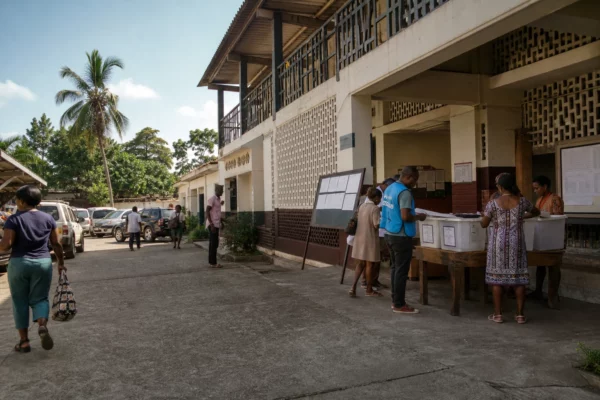
The first hours of voting were marked by low turnout in several districts. Two locations in the south of the capital, São Tomé, drew particular attention: Rolas Islet and Messias Alves beach. In these areas, ballot boxes could not be delivered immediately because of a boycott. The National Electoral Commission, led by Jeudiger Nascimento, acknowledged its concern over visible abstention at several polling stations, without giving an official figure at this stage.
As the day went on, however, the situation calmed. The European Union’s observation mission described a calm, peaceful and orderly atmosphere, with no major incident reported by midday. The European team had begun deploying on 14 June, with a core team of seven analysts, followed by 14 short-term observers who joined the field on 15 July. The mission also included long-term observers deployed across São Tomé and Príncipe Island.
The election timetable had already been set several months earlier. President Carlos Vila Nova had scheduled the first round of the presidential election for 19 July 2026, with a possible second round on 9 August 2026 if no candidate secured an absolute majority. Parliamentary, local and regional elections are scheduled for 27 September 2026.
A contest within the outgoing majority, rather than a battle between opposing camps
The first round featured four candidates, but the contest centred mainly on two figures from the same political family: incumbent president Carlos Vila Nova and Nito d’Abreu. This gives the vote the character of an internal contest within ADI, the Independent Democratic Action, rather than a conventional clash between opposing camps. The other candidates, lawyer Miques João and economist Eugénio Tiny, played a more limited political role in the campaign narrative.
Carlos Vila Nova’s name remains associated with a turbulent institutional episode. In January 2025, he dismissed Patrice Trovoada’s government. Later, the Constitutional Court ruled that the decision was contrary to the São Toméan Constitution, although its effect was limited to the future, according to reports in January 2026. The ruling fuelled a wider debate over the balance of powers, but did not trigger a lasting institutional rupture.
In this context, the incumbent campaigned on political stability. This is a familiar argument in a small island state where the executive, parliament, judiciary and security services have little room for manoeuvre. ECCAS, for its part, stresses regional integration, institutional peace and democratic consolidation. For São Tomé and Príncipe, this stability is not abstract: it shapes the country’s economic appeal, its ability to absorb aid and its credibility abroad.
What this election says about São Toméan democracy
The calm observed on Sunday confirms a point often made about São Tomé and Príncipe: its relatively peaceful electoral culture, especially compared with more fragmented political arenas elsewhere in Africa. But calm alone is not enough to dispel the fault lines. The morning boycott, falling turnout and competition between camps rooted in the same party base point to a political life shaped by personal rivalries, internal manoeuvring and strong social expectations.
For voters, the stakes are tangible. In São Tomé, institutional politics is quickly judged by its impact on everyday life: continuity of services, management of the cost of living, confidence in the justice system and the state’s ability to avoid repeated crises. For political leaders, the vote is also a test of internal discipline. When the incumbent and a rival fly the same flag or claim to represent it, the presidential election becomes a decision on the direction of the dominant camp, not just on a platform.
The significance of the vote also extends beyond the archipelago. In Central Africa, ECCAS is seeking to strengthen its cooperation and stability mechanisms. In that context, every election held without incident in São Tomé and Príncipe sends a positive signal to the region. The question now is whether a second round will be needed, and whether the 2026 electoral sequence will confirm this initial lesson: the country is moving forward, but under strain, with institutions still having to prove their resilience at every stage.