Algeria
 Egypt
 Libya
 Morocco
 Sudan
 Tunisia
 Benin
 Burkina Faso
 Cabo Verde
 Côte d'Ivoire
 Ghana
 Guinea
 Guinea-Bissau
 Liberia
 Mali
 Mauritania
 Niger
 Nigeria
 Senegal
 Sierra Leone
 The Gambia
 Togo
 Cameroon
 Central African Republic
 Chad
 DR Congo
 Equatorial Guinea
 Gabon
 Republic of the Congo
 Burundi
 Comoros
 Djibouti
 Eritrea
 Ethiopia
 Kenya
 Madagascar
 Malawi
 Mauritius
 Mozambique
 Rwanda
 Seychelles
 Somalia
 South Sudan
 Tanzania
 Uganda
 Angola
 Botswana
 Eswatini
 Lesotho
 Namibia
 South Africa
 Zambia
 Zimbabwe
In São Tomé, a tense presidential election with no change of course
In São Tomé, an election is never decided solely at the ballot box. It also says something about the stability of a small island state that is banking on institutional continuity, its diaspora and the still unrealised promise of its offshore resources. This time, Sunday’s presidential election is taking place in a narrowed field dominated by two names, as the campaign draws to a close in a measured atmosphere.
São Tomé and Príncipe is part of Central Africa and remains a member of the Economic Community of Central African States, ECCAS, where political stability and regional integration are particularly important issues for a small archipelago. The country also has strong ties to the Portuguese-speaking world through the CPLP, which is often present during electoral periods.
Four active candidates, but a contest already narrowed
The Constitutional Court approved five candidacies for the 19 July 2026 presidential election before rejecting that of businessman Nino Monteiro. The approved candidates were Carlos Vila Nova, Nito D’Abreu, Jorge Bom Jesus, Miques João Bonfim and Eugénio Tiny. The rejection of Nino Monteiro was based on questions of nationality and irregularities in his application, according to the court’s published ruling.
Later, former prime minister Jorge Bom Jesus announced that he was withdrawing from the race. But the withdrawal came after the legal deadline, which explains why his name remains printed on the ballot papers. On the ground, this leaves four genuinely active candidacies, with the political contest largely focused on a face-off between incumbent president Carlos Vila Nova and MP Nito D’Abreu.
This has a straightforward consequence for voters: the ballot paper will show more names than the campaign’s actual debate. In an election across a country of 964 square kilometres, this discrepancy matters, as it could cause confusion at polling stations where a clear choice remains essential.
A closely monitored vote, from central São Tomé to the diaspora
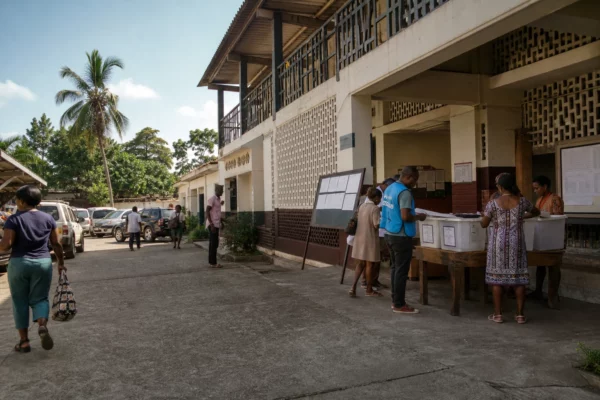
The National Electoral Commission has set the electorate at 142,191 registered voters, including 121,670 in the archipelago and 20,521 in the diaspora. The number of voters abroad is significant for a country where family, economic and political ties cross borders, particularly with Portugal and other host countries.
The vote has also attracted several observer missions. The European Union has deployed a mission for the 19 July presidential election and the other polls scheduled for later in the year. The CPLP has also formed its own mission at the request of the São Toméan authorities, while the African Union has confirmed its presence through its election observation mechanisms.
This international monitoring is not a trivial matter. In São Tomé and Príncipe, changes of government have generally taken place within preserved institutional frameworks, but elections remain sensitive because they can usher in, or bring an end to, periods of cohabitation between the president and a government of a different political hue. The country has already experienced this kind of often fragile balance, in which the Cor-de-Rosa Palace must work with a politically different National Assembly.
What this election says about the country, and beyond
Ultimately, the issue goes beyond the identity of the next head of state. The São Toméan president does not directly run the executive on a day-to-day basis, but has an influence on institutional stability, the appointment of certain officials and political arbitration in a system where government crises are more frequent than crises of regime. For the population, this translates very concretely into an expectation of clarity, continuity and predictability, particularly in a country with a narrow economy that is dependent on vulnerable sectors.
The oil question illustrates this tension. São Tomé and Príncipe continues to be described as a country with significant offshore potential, but with no commercial hydrocarbon production to date. Political debate is therefore still shaped by the promise of economic diversification, spanning fishing, cocoa, services, tourism and maritime appeal, rather than by revenue that is already available.
In this context, the presidential election is also a test of democratic credibility. For ECCAS, which is seeking to consolidate frameworks for peace and integration in a region often shaken by difficult transitions, São Tomé’s case matters. For the CPLP, it is another reminder that elections in Portuguese-speaking Africa are closely monitored, not as a formality but as an indicator of how institutions are functioning.
The next stages of the calendar will matter just as much. After the presidential election, São Toméans will go to the polls for legislative, local and regional elections scheduled for 27 September. In other words, the July vote does not close the political cycle; it opens it. And it is often in the interplay between a presidential election and the balance of forces to come that the true meaning of the political moment in São Tomé emerges.