Algeria
 Egypt
 Libya
 Morocco
 Sudan
 Tunisia
 Benin
 Burkina Faso
 Cabo Verde
 Côte d'Ivoire
 Ghana
 Guinea
 Guinea-Bissau
 Liberia
 Mali
 Mauritania
 Niger
 Nigeria
 Senegal
 Sierra Leone
 The Gambia
 Togo
 Cameroon
 Central African Republic
 Chad
 DR Congo
 Equatorial Guinea
 Republic of the Congo
 São Tomé and Príncipe
 Burundi
 Comoros
 Djibouti
 Eritrea
 Ethiopia
 Kenya
 Madagascar
 Malawi
 Mauritius
 Mozambique
 Rwanda
 Seychelles
 Somalia
 South Sudan
 Tanzania
 Uganda
 Angola
 Botswana
 Eswatini
 Lesotho
 Namibia
 South Africa
 Zambia
 Zimbabwe
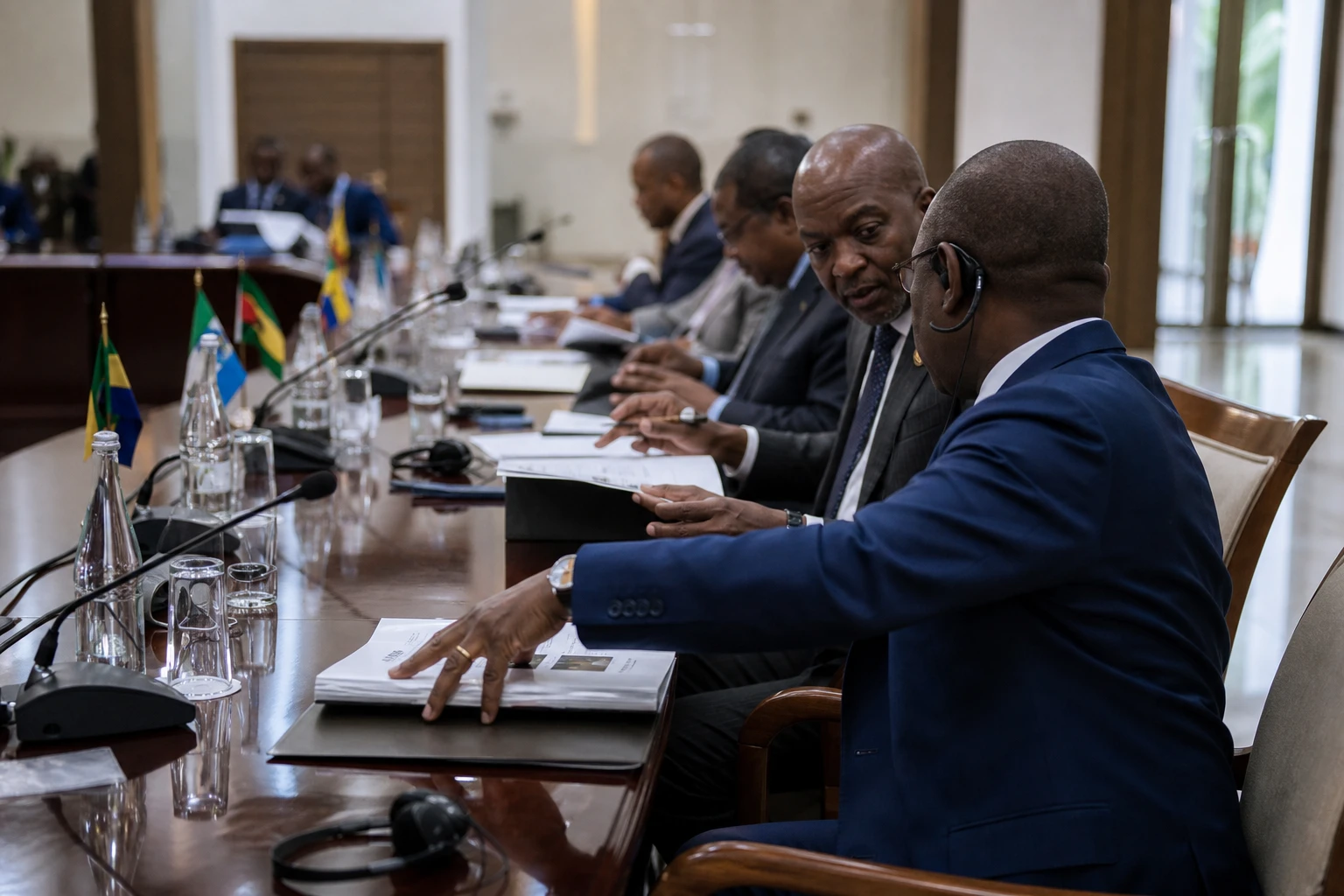
In Paris, Libreville seeks to consolidate a partnership without papering over new divisions
When a Gabonese head of state arrives in Paris for a state visit, the agenda is never limited to contracts alone. It also touches on Gabon’s place in the Francophone balance, its diplomatic room for manoeuvre and how the authorities respond to domestic criticism. This time, too, the visit comes at a charged moment: Brice Clotaire Oligui Nguema is in France from 19 to 22 July 2026 at Emmanuel Macron’s invitation, with economic, cultural and military issues on the agenda.
The regional context matters as much as protocol. Gabon belongs to CEMAC, the Economic and Monetary Community of Central Africa, where states closely monitor their neighbours’ institutional stability. At continental level, the African Union has reiterated since 2023 that a return to constitutional order must go hand in hand with credible political dialogue. In 2026, the organisation continues to support Libreville while remaining attentive to democratic safeguards.
Highly political state visit as opposition remains under pressure
Brice Clotaire Oligui Nguema’s visit comes amid a Franco-Gabonese relationship that both capitals describe as historic. The Gabonese presidency said it wanted to discuss the economic transformation under way in Libreville, as well as prospects for strategic cooperation. Gabon’s foreign ministry confirmed that the president had arrived at Orly for a three-day visit, from 19 to 22 July.
But the diplomatic stage is set against a more tense backdrop. Alain-Claude Bilie-By-Nze, a former prime minister and Brice Clotaire Oligui Nguema’s main opponent in the 2025 presidential election, has been held in pre-trial detention since 16 April 2026. On 2 June, the Libreville Court of Appeal rejected his application for release, keeping him behind bars. Several African media outlets and the AP reported that his party denounced the proceedings as arbitrary, while the head of state denied any executive interference in the case.
The court case is now weighing on the image of Gabon’s authorities as they seek to present themselves as a stabilising force, having emerged from the transition that began after the August 2023 coup. The African Union welcomed steps towards ending the transition in 2024 and again in 2026, while reiterating the need for inclusive governance. In short, institutional normalisation alone is not enough: it must also be reflected in the treatment of political opponents.
What this moment says about Gabon in 2026
For Gabon’s authorities, the Paris visit is an opportunity to secure economic and technical support as Libreville seeks to revive local resource processing, modernise infrastructure and reassure investors. For the opposition, by contrast, it offers a chance to draw international attention to persistent political restrictions. The contrast is clear: on one side, an executive touting restored stability; on the other, a political opponent held in prison in a case that has become symbolic.
This tension is not unique to Gabon, but it takes a particular form there. In several countries in Central and West Africa, the end of a crisis is judged less by the wording of laws than by practice: independent justice, freedom of expression and genuine political competition. Gabon, which wants to become a reliable partner again in the CEMAC region, knows it will also be judged on these grounds. This is where the visit’s continental significance lies: it will say less about the state of a bilateral relationship than about how a regime born of a transition intends to reconcile diplomatic openness with domestic political control.
The coming days will therefore be decisive on two fronts. In Paris, Libreville is seeking concrete commitments. In Libreville, Bilie-By-Nze’s detention continues to fuel debate over the rule of law. Between the two, the African reading of the case remains the same: lasting stability is measured not only by the quality of handshakes, but by the confidence that institutions inspire across the political spectrum.