Algeria
 Egypt
 Libya
 Morocco
 Sudan
 Tunisia
 Benin
 Burkina Faso
 Cabo Verde
 Côte d'Ivoire
 Ghana
 Guinea
 Guinea-Bissau
 Liberia
 Mali
 Mauritania
 Niger
 Senegal
 Sierra Leone
 The Gambia
 Togo
 Cameroon
 Central African Republic
 Chad
 DR Congo
 Equatorial Guinea
 Gabon
 Republic of the Congo
 São Tomé and Príncipe
 Burundi
 Comoros
 Djibouti
 Eritrea
 Ethiopia
 Kenya
 Madagascar
 Malawi
 Mauritius
 Mozambique
 Rwanda
 Seychelles
 Somalia
 South Sudan
 Tanzania
 Uganda
 Angola
 Botswana
 Eswatini
 Lesotho
 Namibia
 South Africa
 Zambia
 Zimbabwe
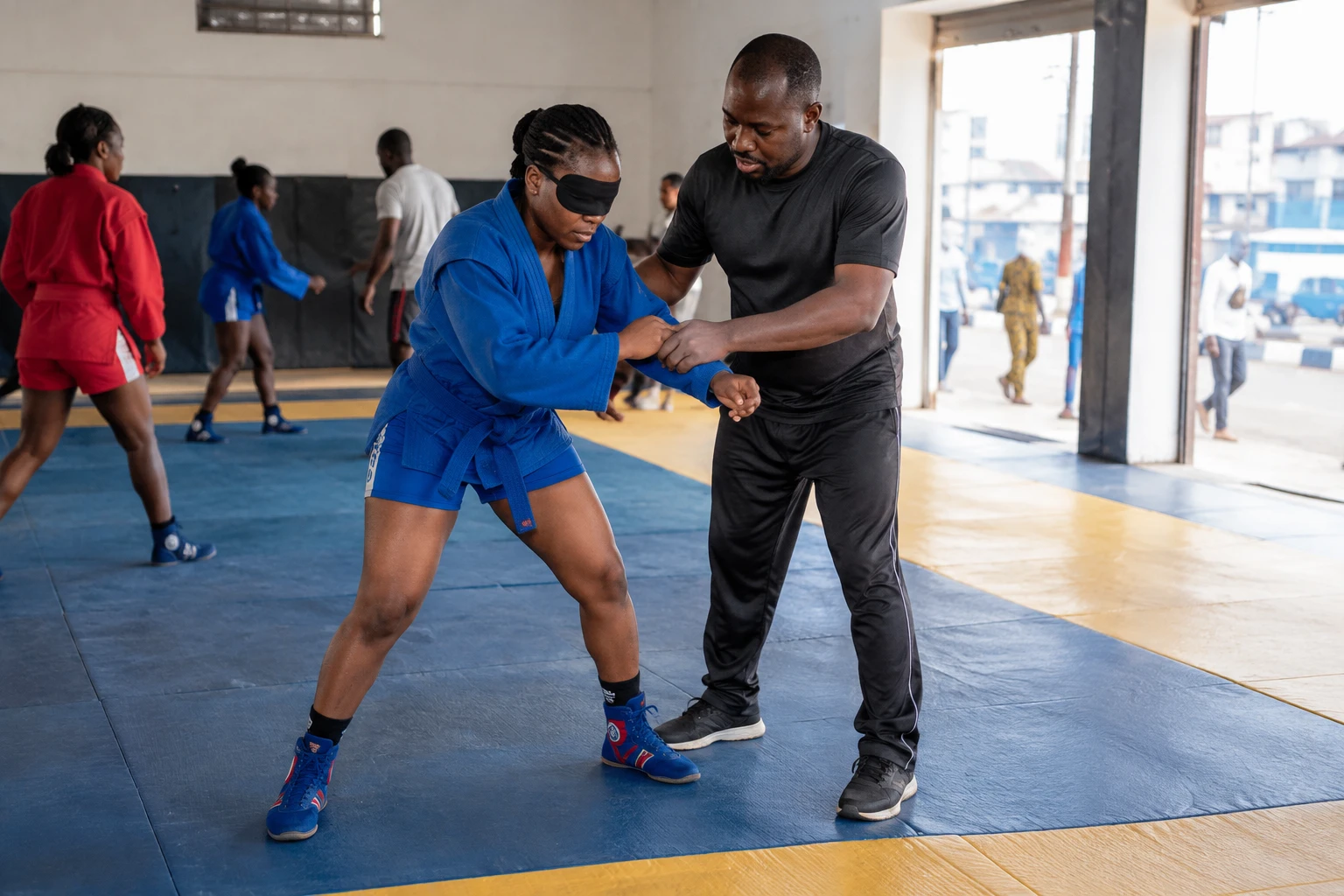
In Lagos, getting to training can already be a test of transport and finances. For Rukayat Taiwo Suleimon, those obstacles have not stopped at the door of the mat: they have followed a career that has just put Nigeria in the spotlight for sambo adapted for blind athletes.
In April 2026, the Nigerian athlete won gold in the 54kg category at the Sambo World Cup in Yerevan, Armenia. Her victory marks a first for blind women at an international sambo competition recognised by the world federation. It also raises a very practical question: how can an individual achievement be turned into a sustainable sporting career?
A historic win in a growing sport
Sambo is a combat sport that originated in the Soviet Union. It combines throwing techniques and ground wrestling, among other elements. In the version for blind athletes, tactile cues and referees’ instructions play an essential role. The sport therefore requires both physical preparation and tailored support.
In Yerevan, Suleimon defeated Uzbekistan’s Charos Ortikova 13-2 in the final, according to the International Sambo Federation and Nigerian daily The Punch. It was her first international competition. The result is corroborated by these two sources, one an international sports body and the other a Nigerian media outlet.
The achievement comes at an unprecedented moment for the sport. In Yerevan, blind women took part for the first time in an international competition organised by the International Sambo Federation (FIAS). Suleimon was joined by compatriot Elizabeth Aseso, who competed in the 59kg category. Aseso did not reach the podium, but their joint presence gave Nigeria a pioneering role in this opening-up of the sport.
Suleimon’s success extends the recent progress of blind sambo in Nigeria. In 2024, Samuel Oladele Kekere became the first blind African athlete to compete at the sport’s world championships. In 2025, Sodiq Ajibade won bronze at those championships, according to FIAS. Suleimon’s medal marks another step: after a first appearance and then a men’s podium finish, a Nigerian woman has now won gold at the World Cup.
Sport as a pathway, not a story of resilience
Suleimon lost her sight in 2009, after operations that did not prevent the progression of glaucoma, a disease that damages the optic nerve. She later joined a vocational training centre for blind people in Lagos. A meeting with a coach led her to para-athletics, then to judo and sambo.
Since 2011, she has won more than 20 national medals in sprinting, discus and shot put, according to information reported by FIAS. Her career is therefore not simply a story of an unexpected victory. It reflects years of training in several sports, before her international sambo debut.
This distinction matters. Telling her story solely as one of individual triumph would obscure the conditions that make a career possible: an accessible training venue, qualified coaches, equipment, competitions and funded travel. Suleimon says the journey to training and its cost make it difficult to stick to a regular programme. She also says the recognition generated by her results has not translated into sufficient support in Nigeria.
Sherif Hammed, vice-president of the Nigeria Sambo Association, has also cited a lack of resources and specialised facilities. These remarks, reported in the article about the athlete, remain attributed testimony: on their own, they do not amount to a national assessment of funding. They nevertheless highlight the gap between international medals and the resources needed to prepare for them.
This gap can affect athletes in different ways. In Lagos, transport costs and access to facilities directly determine whether athletes can attend training sessions. For blind women athletes, the availability of support and adapted training arrangements adds a particular challenge. A medal does not resolve these difficulties; it makes the responsibility of sports bodies and public authorities more visible.
From Lagos to the regional and global stage
Nigeria is part of a West African sporting landscape in which national federations are seeking to develop disciplines that receive less media attention than football or athletics. ECOWAS, the Economic Community of West African States, is a regional organisation for political and economic co-operation. It is not organising this World Cup, but the movement of athletes and expertise within the region can help build stronger sporting pathways.
The stakes go beyond Nigeria. Suleimon and Aseso’s participation brings African women into a category that had until now been absent from international blind sambo competitions. It also challenges sports bodies not to confuse inclusion on a programme with genuine access to participation: adding an event to the calendar guarantees neither funding, transport nor continuity of training.
The next event is already on the calendar: the Sambo World Championships will take place in Tashkent, Uzbekistan, from 6 to 8 November 2026. FIAS says the programme includes women’s blind sambo. Nigeria has named Suleimon in its delegation, according to Nigerian daily The Guardian Nigeria. Her performance in Yerevan shows her potential; what comes next will also depend on the conditions that allow her to keep training and competing.
For African sport, the story does not end on the podium. It will be shaped by the ability of federations and public authorities to support athletes after the applause, without reducing their role to a fleeting source of pride. Suleimon’s journey highlights both a Nigerian success and the institutional work still needed to enable other women to step on to the mat.