Algeria
 Egypt
 Libya
 Morocco
 Sudan
 Tunisia
 Benin
 Burkina Faso
 Cabo Verde
 Côte d'Ivoire
 Ghana
 Guinea
 Guinea-Bissau
 Liberia
 Mali
 Mauritania
 Niger
 Senegal
 Sierra Leone
 The Gambia
 Togo
 Cameroon
 Central African Republic
 Chad
 DR Congo
 Equatorial Guinea
 Gabon
 Republic of the Congo
 São Tomé and Príncipe
 Burundi
 Comoros
 Djibouti
 Eritrea
 Ethiopia
 Kenya
 Madagascar
 Malawi
 Mauritius
 Mozambique
 Rwanda
 Seychelles
 Somalia
 South Sudan
 Tanzania
 Uganda
 Angola
 Botswana
 Eswatini
 Lesotho
 Namibia
 South Africa
 Zambia
 Zimbabwe
A reassuring signal, but no blank cheque
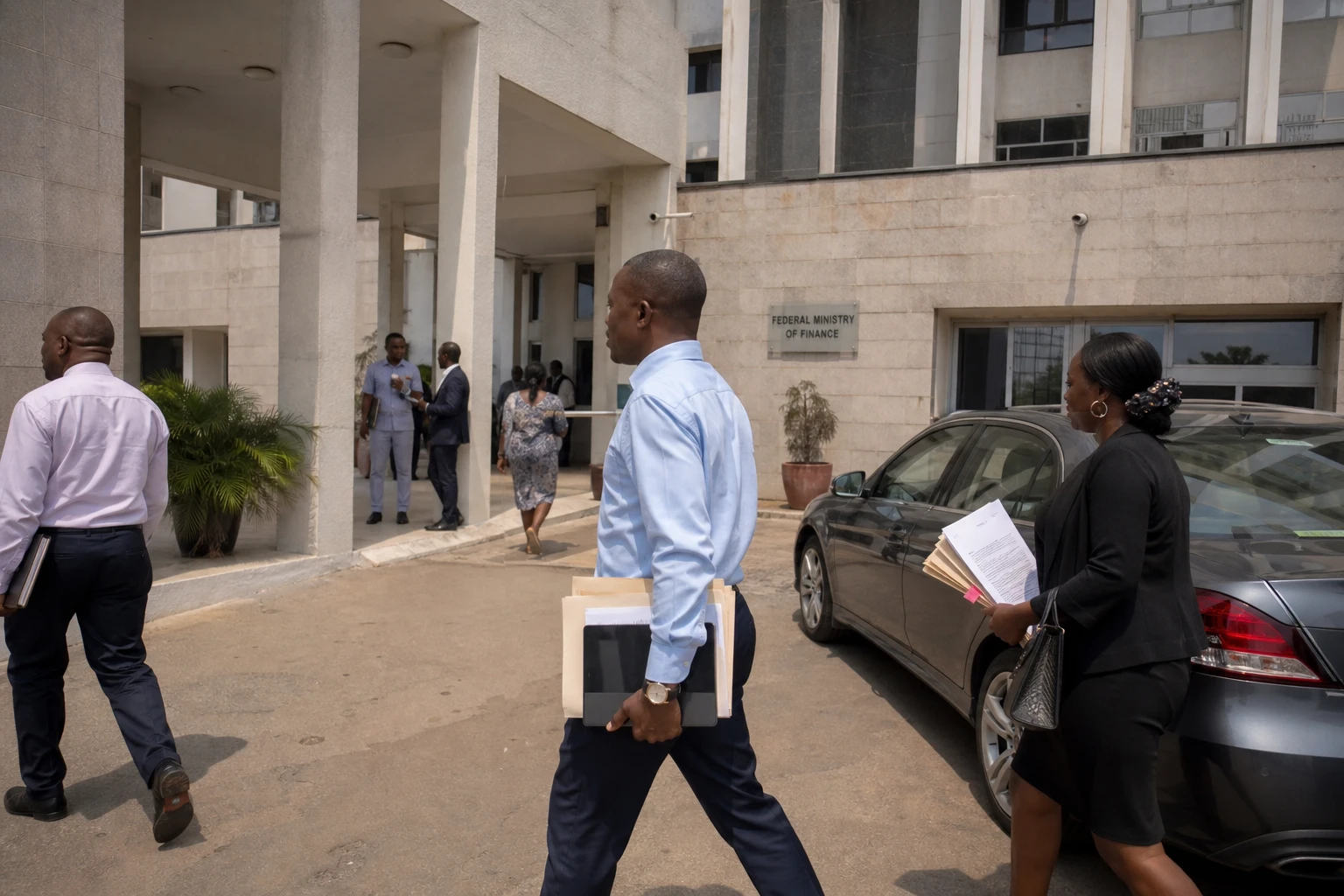
In Abuja, the message from rating agencies amounts to a partial green light. Nigeria is gaining external credibility, but it has yet to shake off its underlying vulnerabilities. Foreign-exchange reserves have strengthened, economic activity is picking up and the currency has regained some breathing space. However, weak public revenues, the burden of debt and social tensions continue to constrain the Nigerian government’s room for manoeuvre.
This contrast is no minor matter. In West Africa’s largest economy, market perceptions matter as much as the reforms themselves. They determine the state’s borrowing costs, the price of credit for businesses and, ultimately, the country’s ability to turn recovery into sustainable growth.
Visible reforms under ECOWAS scrutiny
Nigeria remains a pillar of ECOWAS, the Economic Community of West African States, whose economic stability affects the entire sub-region. When Abuja makes a move, regional markets take note. The country also remains a key indicator for investors looking at West Africa beyond its crises, in terms of its productive capacity, domestic market and weight in trade flows.
Since Bola Tinubu took office as president in 2023, the authorities have embarked on far-reaching reforms. The removal of fuel subsidies and liberalisation of the foreign-exchange market have fundamentally altered the macroeconomic balance. S&P explicitly linked its May 2026 decision to this reform drive, higher oil production, stronger domestic refining and an improved external position.
The IMF has also noted an improvement in Nigeria’s growth outlook. It estimated real growth at 4% in 2025 and 4.1% in 2026, while pointing out that inflation remains a drag on households and businesses. The Nigerian Bureau of Statistics, for its part, reported growth of 3.89% in the first quarter of 2026, confirming a faster pace than in the same period of 2025.
Moody’s, S&P and Fitch see the same improvement, but not the same risks
On 28 August 2026, Moody’s raised Nigeria’s outlook from “stable” to “positive”, while keeping its B3 rating. The agency highlighted rising foreign-exchange reserves and stronger-than-expected growth. It also cited the impact of a more favourable oil environment and a current-account surplus bolstered by exports of refined products. But it kept the B3 rating because of persistent fiscal pressures, still-weak revenue mobilisation and limited debt-servicing capacity.
In May 2026, S&P Global Ratings had already sent a similar signal, albeit with a different emphasis. The agency raised Nigeria’s sovereign rating from B- to B, with a stable outlook. It welcomed the reforms, an improved balance of payments, the expansion of local refining and the recovery in oil production. However, it warned that inflation, unemployment and the social cost of reforms remained major political risks.
Fitch, for its part, affirmed its B rating with a stable outlook in April 2026. The agency acknowledged progress on reserves, investor confidence and non-oil activity. But it emphasised several structural weaknesses: the burden of debt service, uneven governance, limited institutional capacity and continued dependence on hydrocarbons. In other words, Nigeria can borrow somewhat more easily, but remains exposed to external shocks.
The real test lies in revenues, prices and everyday life
For the Nigerian authorities, the sensitive issue is not simply securing a better rating. It is proving that reforms are improving everyday economic life. Markets want to see higher tax revenues, more sustainable debt and better-contained inflation. Households, meanwhile, judge chiefly by the cost of food, transport and electricity. When these three dimensions do not converge, financial confidence advances faster than social relief.
Reserve figures illustrate this cautious recovery. Both the IMF and the Central Bank of Nigeria have documented a strengthening of external buffers in 2026. The central bank had projected reserves of $51.04bn for 2026, while market data reported at the end of August put them above $53bn. This accumulation gives Abuja breathing space, but it is no substitute for stronger public finances or an economy less dependent on oil.
The central bank is also maintaining a tight monetary policy. Its benchmark interest rate remained at 26.5% at the July 2026 meeting. This high level shows that price stability remains a priority, but it also makes credit more expensive for local businesses. In a country where the informal sector accounts for a large share of employment, the trade-off between disinflation and growth remains a delicate one.
An improvement to watch closely across West Africa
Nigeria’s trajectory matters to West Africa in ways that go far beyond trading floors. A lasting improvement in Nigeria’s sovereign profile could support banks, importers, oil companies and neighbouring states that trade with it. Conversely, if current gains do not translate into public revenues and lower social vulnerability, the upturn could prove superficial.
The next challenge is therefore not symbolic. It is whether the Nigerian government in Abuja can turn favourable financial signals into lasting stability. The agencies have acknowledged an improvement. They have not declared victory. Nigeria is moving forward, but still with conditions attached.