Algeria
 Egypt
 Libya
 Morocco
 Sudan
 Tunisia
 Benin
 Burkina Faso
 Cabo Verde
 Côte d'Ivoire
 Ghana
 Guinea
 Guinea-Bissau
 Liberia
 Mali
 Mauritania
 Niger
 Senegal
 Sierra Leone
 The Gambia
 Togo
 Cameroon
 Central African Republic
 Chad
 DR Congo
 Equatorial Guinea
 Gabon
 Republic of the Congo
 São Tomé and Príncipe
 Burundi
 Comoros
 Djibouti
 Eritrea
 Ethiopia
 Kenya
 Madagascar
 Malawi
 Mauritius
 Mozambique
 Rwanda
 Seychelles
 Somalia
 South Sudan
 Tanzania
 Uganda
 Angola
 Botswana
 Eswatini
 Lesotho
 Namibia
 South Africa
 Zambia
 Zimbabwe

A ranch is more than a fence around herds. In Nigeria, the challenge is also to bring pasture, water, veterinary care and markets closer together, while organising the sharing of land between herders and farmers. The Jigawa government is banking on three sites to test this approach across the state.
Three sites planned to organise livestock farming in Jigawa
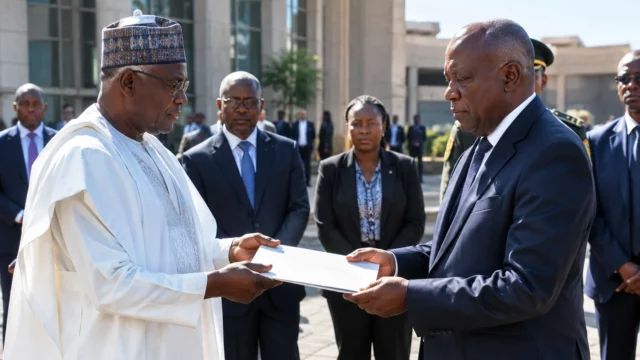
On 1 November 2026, Salim Abdulrahman, the state commissioner for Livestock Development, announced an investment of 4.5 billion naira to develop three ranches. The announcement was made by the Jigawa authorities, reported by the News Agency of Nigeria (NAN) and carried by several media outlets. Available information does not yet set out a timetable for the works.
The sites are planned for the Sankara reserve in Ringim, the Kashamai reserve in Kafin Hausa, and the Kukar Mekiya reserve in Kiyawa. According to the commissioner, each would cover 510 hectares and could accommodate up to 3,000 households. The announced facilities include pasture, water points, veterinary clinics, livestock markets, schools, health facilities and electricity supply.
The announced sum is to come from a 17.2 billion naira allocation for livestock farming in the state’s 2026 budget. Whether the facilities are actually delivered, how they are funded in detail and what rules govern access to land will be crucial in determining whether the announcements translate into services accessible to herders.
A national shift, but models still to be tested
Jigawa is not alone in preparing this kind of infrastructure. On 29 August 2026, the federal government inaugurated a pilot project in the Gongoshi reserve in Adamawa State. About 9,600 hectares were made available by the state, according to the News Agency of Nigeria’s report. The first phase is to combine meat and milk production, fodder, and sheep and goat farming.
In Wase, in Plateau State, the federal Ministry of Livestock Development announced in June its intention to allocate about 30,000 hectares for livestock production facilities, including fattening, dairy and meat processing. The reserve covers more than 100,000 hectares, according to the federal Ministry of Information. These federal and state projects point to a shared direction, but their announcements do not yet prove that the sites are operating at full capacity.
The shift is part of the creation, in July 2024, of a federal ministry dedicated to livestock development. In April 2026, the ministry and the International Livestock Research Institute (ILRI) published a sector plan for 2026-2040. It focuses on animal feed, health and biosecurity, infrastructure and markets, as well as the participation of women and young people.
Land, services and trust at the heart of the challenge
In northern Nigeria, pastoral mobility allows herds to follow pasture and water sources. But pressure on land, the expansion of cultivation and insecurity make these movements more difficult and can intensify tensions between farmers and herders. Ranching seeks to organise part of production around developed sites. It will not automatically eliminate conflict: land rights, access to resources and consultation with communities will remain essential.
The services announced in Jigawa could reduce losses caused by animal disease and make it easier to sell livestock. They could also benefit families living around the sites, if schools, healthcare and markets are actually built and opened. Conversely, poorly maintained infrastructure or a contested allocation of land could shift tensions rather than resolve them. The pastoral and farming communities concerned will therefore need to have a place in managing the reserves.
The strategy also addresses an economic challenge: adding more value to meat, milk and leather in Nigeria, rather than limiting public action to producing live animals. The federal government estimates that the sector is worth about $32 billion and has set a target of at least $74 billion by 2035. This figure is an official target, not an assured outcome. Reaching it will also depend on roads, the cold chain, abattoirs, processing and access to finance.
A Nigerian issue that reaches beyond its borders
The issue concerns all of West Africa, where herds and markets cross borders. ECOWAS, the Economic Community of West African States, treats pastoralism and livestock farming as regional issues linked to trade, natural resources and conflict prevention. A shift towards more permanent sites in Nigeria could therefore change routes, markets and the needs of cross-border herders.
The next step will be less about announcing new hectares than about implementation: completed works, operational veterinary services, fair access to water and pasture, and mechanisms for resolving disputes. In Jigawa, as in Gongoshi and Wase, these factors will show whether ranching becomes a lasting tool for productivity and coexistence, or remains a development project still on paper.
Documentary sources: report on the Jigawa announcement attributed to NAN ; announcement of the Gongoshi pilot project ; official information on the Wase reserve ; Nigeria’s livestock sector plan, 2026-2040 ; ECOWAS regional priorities on livestock and pastoralism.