
 Algeria
 Egypt
 Libya
 Morocco
 Sudan
 Tunisia
 Benin
 Burkina Faso
 Cabo Verde
 Côte d'Ivoire
 Ghana
 Guinea
 Guinea-Bissau
 Liberia
 Mali
 Mauritania
 Niger
 Senegal
 Sierra Leone
 The Gambia
 Togo
 Cameroon
 Central African Republic
 Chad
 DR Congo
 Equatorial Guinea
 Gabon
 Republic of the Congo
 São Tomé and Príncipe
 Burundi
 Comoros
 Djibouti
 Eritrea
 Ethiopia
 Kenya
 Madagascar
 Malawi
 Mauritius
 Mozambique
 Rwanda
 Seychelles
 Somalia
 South Sudan
 Tanzania
 Uganda
 Angola
 Botswana
 Eswatini
 Lesotho
 Namibia
 South Africa
 Zambia
 Zimbabwe
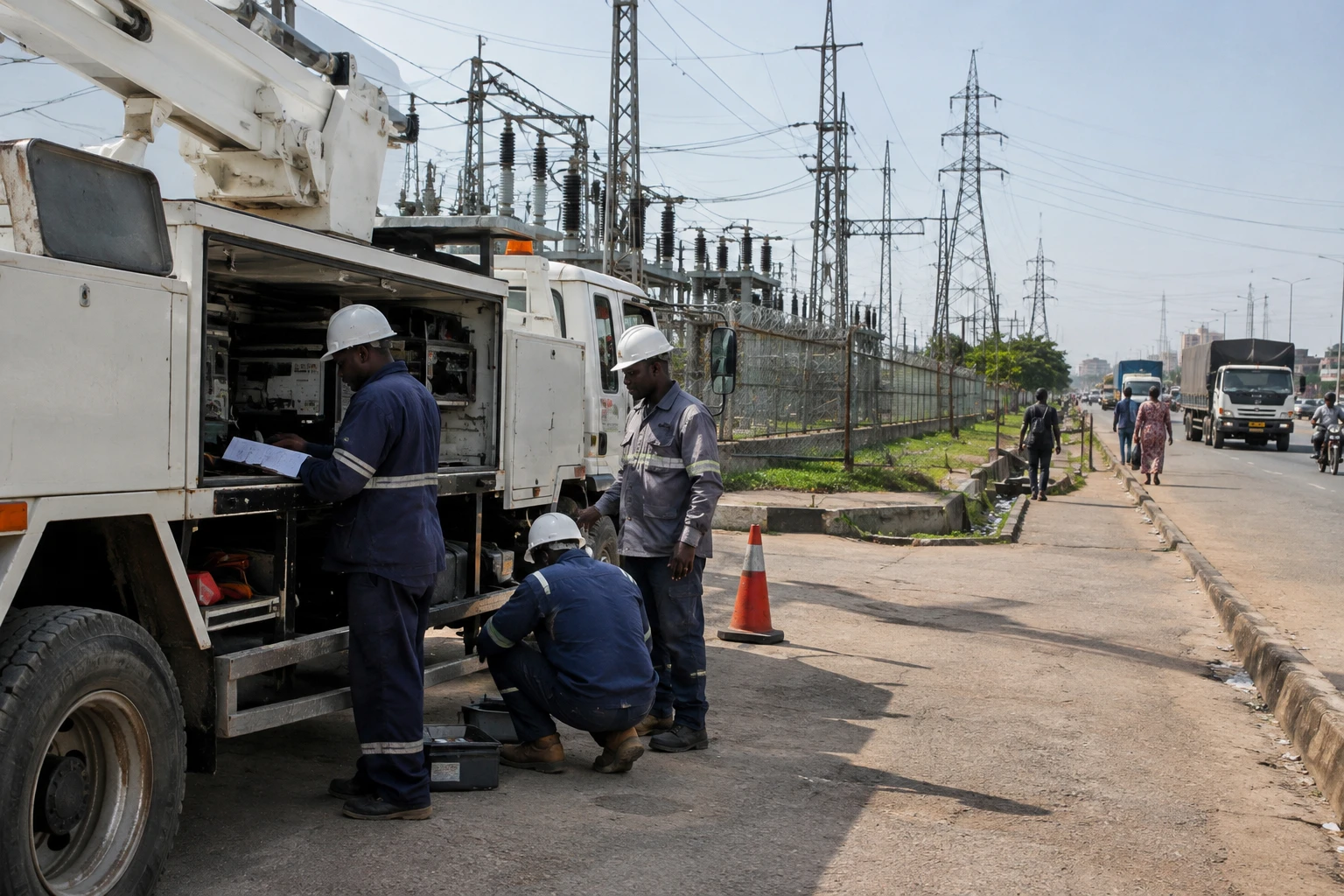
Restoring a power line can bring hundreds of megawatts back into service without guaranteeing that every neighbourhood will get its electricity back. In Nigeria, repairs to the Benin-Egbin route have improved supply to the Lagos grid, while residents continued to report outages.
A grid under strain, from generation to neighbourhoods
The outage occurred in a system where several links must work together: power stations generate electricity, the transmission network carries it, and distribution companies then deliver it to consumers. An improvement on a high-voltage line therefore does not automatically resolve generation difficulties or local distribution constraints.
On 5 November, the Nigerian Independent System Operator (NISO), the body responsible for coordinating the operation of the national grid, attributed the drop in generation to gas supply constraints at thermal power stations and reduced water inflows to hydroelectric reservoirs. These difficulties reduced the volumes allocated to distributors and the hours of supply, according to the operator and Nigerian media.
This vulnerability has a regional dimension in a West Africa where power grids and energy exchanges are interconnected. But for Nigerian consumers, the immediate issue remains national: available capacity must pass through a reliable network before reaching businesses, households and public services.
Line restored, but not everywhere
On Monday 9 November, Federal Minister of Power Joseph Olasunkanmi Tegbe announced the return to service of the 330-kilovolt Benin-Egbin line, which had been damaged by acts of vandalism. He said power had been restored in several areas of Lagos, Ogun, Oyo and Kwara, as well as in the Federal Capital Territory, where Abuja is located.
According to the minister, the line’s unavailability had reduced transmission capacity to the Lagos power complex by 300 to 400 megawatts. Following repairs and the return of some generating units, more than 1,000 megawatts were once again being transmitted to the centre, a level he said was comparable to that before the disruptions. These figures are those provided by the government.
The restoration of transmission did not, however, mean an immediate return to normal for every user. Accounts reported in the Nigerian press described continuing outages in parts of Igbogbo, in Ikorodu, and on Orchid Road, in Lagos. The minister acknowledged that teams were continuing to work in areas still without a full power supply.
The difference between the megawatts received by a complex and the electricity available at a particular address is due in part to local distribution, faults and the allocation of electricity across the networks. For households, shops and small businesses, an announced increase in capacity therefore does not erase the impact of hours without power: reliance on generators, fuel costs and interrupted activity.
A second line expected in Lagos
The Lagos region’s grid remains dependent on vulnerable infrastructure. The 330-kilovolt Osogbo-Ikeja West line has also been out of service for about 18 months after transmission towers were vandalised. Tegbe estimated that it could add up to 400 megawatts to the Lagos complex. The federal government is targeting a return to service before the end of November, a deadline that remains to be verified.
The repair of the Benin-Egbin line thus addresses a specific interruption, but does not remove dependence on gas, the hydroelectric generation limits reported by NISO, or weaknesses in transmission and distribution. Reliability depends on the entire chain, not on a single piece of infrastructure.
States seek local solutions
Alongside the federal grid, Lagos and Ogun are developing supply projects of their own. Lagos has announced agreements with independent power producers, including one to rehabilitate the Akute power station, with a contracted capacity of 26 megawatts. Ogun is relying in particular on the Light Up Ogun programme, which plans a 30-megawatt power station near Abeokuta as part of a broader target of 100 megawatts.
These projects are part of the reform launched by the Electricity Act of 2023, which allows states to establish and regulate their own electricity markets. The Nigerian Electricity Regulatory Commission (NERC) transferred oversight of the Lagos and Ogun markets to the authorities in those states in 2025. Decentralisation can bring regulation closer to local needs, but it does not replace transmission lines or coordination with the national grid.
The test for federal authorities and state governments alike will be to turn announced capacity into a regular, measurable supply for users. The end of November is the next deadline for the Osogbo-Ikeja West line. Until then, the gap between transmission figures and neighbourhood experience will remain a practical indicator of the strength of Nigeria’s electricity system.



