Algeria
 Egypt
 Libya
 Morocco
 Sudan
 Tunisia
 Benin
 Burkina Faso
 Cabo Verde
 Côte d'Ivoire
 Ghana
 Guinea
 Guinea-Bissau
 Liberia
 Mali
 Mauritania
 Niger
 Senegal
 Sierra Leone
 The Gambia
 Togo
 Cameroon
 Central African Republic
 Chad
 DR Congo
 Equatorial Guinea
 Gabon
 Republic of the Congo
 São Tomé and Príncipe
 Burundi
 Comoros
 Djibouti
 Eritrea
 Ethiopia
 Kenya
 Madagascar
 Malawi
 Mauritius
 Mozambique
 Rwanda
 Seychelles
 Somalia
 South Sudan
 Tanzania
 Uganda
 Angola
 Botswana
 Eswatini
 Lesotho
 Namibia
 South Africa
 Zambia
 Zimbabwe
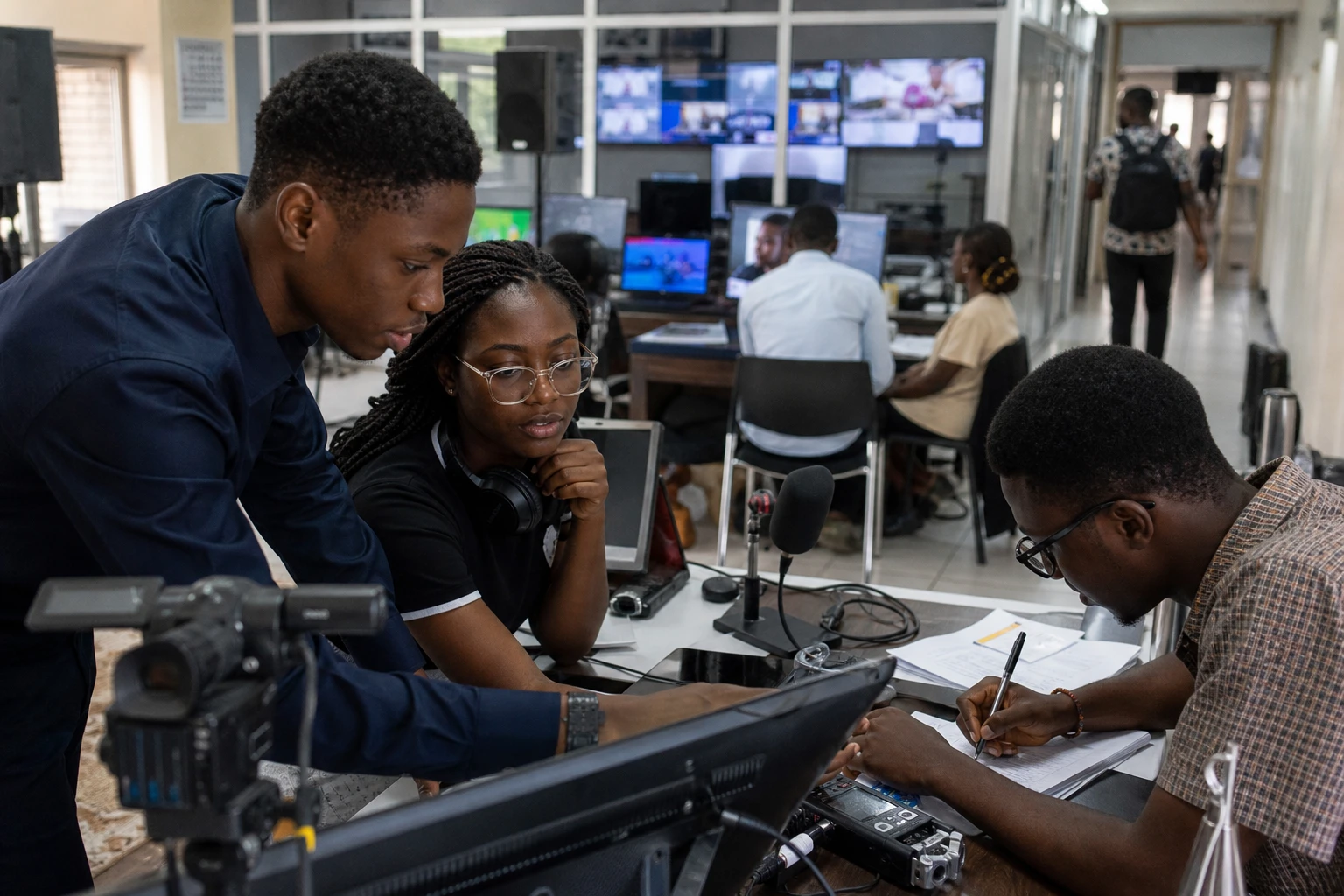
In Lagos, a campus becomes a digital sovereignty laboratory
At many African universities, innovation often remains a word in speeches. At the University of Lagos, it is now taking shape in a tangible place: a workshop, screens, 3D printers, robots and students prototyping solutions for very local needs. The message is clear. Nigeria no longer wants merely to consume artificial intelligence tools designed elsewhere. It is seeking to build them, test them and adapt them to its own realities.
This decision is part of a broader sequence of events. In Abuja, the federal government, the United Nations Development Programme (UNDP) and the Tertiary Education Trust Fund, or TETFund, launched the national roll-out of the University Innovation Pods, abbreviated to UniPods, in April 2026. The idea is simple: to turn selected public universities into platforms for applied research, entrepreneurship and technology transfer. The Lagos pilot site serves as a showcase. It is intended to demonstrate what a partnership between the state, a university and the UN system can produce when the goal is to develop useful skills and bring viable projects to life.
A first pod to launch a national network
The official launch of the AI UniPod at the University of Lagos took place on 7 April 2026. UNDP described the date as the starting point for the national roll-out of the UniPod network, with Lagos as the first stage. The organisation also said Nigeria was becoming the first African country to extend the timbuktoo model, its pan-African innovation programme, nationwide with direct public co-financing.
TETFund plays a central role here. Its official mandate is to provide supplementary support to public higher education institutions, particularly for infrastructure, equipment, research and knowledge production. This is precisely the kind of intervention that gives the project its national reach. The Lagos pod is not conceived as a stand-alone space. It is intended to serve as a model for other hubs, with different specialisations depending on location and sector, from agriculture and mining to the blue economy.
The network’s structure matters as much as the site itself. In Lagos, the AI UniPod is presented as a launch hub. In Nasarawa, a pod dedicated to mining technologies was already activated in May 2026. This progress confirms that the federal government wants to connect several universities to distinct productive sectors, rather than concentrate its efforts on a single urban showcase. For a country of more than 200 million people, the question is not only how to launch an innovation. It is how to spread it beyond the commercial capital and embed it in concrete sectors.
Training, prototyping and commercialising
On campus, the hub has been designed as a workspace rather than a classroom. Students have access to fabrication tools, collaborative areas and guidance to help them move from idea to prototype. This is the vision summed up by the pod’s management: to provide AI research infrastructure for West Africa. The site hosts students, recent graduates and professionals. It combines training, experimentation and incubation.
This approach addresses a problem widely recognised in Nigeria and across much of the continent: the gap between ideas and bringing them to market. In Nigeria, many young people can code, set up a small business or test an app. But equipment, datasets, testing spaces and support are often lacking. The AI UniPod aims to bridge this gap. An electronic physics student has already developed a motion-detection robot for video surveillance. Another, studying data science, is working on tools capable of identifying objects and behaviours suited to the Nigerian context.
The stakes go beyond student creativity alone. A final-year electronic engineering student has also started a training business to help Nigerian professionals digitise their businesses, automate some tasks and integrate AI into basic customer service functions. This kind of example shows what the project is seeking: immediately useful applications for small businesses, online vendors, artisans and organisations operating in the informal economy. In a country where this economy remains essential, innovation is not valuable only for its sophistication. It is also valuable for its ability to improve everyday productivity.
The project also addresses a structural limitation often highlighted by African researchers: the lack of sufficient local datasets to train relevant models. The point comes up in accounts gathered in Lagos, but it also connects with continent-wide debates about dependence on data and architectures developed outside Africa. Without African datasets, AI systems risk failing to understand the practices, languages, behaviours or security contexts specific to the continent.
Why Lagos matters beyond Nigeria
The choice of Lagos is no accident. The city brings together universities, start-ups, funders and incubators, and accounts for a significant share of Nigeria’s digital market. It also serves as a bridge to the diaspora, investors and regional technology networks. By establishing the first AI UniPod at the University of Lagos, the federal government and its partners are betting on an already vibrant environment where research can connect with the market more quickly than elsewhere.
But its greatest significance is regional. For several years, West African governments have been talking about digital transformation, the creation of skilled jobs and the modernisation of universities. Nigeria is now adding a practical instrument. This matters within ECOWAS, where competition for digital talent is real, and in the wider debate about Africa’s place in the AI economy. The Lagos project aligns with the African Union’s continental strategy, which advocates coordinated national approaches, ethical AI and inclusive ecosystems.
What the continent will be watching now is not just the announcement. It is whether these pods can produce useful prototypes, viable businesses and trained researchers. It will also be watching how Abuja funds the next phase beyond Lagos, in other federated states and in other disciplines. If the network delivers on its promises, it could become an African model of university innovation backed by public policy. If its momentum fades, it will join the long list of projects that make a splash at launch but prove too fragile to transform the knowledge economy in any meaningful way.