
 Algeria
 Egypt
 Libya
 Morocco
 Sudan
 Tunisia
 Benin
 Burkina Faso
 Cabo Verde
 Côte d'Ivoire
 Ghana
 Guinea
 Guinea-Bissau
 Liberia
 Mali
 Mauritania
 Niger
 Senegal
 Sierra Leone
 The Gambia
 Togo
 Cameroon
 Central African Republic
 Chad
 DR Congo
 Equatorial Guinea
 Gabon
 Republic of the Congo
 São Tomé and Príncipe
 Burundi
 Comoros
 Djibouti
 Eritrea
 Ethiopia
 Kenya
 Madagascar
 Malawi
 Mauritius
 Mozambique
 Rwanda
 Seychelles
 Somalia
 South Sudan
 Tanzania
 Uganda
 Angola
 Botswana
 Eswatini
 Lesotho
 Namibia
 South Africa
 Zambia
 Zimbabwe
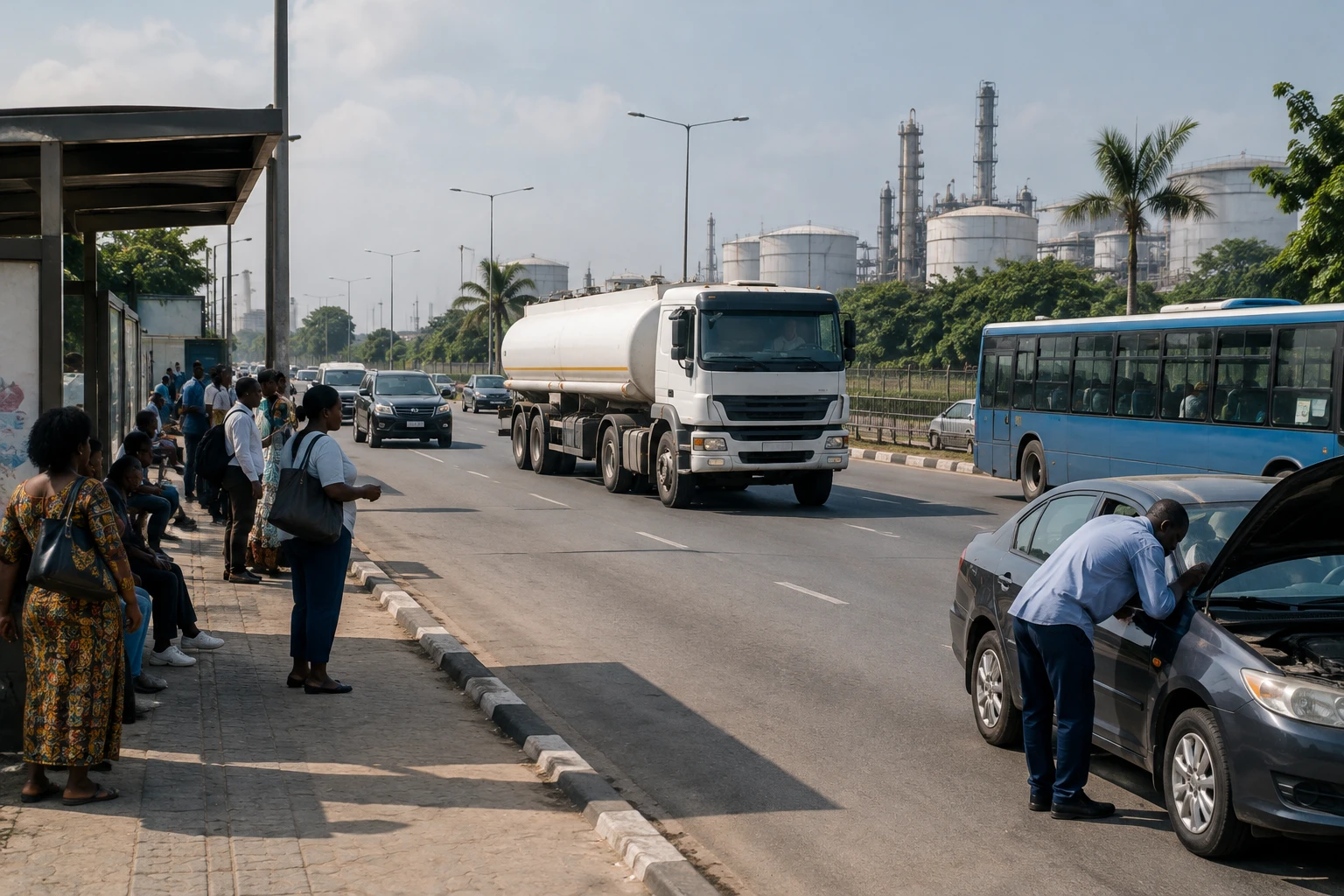
In Nigeria, producing more fuel is not enough to guarantee that it reaches motorists at a fair price. Transport, storage and access to markets matter just as much. These are the links in the supply chain where the group of Nigerian industrialist Aliko Dangote is now expanding its activities, with projects that extend far beyond his home country.
From refining to supply routes
The Lekki refinery, near Lagos, began production in 2024. With a nominal capacity of 650,000 barrels per day, it has become a major part of Nigeria’s fuel market. A major crude oil producer, Nigeria had for decades depended on imports of refined products, in part because its state-owned refineries operated poorly or remained shut. The International Monetary Fund has also noted the facility’s start-up and its stated capacity. The IMF report on the Nigerian economy recalls the scale of the change under way.
The group is nevertheless seeking to reduce its dependence on suppliers and intermediaries. It has invested in road transport and port infrastructure, while Dangote has expanded its interests into crude oil production in the Niger Delta. This integration could reduce some logistics costs. On its own, however, it does not guarantee a steady supply or a sustained fall in prices: these also depend on global prices, the exchange rate, taxes and competition.
On 21 October 2026, Dangote announced that it had acquired about a quarter of Kenya Pipeline Company, which transports and stores petroleum products between the port of Mombasa and inland markets. Kenyan media valued the transaction at 42.5 billion shillings, or about $327 million, for a 24.76% stake. Dangote’s confirmation and reports published in Kenya corroborate the deal. S&P Global Commodity Insights and Kenyan outlet The Star reported on it. The stake makes his group a major shareholder, but does not give it control of the company.
A regional bet, with conditions to meet
The investment in Kenya’s network takes on particular significance following the start of construction work on a refinery in Lamu on 30 September 2026. The project, estimated at $16 billion and designed to process up to 700,000 barrels per day, is aimed at East African markets. The Kenya News Agency and Kenya’s Ministry of Transport confirmed the ceremony and planned capacity. The Kenya News Agency notes that the site is part of the LAPSSET corridor, a transport project linking Kenya with Ethiopia and South Sudan.
The construction work remains a project, not capacity that is already available. Funding, access to crude, transport infrastructure and regional markets will all need to fall into place. In Lamu, residents are disputing ownership of the land concerned, while environmental groups are warning about potential effects on coastal ecosystems. The Associated Press reported on these disputes ahead of the launch. These local issues will affect the timetable as much as financial and technical decisions.
Dangote’s network is not limited to Nigeria and Kenya. Storage and transport projects are also being discussed in the Horn of Africa, including between Ethiopia and Djibouti. But investment announcements should not be confused with facilities that are completed or operational. For each corridor, viability will depend on agreements between states, infrastructure security, available volumes and actual demand.
Economies of scale or market concentration?
The comparison with past oil integration strategies rests on a simple idea: controlling several stages can help manage costs and timings. For countries that import fuel, more refining on the continent could also reduce exposure to supply disruptions and shipping costs. The effects will not be the same everywhere, however. Industrial companies may benefit from a more predictable supply, while independent hauliers, distributors and small operators risk losing some of their business if a single group controls more links in the chain.
In Nigeria, the question is particularly tangible. The refinery could reduce dependence on imports of finished products, but its size also gives it considerable influence over supply. Nigerian authorities will need to monitor access to crude, competition among distributors and the pass-through of costs to consumers. In a country where households and small businesses are sensitive to transport and energy prices, installed capacity is not enough: availability and retail prices matter just as much.
At regional level, the Economic Community of West African States (ECOWAS), which brings together West African countries, is not the organisation directly concerned by the Kenyan acquisition. That deal is taking place in East Africa, where Kenya’s interests and those of its neighbours intersect around ports, pipelines and access to fuel. The Dangote Group thus links several markets, but each state retains its own rules, energy priorities and competing projects.
The next step: turning announcements into services
The pan-African reach of this expansion will depend less on the size of announced projects than on how they work in practice. The start-up of Lamu, the investments actually made in Kenya’s network and the way authorities organise competition will need to be monitored. It will also be important to establish whether logistics savings translate into more affordable prices, and whether jobs and contracts benefit local economies.
The group is building a presence spanning refining and distribution, in Nigeria and beyond. This strategy could strengthen Africa’s industrial capacity. It also concentrates more economic power in the hands of a private player. The balance between efficiency, competition and the public interest will therefore be decisive, in Abuja as well as in the capitals of countries hosting this infrastructure.



