Algeria
 Egypt
 Libya
 Morocco
 Sudan
 Tunisia
 Benin
 Burkina Faso
 Cabo Verde
 Côte d'Ivoire
 Ghana
 Guinea
 Guinea-Bissau
 Liberia
 Mali
 Mauritania
 Niger
 Senegal
 Sierra Leone
 The Gambia
 Togo
 Cameroon
 Central African Republic
 Chad
 DR Congo
 Equatorial Guinea
 Gabon
 Republic of the Congo
 São Tomé and Príncipe
 Burundi
 Comoros
 Djibouti
 Eritrea
 Ethiopia
 Kenya
 Madagascar
 Malawi
 Mauritius
 Mozambique
 Rwanda
 Seychelles
 Somalia
 South Sudan
 Tanzania
 Uganda
 Angola
 Botswana
 Eswatini
 Lesotho
 Namibia
 South Africa
 Zambia
 Zimbabwe
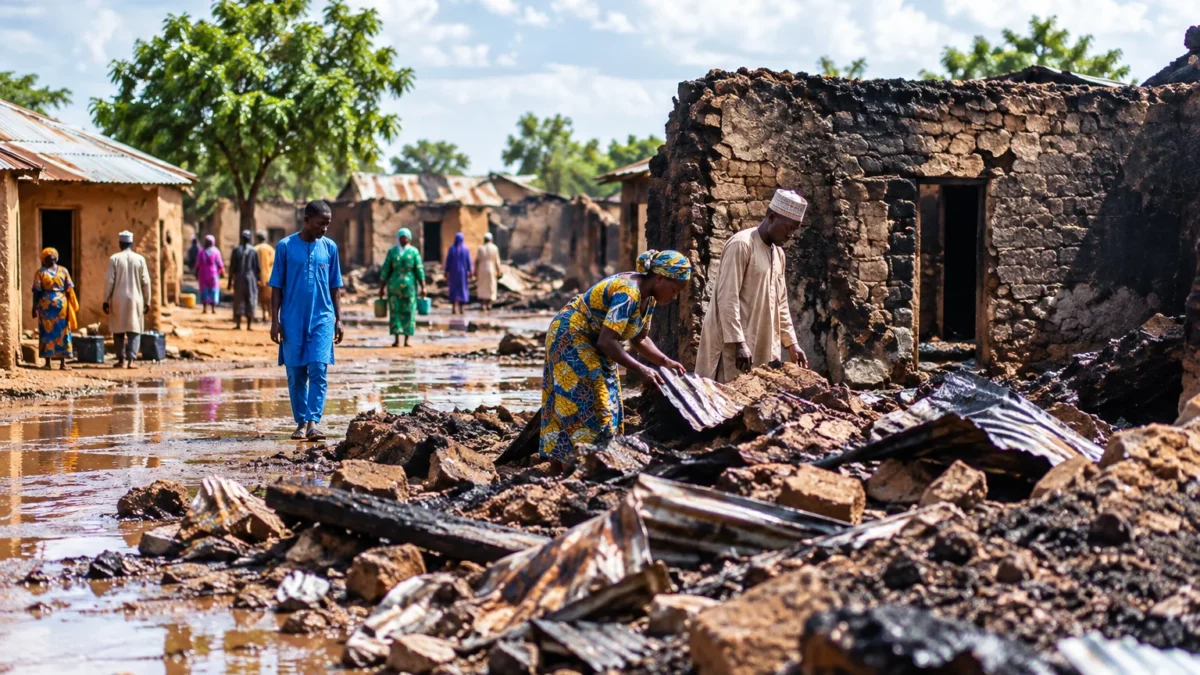
In Borgu district, in Niger State, in west-central Nigeria, an attack followed by deadly revenge struck villages on 21 and 22 November. The death toll remains disputed. But the sequence of violence is clear: civilians were killed, homes burned and communities exposed to further reprisals.
Two attacks and conflicting death tolls in Borgu
The violence began at dawn on Saturday 21 November in Lumma Ba’are. The Niger State government said five people, including the village head, had been killed and five others injured. Police later reported six deaths in the first attack and homes set on fire. Official accounts themselves therefore changed.
Retaliatory attacks then targeted Fulani communities, particularly around Wawa. On 25 November, the Nigerian police said more than 30 people had died in the violence. An association representing Fulani herders had earlier put the figure at 64. This toll has not been confirmed by the authorities and cannot be considered definitive.
The United Nations High Commissioner for Human Rights, for its part, reported dozens of deaths and disappearances during the attacks on 21 and 22 November. Its spokesperson, Jeremy Laurence, warned of the risk of an escalation in violence and called on the authorities to protect residents. The information available is not yet sufficient to establish a consolidated death toll or confirm all the reported circumstances.
The distinction between the communities targeted also matters. Residents reportedly blamed the initial attack on Fulani people, but there is no public evidence establishing their collective responsibility. The reprisals then affected Fulani populations. Attributing the actions of a few individuals to an entire group risks fuelling a cycle in which perceived group identity becomes a motive for violence.
A region facing several forms of insecurity
Niger State is in Nigeria, whose capital is Abuja. It is not the neighbouring Republic of Niger, whose capital is Niamey. Borgu, a rural area of the Nigerian state, lies in a region where residents already face armed attacks, kidnappings and tensions over access to land and resources.
It would nevertheless be misleading to reduce this violence to a conflict between farmers and herders. Reports on the initial attack mention armed men, but the attackers’ identity and motives remain to be established. Local tensions and land disputes may form part of the backdrop, but they are not proof of who carried out this particular attack. The authorities must distinguish established facts from accusations directed at an entire community.
North-western and central Nigeria face a range of threats: armed criminal groups, kidnappings and communal violence, alongside the activities of jihadist groups in some areas. These phenomena sometimes overlap, but they are not the same. This distinction is essential to understanding residents’ needs and directing the security response.
The immediate impact is on civilians in the villages concerned. Deaths and disappearances separate families; burned homes leave residents without shelter and possessions. In areas where livelihoods often depend on farming, livestock and local markets, insecurity can also prevent people from reaching fields or selling a harvest. The sources consulted provide no verified count of displaced people or economic losses.
The response needed: protect, investigate, prevent
The Niger State government condemned the attack on Lumma Ba’are and announced the deployment of security teams. Police, in turn, said they had reinforced tactical resources in Borgu after an assessment visit. These announcements mark an immediate response; they are not enough to guarantee the villages’ lasting security or, on their own, establish responsibility.
The High Commissioner’s office called for those responsible to be brought to justice in accordance with human rights. A credible investigation must document the initial attack and the reprisals separately, preserve evidence and hear witnesses without identifying suspects on the basis of their origin. It must also search for missing people and protect residents under threat.
Local authorities face a twofold challenge: preventing further attacks and ensuring that security operations are not seen as targeting an entire community. Traditional leaders, local associations and law enforcement can help curb rumours, relay warnings and support a return to calm. But mediation does not replace investigation or justice.
Implications for cohesion in Nigeria and West Africa
At national level, these events highlight the difficulty of protecting rural communities in a vast federal country, where responses depend on state authorities, the federal police and other security services. For Borgu residents, the immediate issues are practical: being able to return home, access their land and travel without fear of an attack or collective accusation.
ECOWAS, the West African political and economic co-operation organisation, is not the main operational framework for this local crisis. But stability in border areas and the movement of armed groups also concern neighbouring countries. The regional significance lies above all in the risk that violence could spread and the need for co-operation between authorities when threats cross borders.
In the coming days, the points to watch are the publication of a verified death toll, the findings of investigations and the ability of deployed forces to protect all the villages concerned. Confirmation of reported disappearances and the identification of those responsible will also help distinguish facts from rumours. Without these steps, the disputed toll and accusations against communities could continue to fuel fear and reprisals.