Algeria
 Egypt
 Libya
 Morocco
 Sudan
 Tunisia
 Benin
 Burkina Faso
 Cabo Verde
 Côte d'Ivoire
 Ghana
 Guinea
 Guinea-Bissau
 Liberia
 Mali
 Mauritania
 Niger
 Nigeria
 Senegal
 Sierra Leone
 The Gambia
 Togo
 Cameroon
 Central African Republic
 Chad
 DR Congo
 Equatorial Guinea
 Gabon
 Republic of the Congo
 São Tomé and Príncipe
 Burundi
 Comoros
 Djibouti
 Eritrea
 Ethiopia
 Kenya
 Madagascar
 Malawi
 Mauritius
 Mozambique
 Rwanda
 Seychelles
 Somalia
 South Sudan
 Tanzania
 Uganda
 Angola
 Botswana
 Eswatini
 Lesotho
 South Africa
 Zambia
 Zimbabwe
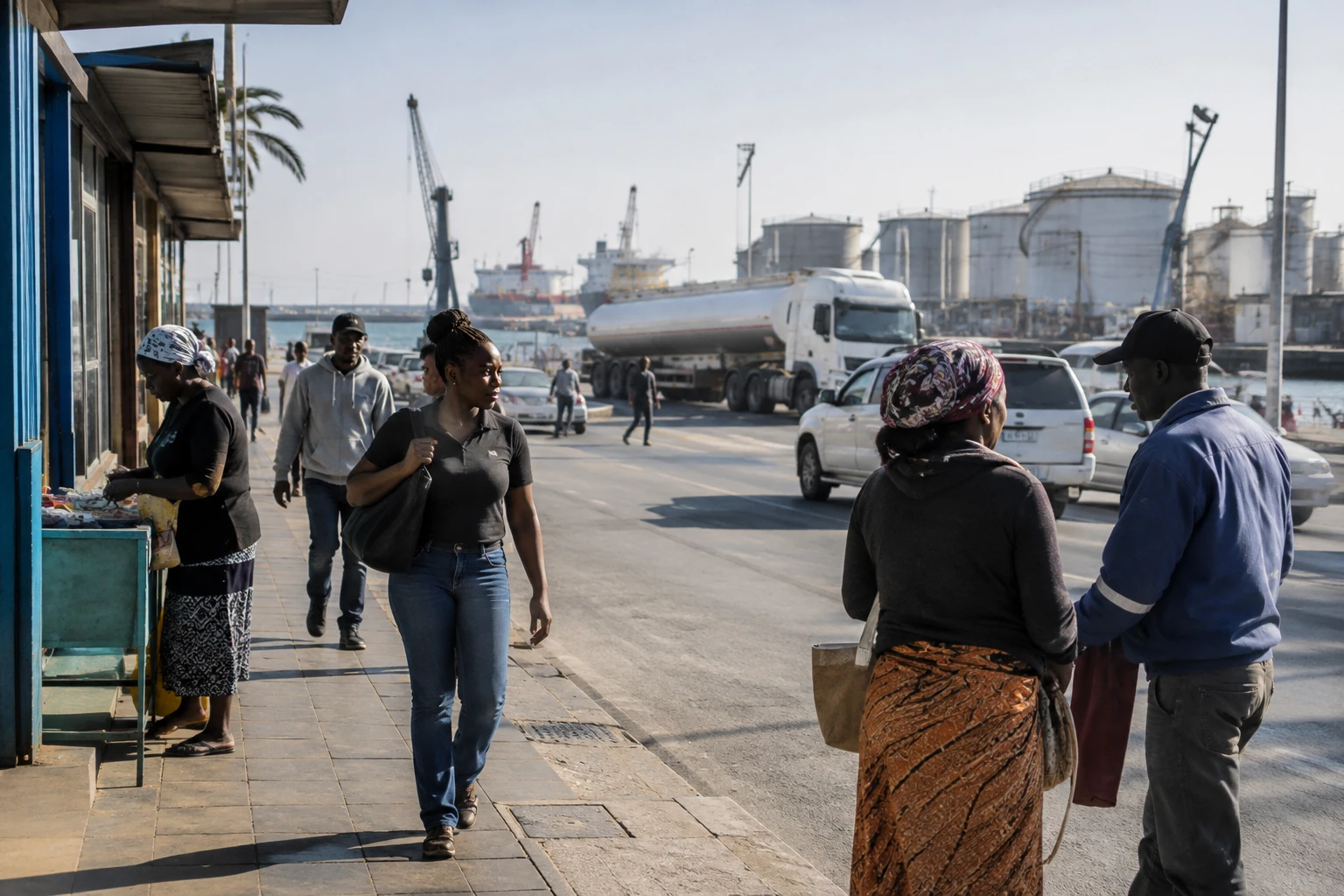
At Walvis Bay, the question is not simply where to store more fuel. For Namibia, the challenge is also to secure supplies, strengthen its role as a regional gateway and preserve local benefits from a cross-border network.
A port already geared towards regional trade
Namibia imports all its refined petroleum products. According to the Namibian Ministry of Industry, Mines and Energy, national consumption is about 1.1 billion litres a year. The country has no operational refinery and remains exposed to maritime transport costs and fluctuations in international markets.
Walvis Bay already occupies a central place in southern African trade. The port is linked to several road and trade corridors serving Botswana, Zambia and Zimbabwe, among others. Namibia and these countries are members of SADC, the Southern African Development Community, which organises regional economic cooperation.
The country also has a 75-million-litre public depot, operated by national company Namcor. Commissioned in 2021, it aims to raise strategic reserves to the equivalent of 30 to 45 days’ supply in the event of an interruption to imports. The private project announced at Walvis Bay would change the scale of storage, but would not replace this public role.
A terminal announced, a network still to be defined
On 4 November 2026, Aliko Dangote presented a project at Farm 58, near Walvis Bay, for an oil terminal linked to a regional pipeline network. Namibian President Netumbo Nandi-Ndaitwah said the project had been placed under the coordination of the presidency in 2025, with the aim of avoiding administrative delays.
The planned terminal could store 600 million litres: 360 million litres of diesel and 240 million litres of petrol. That is eight times the capacity of the national Namcor depot. The Dangote Group has cited a total investment of about $2.5 billion and a construction period of 18 to 20 months. These announcements do not, however, amount to a firm completion date.
The project also envisages a pipeline of about 1,700 kilometres to inland markets, including Botswana, Zambia, Zimbabwe, Malawi and the Democratic Republic of the Congo. Its exact route has yet to be determined. Technical studies, surveys and permits in the countries concerned will determine the next steps.
The political launch ceremony does not mean that work on the terminal or cross-border pipeline has begun. Namibia’s environmental register says the application concerning the subdivision of Farm 58 is still under review. It concerns land development; a separate assessment must still address the impacts of the terminal itself.
Energy security is not measured in litres alone
For consumers and businesses, greater storage capacity could help cushion logistical disruptions. A pipeline could also reduce reliance on tanker trucks over long distances. But these infrastructure projects alone cannot guarantee lower prices: fuel purchase costs, exchange rates, port charges and competition between suppliers will continue to affect prices.
The project could also redistribute transport activity. Namibian road hauliers might lose some of the volumes moved by truck, while local businesses could win construction, maintenance and services contracts. In 2025, opposition officials called for benefits for Namibian workers and businesses to be better guaranteed. This will depend on the contracts awarded and local-content rules.
The effects will not be the same everywhere. Walvis Bay could benefit from port and logistics activity. Towns along the future route could gain easier access to products, if connections and tariffs allow. Remote regions, by contrast, will not automatically benefit from a pipeline designed primarily to move volumes between depots and major markets.
A test for southern African integration
The project forms part of a broader ambition: to make the Namibian port a supply point for landlocked countries. It complements existing transport corridors, but adds energy infrastructure requiring agreements between states, compatible standards and customs coordination. SADC provides a framework for cooperation; it does not replace national permits or commercial negotiations.
The Dangote Group is also seeking to expand markets for its Nigerian refinery, located in Lekki. For Namibia, this prospect could diversify sources of supply. It does not, however, remove dependence on imports and concentrates a significant part of the project around a single private supplier. The ability to maintain multiple suppliers will therefore remain a matter of resilience.
The next milestones will be concrete: completion of the environmental review, publication of the route, agreements with transit countries, detailed financing and a confirmed construction timetable. Until then, Walvis Bay is at the centre of an ambitious proposal, but its regional benefits will depend on regulatory decisions and the effective sharing of returns.
The Namibian news agency NAMPA’s report on the project’s presidential coordination ; The Namibian newspaper’s details on the launch and the announced investment ; the official environmental register for Farm 58.