Algeria
 Egypt
 Libya
 Morocco
 Sudan
 Tunisia
 Benin
 Burkina Faso
 Cabo Verde
 Côte d'Ivoire
 Ghana
 Guinea
 Guinea-Bissau
 Liberia
 Mali
 Mauritania
 Niger
 Nigeria
 Senegal
 Sierra Leone
 The Gambia
 Togo
 Cameroon
 Central African Republic
 Chad
 DR Congo
 Equatorial Guinea
 Gabon
 Republic of the Congo
 São Tomé and Príncipe
 Burundi
 Comoros
 Djibouti
 Eritrea
 Ethiopia
 Kenya
 Madagascar
 Malawi
 Mauritius
 Mozambique
 Rwanda
 Seychelles
 Somalia
 South Sudan
 Tanzania
 Uganda
 Angola
 Botswana
 Eswatini
 Lesotho
 South Africa
 Zambia
 Zimbabwe
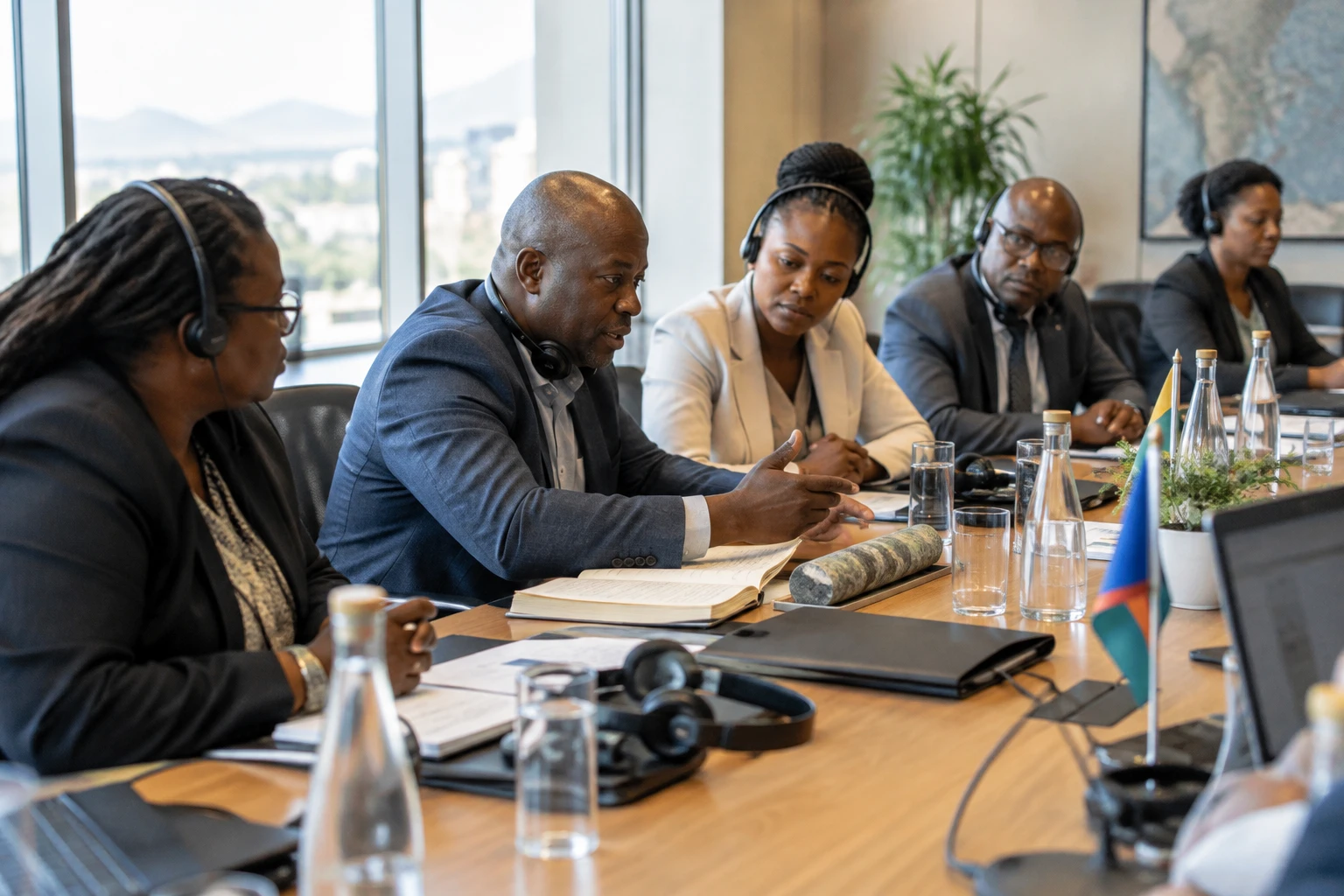
There is a long road between the first drill holes and a possible mine. In Namibia, the Bonya project still has to demonstrate that its rare earths can be extracted in a technically viable and economically profitable way. The next steps will turn geological indications into more robust data — but will not, on their own, guarantee that a mine is built.
An exploration project in a mining region
Bonya is in south-western Namibia. It comprises two exploration areas, Teufelskuppe and Kieshöhe, where teams are studying carbonatite formations, rocks that can concentrate certain rare earth elements. The project is in a country where mining, particularly uranium and diamonds, already plays an important role in the economy.
Namibia is a member of the Southern African Development Community (SADC), which brings countries in the region together around economic co-operation goals. The issue therefore goes beyond exploration at a single site: local mineral processing and the distribution of the value generated are among the regional concerns, as several countries seek to develop their mineral resources.
Kendrick Resources, a London-listed exploration company, reached an agreement in February 2026 giving it a 70% interest in the permits linked to Bonya. This does not mean the company already owns a producing mine. It remains in an exploration and evaluation phase, with technical and regulatory steps still to complete.
From drilling to initial estimates
On 28 October 2026, Kendrick said it had completed a six-month programme at Teufelskuppe: 100 drill holes, totalling 7,512 metres. One of the aims was to gain a better understanding of the mineralised formations beneath the surface. A specialist Namibian media outlet had also reported the previous day that more than 100 drill holes had been completed and evaluation work was progressing.
The company has appointed Sound Mining, an independent consultancy, to prepare an initial mineral resource estimate for Teufelskuppe. It is targeting publication by the end of January 2027. The estimate is intended to specify the volume of rock involved, its grade in the sought-after elements and the confidence level of the data. It will be prepared under the JORC Code, an Australian standard used to report mining exploration results.
The distinction between an estimate and an exploitable reserve is essential. A resource estimate describes what can be assessed from geological data. It does not prove that extraction will be profitable, or that all the materials present can be recovered. The results will still need to be confirmed by certified analyses and studies of costs, processes and site constraints.
Work is also continuing at Kieshöhe, Bonya’s second area. Kendrick is drilling there to determine whether this zone can add to Teufelskuppe’s potential. At this stage, the two sites are not at the same level of development: the announced initial estimate concerns Teufelskuppe, while Kieshöhe remains under evaluation.
Recovery: a decisive test
The amount present in the rock is only part of the equation. It is also necessary to establish what proportion of the elements can be separated and recovered, using which processes and at what cost. Three Teufelskuppe samples have been sent to the German laboratory Anzaplan for metallurgical tests. Kendrick expects a preliminary report before the end of 2026.
These tests can help define an appropriate processing route. They do not, however, demonstrate profitability. The outcome will depend in particular on confirmed grades, the recovery rate, the investment required, operating costs and financing conditions. A pre-feasibility study and a preliminary economic assessment are targeted for mid-2027.
These dates are targets announced by the company, not guarantees of timing or production. Before any mine can be developed, the project will have to undergo further studies, obtain the necessary permits and secure financing. The development arrangements and the role of any potential partners also remain to be clarified.
Value addition at stake
For Namibia, the issue is not limited to attracting capital for exploration. If Bonya progresses, decisions on ore processing, partnerships and local benefits will shape the value the country can derive from the project. The available announcements describe geological work and laboratory tests; they do not yet establish where the ore would be processed or what benefits would accrue to the communities concerned.
The distinction also matters to investors and public authorities. Kendrick must fund the work stipulated under its agreement and establish the project’s potential viability. For the population and local businesses, the practical effects will depend on subsequent decisions: technical choices, infrastructure needs, jobs, environmental management and permit conditions. These questions are not settled by the completion of drilling alone.
Across Southern Africa, Bonya is part of a period in which so-called critical minerals are attracting attention from several markets and governments. But competition to secure supplies does not in itself guarantee that extraction will lead to more processing on the continent. The project’s progress will therefore depend as much on technical results as on commercial agreements and development choices.
The milestones to watch are now clear: the metallurgical report expected before the end of 2026, the JORC estimate announced for January 2027, and then the economic studies targeted for mid-2027. They will make it possible to assess Bonya’s potential more concretely. They will not replace permits, financing or decisions on the value that will remain in Namibia.