Algeria
 Egypt
 Libya
 Morocco
 Sudan
 Tunisia
 Benin
 Burkina Faso
 Cabo Verde
 Côte d'Ivoire
 Ghana
 Guinea
 Guinea-Bissau
 Liberia
 Mali
 Mauritania
 Niger
 Nigeria
 Senegal
 Sierra Leone
 The Gambia
 Togo
 Cameroon
 Central African Republic
 Chad
 DR Congo
 Equatorial Guinea
 Gabon
 Republic of the Congo
 São Tomé and Príncipe
 Burundi
 Comoros
 Djibouti
 Eritrea
 Kenya
 Madagascar
 Malawi
 Mauritius
 Mozambique
 Rwanda
 Seychelles
 Somalia
 South Sudan
 Tanzania
 Uganda
 Angola
 Botswana
 Eswatini
 Lesotho
 Namibia
 South Africa
 Zambia
 Zimbabwe
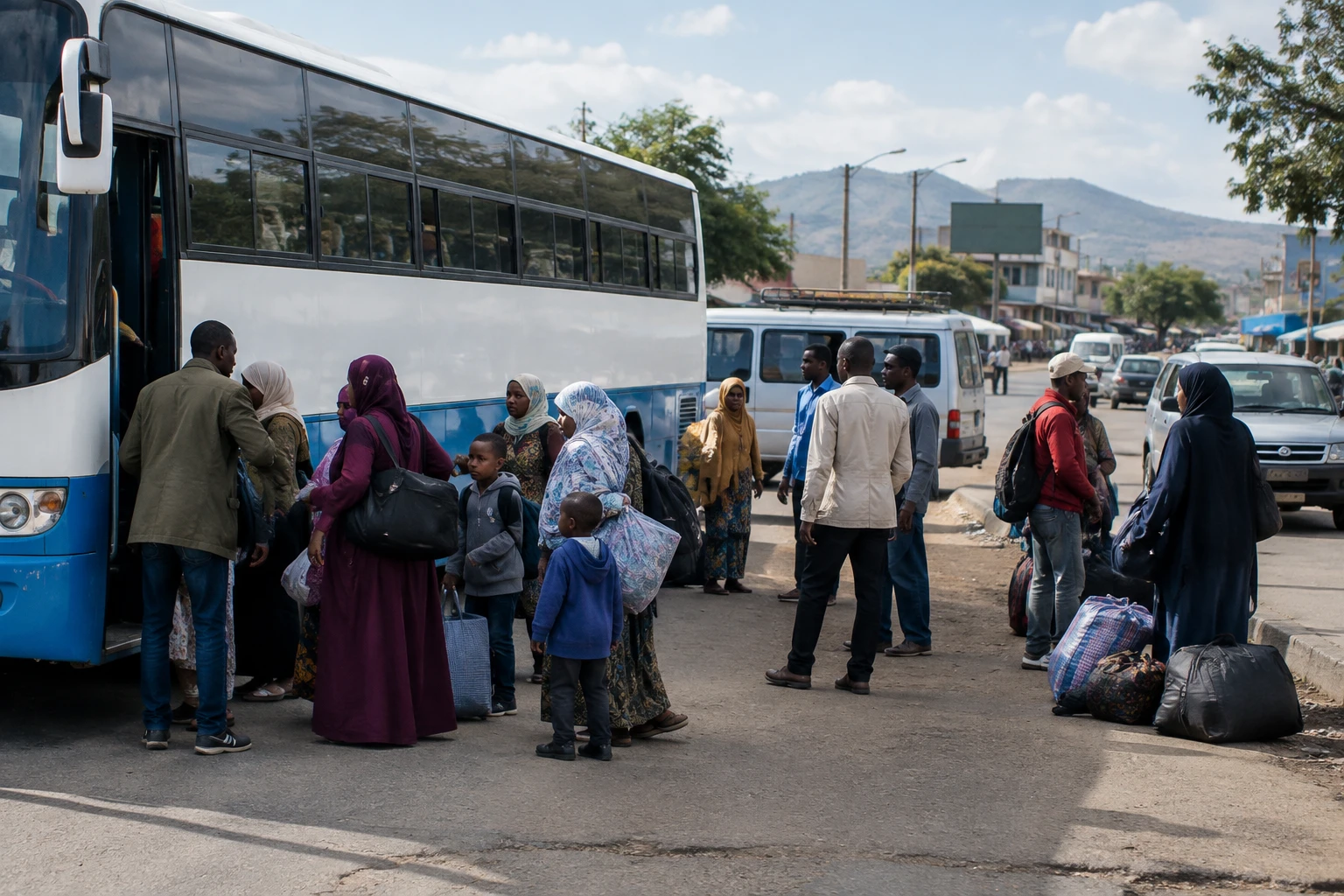
In Moyale, the border between Ethiopia and Kenya has become an immediate refuge for tens of thousands of people. But the rapid arrival of displaced families is also testing the capacity of Kenyan communities to host them, in an area where access to water, food and services remains fragile.
An estimate rising with new crossings
The United Nations High Commissioner for Refugees (UNHCR) says up to 50,000 people are reported to have crossed the border since 22 October. This figure, released on 28 October, remains provisional: registration and verification of arrivals are continuing. Two days earlier, an initial estimate reported by the African Press Agency put the number at about 36,000. The figures therefore reflect counts made at different times, rather than a definitive total.
Most of those who have arrived are women and children. Some are staying with relatives or families in the Marsabit region. Others are being accommodated in temporary shelters, including schools and churches. UNHCR identifies food as the most urgent need, ahead of clean water, shelter, sanitation and healthcare.
The Kenyan authorities, UNHCR, the International Organization for Migration, UNICEF, the World Food Programme and the Kenya Red Cross are coordinating aid. However, an accurate count is difficult: some people are staying with host families rather than in registered sites. Local officials in Marsabit have appealed for additional support, fearing that the resources of host communities will soon be overwhelmed.
A long-running dispute reignited in Moyale
The violence broke out in an Ethiopian town administered jointly by the Oromia and Somali regions. On 18 October, a confrontation erupted over the opening of a Somali administrative office and the raising of its flag in a disputed area. The clashes then spread. The circumstances surrounding the death of a 13-year-old girl, reported during the initial incidents, remain contested.
The dispute is not only about a symbol. It is rooted in longstanding tensions over administrative boundaries, land and resources. The area is inhabited in particular by Borana communities, linked to the Oromo, and Garre communities, linked to the Somali. The presence of regional security forces and local militias has contributed to the spread of the clashes, according to information available. The fighting in Moyale should, however, be distinguished from other conflicts taking place elsewhere in Ethiopia.
The Ethiopian Somali Region does not refer to the neighbouring country: it is a federal entity within Ethiopia, whose capital is Addis Ababa. Under this federal system, regions have their own institutions, and the delineation of their territories can become a major political and local issue. The federal authorities are therefore faced with managing tensions between regional administrations, in addition to other areas of violence.
Consequences on both sides of the border
For displaced people, crossing into Kenya does not mean the end of their difficulties. Families must find shelter, water and healthcare while seeking to maintain family ties and livelihoods. Children, pregnant women and sick people have particular needs. The influx is also complicating daily life for Moyale residents, who are hosting families while local services and resources are limited.
The situation is also affecting trade. Sporadic gunfire has been reported on the Ethiopian side, and trucks have been stranded near the border crossing. Movement between the two countries matters to traders and transporters, as well as to people whose daily activities extend across the border. A prolonged disruption could therefore affect local incomes, beyond the host sites alone.
In Kenya, Moyale is in Marsabit County, an arid area where services and resources are already stretched. At national level, the country has long hosted refugees from several neighbouring countries. This latest influx is concentrated, however, in a specific border town: the country’s capacity to organise a response does not remove the immediate pressure on host families and local authorities.
A regional issue for IGAD
Ethiopia and Kenya belong to the Intergovernmental Authority on Development (IGAD), a regional organisation in the Horn of Africa. Cross-border displacement and local disputes are a reminder that tensions in the region do not stop at administrative boundaries. Cooperation between Addis Ababa and Nairobi, as well as regional monitoring, matters for protecting civilians and maintaining humanitarian and commercial access routes.
The immediate priority remains meeting needs and verifying the number of people who have arrived. UNHCR warns that further crossings could still change the estimate. Going forward, signs to watch include developments in the clashes around Moyale, the resumption of cross-border traffic and the ability of the Ethiopian and Kenyan authorities to support displaced people without shifting the entire burden onto local communities.
Initial estimates and humanitarian needs have been reported by UNHCR. Changes in the tally and the context of the clashes have also been reported by Associated Press, while the African Press Agency had reported an earlier estimate.